

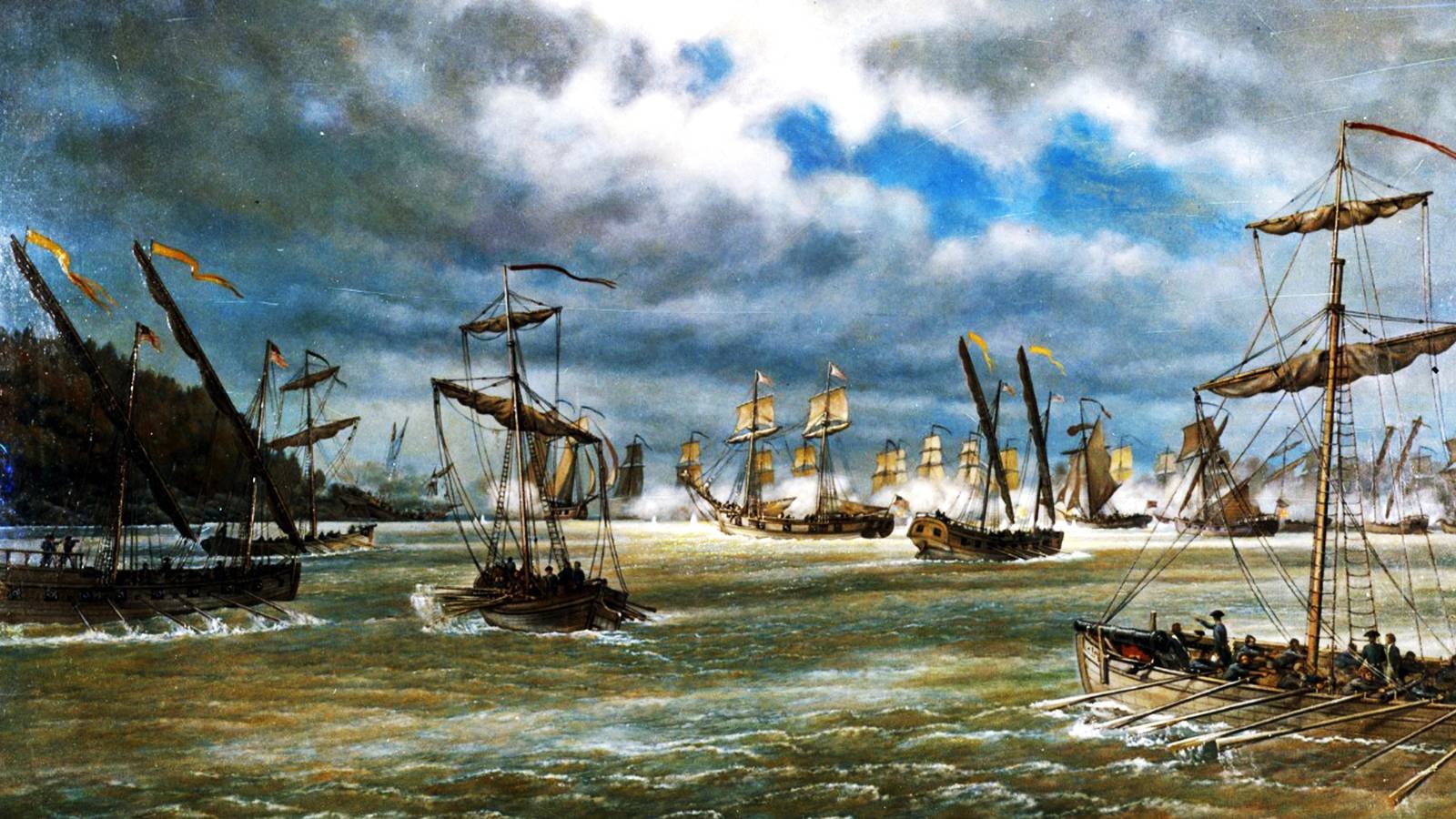
Roughly 250 years before Benedict Arnold’s name became shorthand for treason, he commanded a battered collection of American gunboats into a fight he had little chance of winning.
On Oct. 11, 1776, Arnold’s fleet met a larger, more heavily armed British force on Lake Champlain near Valcour Island in New York. By the time the fighting and pursuit ended two days later, most of the American vessels had been sunk, captured or burned.
The British had won the battle. Arnold had helped cost them the campaign season.
That delay gave American forces another winter to prepare for a renewed invasion from Canada. When the British returned in 1777, their campaign ended at Saratoga—one of the most consequential American victories of the Revolutionary War.
Arnold Picked a Place Where the British Fleet Couldn’t Overwhelm Him
The fight at Valcour Island grew out of the failed American invasion of Canada.
After retreating south in 1776, the Americans faced the possibility that a British army could move down Lake Champlain, seize the Hudson River corridor and separate New England from the rest of the rebelling colonies.
Roads in the region were poor, so controlling the lake was essential. Arnold, a brigadier general in the Continental Army with sea experience, was given the job of slowing the British advance.
Both sides started building. The Americans assembled a makeshift flotilla at Skenesborough, present-day Whitehall, N.Y. The British built and assembled a stronger fleet at the lake’s northern end, including prefabricated vessels shipped from England.
The construction race itself consumed much of the summer of 1776. Arnold knew he could not match the British ship for ship.
Instead, he positioned his fleet in the narrow channel between Valcour Island and the New York shoreline. When the British sailed south on Oct. 11, a north wind carried them past Arnold’s concealed position. They had to turn back and approach from a disadvantage, while the narrow water prevented the full British force from attacking at once.
This still wasn’t enough.
Six Hours of Fighting Left Arnold’s Fleet Shattered
The battle became a close-range artillery fight that lasted through much of the afternoon.
British guns were generally heavier, and Arnold’s inexperienced sailors took a beating. The American gondola Philadelphia was hit repeatedly before sinking shortly after the day’s fighting ended.
The schooner Royal Savage ran aground, was abandoned and later burned by the British. Arnold’s flagship, the galley Congress, was struck repeatedly in its hull, mast and rigging.

Arnold later reported that he had been forced to personally aim many of Congress’ guns because his fleet lacked trained sailors and gunners. He put American killed and wounded at roughly 60 after the first day. Continuing the fight the next morning offered little chance of survival.
That night, Arnold ordered his remaining vessels south. With muffled oars and darkness covering the movement, the Americans slipped past the British fleet. The escape bought them only a brief head start.
British ships caught Arnold’s retreating force on Oct. 13, and several American vessels were captured. Arnold eventually ran Congress and other badly damaged ships ashore, burned them to keep them out of British hands and led his surviving men overland toward safety.
Of the fleet, Arnold reported saving only a handful of vessels.
The British Victory Came Too Late
The destruction of Arnold’s fleet opened Lake Champlain to the British, but the calendar had become another enemy.

British commander Guy Carleton moved as far south as Crown Point. With winter approaching, however, he abandoned plans for a deeper push toward Fort Ticonderoga and withdrew his forces to Canada. The invasion would have to wait until 1777.
When another British army under Gen. John Burgoyne came south the following year, American forces had more time to organize and reinforce the region. Burgoyne ultimately surrendered after the Battles of Saratoga in October 1777.
The victory helped persuade France that the Americans could survive the war and was a major factor in the French decision to enter the conflict against Britain formally. French military and naval support would eventually prove essential to the American victory.
Arnold was at Saratoga, too. Years before his 1780 attempt to betray West Point to the British, he fought aggressively there and suffered a serious leg wound during the American victory.
Valcour Island Gets Another Look 250 Years Later
The battle’s 250th anniversary is bringing renewed attention to a fight often overshadowed by Arnold’s later betrayal.

On Oct. 11, the U.S. Navy Memorial in Washington, D.C., hosted “Valor at Valcour: Revolutionary War Wrecks in Lake Champlain and a Vision for Exhibiting US Navy’s Underwater Archaeology.”
The event, held with the Naval History and Heritage Command, National Museum of the United States Navy and other partners, examined surviving wrecks and archaeological work connected to the battle.
Some of that history still survives in remarkably physical form. The Philadelphia, raised from the cold waters of Lake Champlain in 1935, is preserved at the Smithsonian’s National Museum of American History. Other wrecks and artifacts continue to give archaeologists evidence of what happened in the bay.
Saratoga National Historical Park took a more skeptical look at Valcour’s reputation during an Oct. 12 program. Park Ranger Eric Schnitzer was supposed to examine whether Arnold’s stand truly prevented the British from taking Fort Ticonderoga in 1776 or whether geography, logistics and the approaching winter would have stopped them anyway.
The debate complicates one of the Revolution’s neatest stories. What remains clear is that Arnold forced Britain to spend valuable time building a fleet, fought it on ground of his choosing, and survived long enough to make an already-short campaign season even shorter.
The man remembered for betraying the Revolution had, four years earlier, helped keep it alive.
