

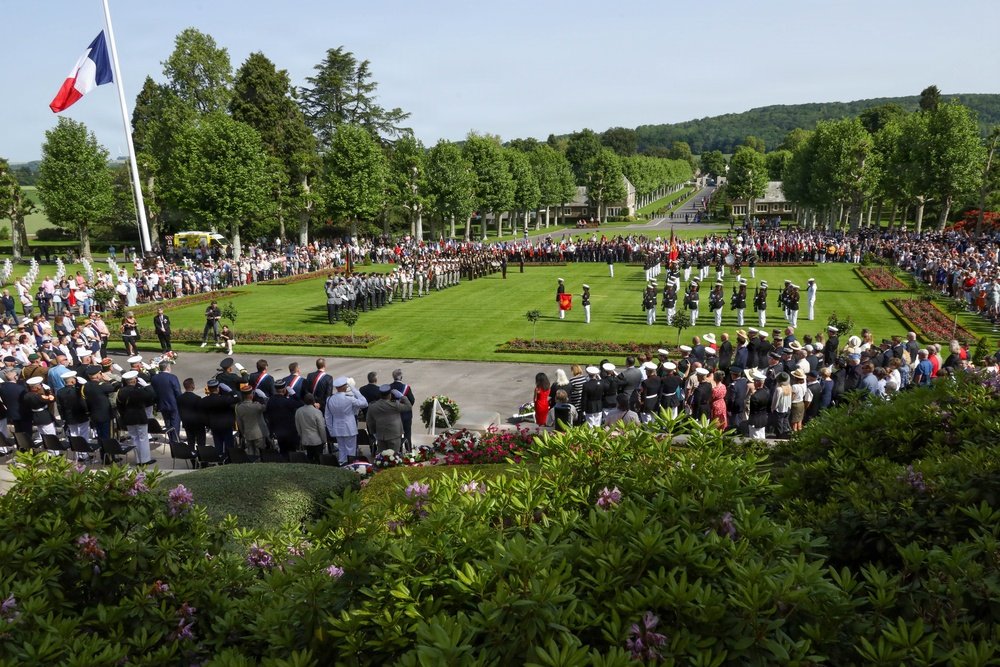
Thousands of American service members fought with everything they had at the Battle of Belleau Wood. Some returned home, while others took their last breaths in the blood-stained wheat fields. More than a century later, 1st Lt. Nicholaus Adams stood on those same hallowed grounds, walking in the exact footsteps of his great-great-grandfather, U.S. Army Pvt. David E. Mathers. For the young Marine, the experience was not just a history lesson, it was deeply personal.
“My great-great-grandfather was a farmer from Smithfield, West Virginia, drafted into Fox Company, 2nd Battalion, 7th Infantry Regiment,” Adams said. “To think I had a blood relative that may have charged across the wheat field into oncoming fire, right where we stood, is [incredible]. Only a few generations later, I’m standing in the exact same location.”
Fought in June 1918 just 59 miles from Paris, the Battle of Belleau Wood was a pivotal World War I clash where Allied forces met a desperate German spring offensive. Ordered to hold their ground, U.S. Marines and Army infantrymen dug in and repelled relentless enemy assaults with deadly rifle fire and brutal close-quarters combat. The sheer ferocity of the Marines throughout the grueling engagement earned them the enduring nickname “Devil Dogs” from their German adversaries. Ultimately, this crucial victory halted the German advance and forever cemented the United States Marine Corps’ reputation as an elite fighting force.
Pvt. Mathers found himself in the thick of some of the most intense fighting of World War I, surviving the campaigns of Belleau Wood, Champagne-Marne, St. Mihiel, and the Meuse-Argonne. But France was not the only place an ancestor of Adams saw combat. Mathers and Adams are part of a long lineage of military service in their family dating back to the 1800s.
“Every generation since the Civil War, the men in my family have served,” Adams said. “I always wanted to serve. Putting on the uniform, continuing my family’s legacy, means a lot to me.”
Adams, a native of Massillon, Ohio, and a U.S. Naval Academy graduate, grew up surrounded by reminders of this legacy. His grandfather, Tom Mathers, was an infantry Marine with 3rd Battalion, 8th Marines in Vietnam, and his father served as a Navy corpsman with the same unit. In their family home, a war chest holds the artifacts of these generations, dog tags, medals, and faded photographs, serving as a tangible link to the past.
“You feel a lot of pride, but also the gravity and how somber the situation was,” he reflected.
The visit proved to be a bridge across time, connecting Adams to the silent stories of his forebears. His grandfather and father had historically kept their military experiences private, a common trait among combat veterans Yet, it was this shared connection to Belleau Wood that finally unlocked decades of silence, prompting his grandfather to speak of his own trials in Vietnam.
That profound connection to the past has also shaped how Adams views his modern duties. He has come to appreciate that the tactics and operations he supports today are built upon the sacrifices of those who answer the call of duty.
“The training we go through at The Basic School and in the field, you stand there and realize they aren’t just buzz phrases we use,” Adams said. “All of that is learned through blood. Those men learned the lessons on a beach or in a wheat field for us.”
Adams carries those lessons with him as a young officer and leader of Marines every day. He takes his work very seriously, as he understands the direct impact it has on those he leads and supports.
“[My job in the Marine Corps] definitely wasn’t what I was expecting, but it’s been amazing to work with the infantry, integrating and figuring out exactly what they need,” he said. “After a few deployments, seeing the direct impact of what happens if we do our job well, it has been very rewarding.”
The journey to France was a professional milestone, a moment of reflection, and an expression of gratitude for Adams. As he looks to the future, he remains focused on leadership, both in and out of uniform, guided by the weight of the history he is now a part of.
“It really makes you think professionally about what we do,” Adams said. “It’s easy to get lost in the noise of today, but standing there, you feel the weight of history, and the absolute responsibility to honor it.”
-30-
