

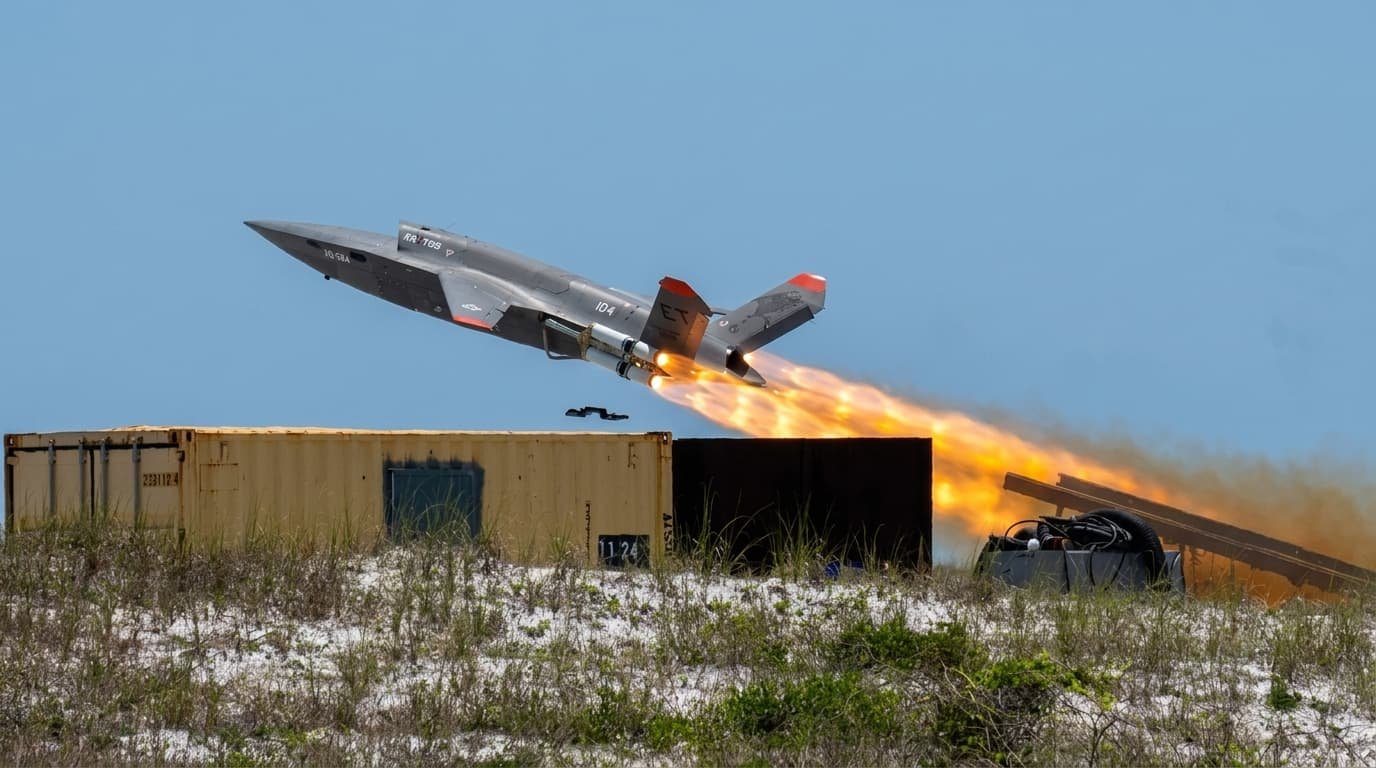
Germany is betting that a relatively small uncrewed aircraft could help its fighter force do more without putting another pilot at risk. The aircraft at the center of that plan is the XQ-58A Valkyrie, a drone developed by American defense company Kratos and now being adapted for European use with Airbus.
On October 12, 2026, Airbus conducted the first European flight of its U740 Valkyrie. The aircraft used a rocket-assisted launch system and reached speeds of up to Mach 0.8 during the test.
That was a useful milestone, but it didn’t prove the drone could yet fight alongside a Eurofighter Typhoon. Airbus still needs to integrate and test its MARS mission system, which is intended to support cooperation between crewed and uncrewed aircraft.
The plan points toward combat readiness in 2029. Reaching that goal will require more than successful flights. The aircraft must share information with other platforms, respond to mission commands, and carry out useful tasks under realistic conditions.
Europe doesn’t need another drone that looks impressive in a demonstration. It needs one that can extend a fighter’s reach and give commanders more options without adding a costly burden. The XQ-58A Valkyrie has a credible path toward that role, but the hardest part of the program is still ahead.
What Is the XQ-58A Valkyrie?
The XQ-58A Valkyrie is designed to give air forces another aircraft they can send into risky missions without placing a pilot onboard. Its value comes from combining a relatively compact airframe with the ability to carry mission equipment and work alongside crewed fighters. That makes it a candidate for the growing role known as a Collaborative Combat Aircraft, or CCA.
Kratos developed the for the U.S. Air Force Research Laboratory’s Low Cost Attritable Aircraft Technology program.
The idea behind an attritable aircraft is straightforward: build a capable platform at a lower cost than a traditional fighter, while accepting that it may not be worth recovering in every possible mission. Attritable doesn’t mean disposable by default. It means commanders have another option when sending a crewed aircraft would carry greater risk or cost.
The XQ-58A Valkyrie’s design also changes how it can operate from the ground. Unlike conventional fighters that need a runway, the original XQ-58A Valkyrie uses a rocket-assisted launch system.
It can take off from a suitable ground site without a long paved runway, which may give operators more choices about where to deploy it. Recovery is a separate challenge, however, and the original design uses a parachute system rather than a normal runway landing.
The European U740 version is being developed with Airbus, which plans to integrate its MARS mission system. That software is intended to help the drone work with crewed aircraft, including the Eurofighter Typhoon. The European effort therefore involves more than importing an American airframe. It requires building and testing the links between the aircraft, its software, and the pilots expected to direct it.
The distinction matters: the XQ-58A Valkyrie has flown, but its future role in European combat aviation still depends on integration and testing.
Why Does Europe Want the Valkyrie as a Loyal Wingman?
Europe wants the XQ-58A Valkyrie because modern fighter aircraft are expensive, and sending a crewed jet into every dangerous mission carries a cost beyond fuel and maintenance. An uncrewed aircraft could help extend a fighter’s reach, carry extra sensors, or take on selected high-risk tasks. The challenge is making those roles useful without creating another complex system that costs too much to operate.
Germany’s interest fits a wider shift toward Collaborative Combat Aircraft. Instead of asking one fighter to carry every sensor and weapon, the concept spreads some tasks across a crewed aircraft and one or more uncrewed partners.
A Eurofighter pilot could, in principle, direct a XQ-58A Valkyrie to scout an area or support a mission while remaining farther from a threat. The exact tasks depend on the systems that are integrated and cleared for use.

That flexibility matters in Europe, where air forces must plan for advanced air defenses, long distances, and the need to keep aircraft available across several missions. An uncrewed aircraft could provide extra capacity without requiring another pilot for every airframe. It may also let commanders accept more risk with the drone than they would with a crewed fighter.
But the phrase loyal wingman can make the concept sound simpler than it is. The drone must receive commands, share useful data, and behave predictably when communications are disrupted. It also needs a clear division of responsibility between software and human operators. A drone that can fly on its own is not automatically able to make sound choices in a fast-moving air battle.
The XQ-58A Valkyrie’s appeal is therefore not just its price or its lack of a cockpit. It is the chance to add more options to a fighter force. Europe will need to prove that those options work in real missions before counting the aircraft as extra combat power.
XQ-58A Valkyrie Specifications, Range, and Payload
The XQ-58A Valkyrie’s main advantage is its combination of long range, high subsonic speed, and runway-independent launch. Those features could let commanders deploy an uncrewed aircraft from locations where conventional fighters cannot easily operate.
But range alone doesn’t tell the full story. Payload, flight profile, and mission equipment all affect what the drone can do.
Kratos lists a range of more than 3,000 nautical miles, a top speed of about Mach 0.86, and an operating altitude of up to 45,000 feet. Its published data also gives the aircraft a maximum launch weight of 6,000 pounds.
| Specification | XQ-58A Valkyrie |
| Length | 30 feet (9.1 metres) |
| Wingspan | 27 feet (8.2 metres) |
| Maximum launch weight | 6,000 pounds (about 2,722 kg) |
| Internal payload capacity | 600 pounds (about 272 kg) |
| Cruise speed | About Mach 0.72 |
| Published top speed | About Mach 0.86 |
| Range | More than 3,000 nautical miles |
| Maximum operating altitude | Up to 45,000 feet |
| Propulsion | Single turbofan engine |
| Launch and recovery | Rocket-assisted launch, parachute recovery |
The internal weapons bay is a key part of the design. In a 2021 test at Yuma Proving Ground, the XQ-58A Valkyrie released an ALTIUS-600 small unmanned aircraft from its bay. That test showed the Valkyrie could carry and deploy another drone, not just conventional weapons.
Read also: How the MQ-28 Ghost Bat Enhances Manned Aircraft Missions
The aircraft also has wing stations for external payloads, giving planners more ways to configure it for different missions.
Its launch method offers flexibility, but recovery still needs planning. The original XQ-58A Valkyrie uses a parachute and airbags to return to the ground, so crews need a suitable recovery area.

Europe’s U740 program builds on the design, but its final payload and mission performance should be treated separately until Airbus confirms them. That distinction matters when judging how much combat capability the aircraft can actually carry.
What Weapons and Missions Could the Valkyrie Support?
The XQ-58A Valkyrie’s value comes from its ability to carry different payloads, rather than relying on a single fixed mission. Its internal bay and external mounting points give planners options for weapons, sensors, and smaller uncrewed aircraft. That flexibility could let the same airframe support different tasks as mission needs change.
One useful example came in 2021, when the U.S. Air Force Research Laboratory tested the release of an ALTIUS-600 small uncrewed aircraft from the XQ-58A Valkyrie’s internal bay at Yuma Proving Ground, Arizona.
The test showed that the XQ-58A could deploy another uncrewed system while airborne. That opens up mission options beyond carrying a conventional weapon, although the test itself did not establish a complete operational capability.

The Valkyrie’s potential mission set includes:
- Air-to-ground missions: Carrying suitable weapons to engage selected ground targets, subject to the aircraft’s approved configuration and integration.
- Reconnaissance and sensing: Carrying sensors that can help gather information or support a crewed aircraft’s view of an area.
- Electronic warfare: Potentially carrying equipment to detect or disrupt electronic signals, depending on the mission payload.
- Decoy and support roles: Drawing attention or adding another airborne platform to complicate an opponent’s response.
- Deployment of smaller drones: Releasing systems such as ALTIUS-600 to extend the mission beyond the Valkyrie’s own sensors or payload.
These roles are not all equally mature. The ALTIUS-600 release was demonstrated, while other missions depend on specific weapons, sensors, software, and operational approval. A payload that fits inside the bay is not automatically ready for combat use.
This distinction will matter for Europe. Airbus and Kratos must determine which mission systems the U740 will carry and how those systems connect to the MARS mission software. Until that work is tested, the original XQ-58A Valkyrie’s demonstrated payload options should not be treated as confirmed European capabilities.
The best measure of the XQ-58A Valkyrie’s flexibility is not the number of missions proposed for it. It’s how many can be carried out reliably with the payloads, software, and links that operators actually have.
Can Airbus Deliver the Valkyrie by 2029?
Airbus and Kratos have until 2029 to turn the XQ-58A Valkyrie into a combat-ready aircraft, but the hardest work is still ahead. The drone has flown in Europe, yet its mission software and links with crewed fighters remain unproven.
The first European flight took place on September 29, 2026. The aircraft used a rocket-assisted launch and reached speeds of Mach 0.8. However, it had not yet flown with Airbus’s MARS mission system.

The next step is to test MARS in flight, then demonstrate how the XQ-58A Valkyrie can work with the Eurofighter Typhoon. Engineers must also verify communications, mission control, and how pilots supervise the drone.
Using an existing airframe saves development time, but software integration can still expose major problems. The German Air Force must also define the first missions the aircraft will perform.
The 2029 date remains a target, not a guarantee. The key milestones to watch are the first MARS-enabled flight and a successful demonstration of Eurofighter teaming.
Can the XQ-58A Valkyrie Give Europe Real Combat Independence?
The XQ-58A Valkyrie could give Europe more control over how it uses uncrewed aircraft, but buying or adapting an American airframe doesn’t automatically create strategic independence. The real test is who controls the mission software, approves updates, integrates weapons, and can keep the aircraft ready without outside support.
Germany’s plan with Airbus offers one route toward greater European control. The Valkyrie’s airframe comes from Kratos, while Airbus is developing the MARS mission system intended to coordinate the aircraft with crewed fighters. This division could let Europe build its own mission logic around an existing aircraft rather than fund a new airframe from the beginning.
But control over software is only one part of the equation. A force also needs access to spare parts, maintenance support, secure communications, mission data, and the ability to change systems when threats shift. If key updates or components depend on another country, Europe’s freedom to act could still have limits.
Cost matters too. The XQ-58A Valkyrie is often described as a lower-cost alternative to sending another crewed fighter into danger. Yet the aircraft’s purchase price is only one part of the total bill.

Operators must also pay for ground equipment, training, software development, weapons integration, repairs, and fleet support. Without a firm European procurement plan and published operating costs, it is too early to say how affordable a useful fleet would be.
There is also a risk in expecting one drone to solve too many problems. Reconnaissance, electronic warfare, decoy missions, and weapons delivery place different demands on sensors, software, and payload capacity. Europe will need to choose which roles matter first and prove them one by one.
The XQ-58A Valkyrie could become a useful European loyal wingman, but the deciding evidence will come from mission trials, not launch footage. Watch for the first MARS-enabled flight, a demonstrated Eurofighter connection, and clear decisions on who will operate and support the aircraft.
Those milestones will reveal whether Europe is gaining a combat capability it can control, or simply adapting a promising foreign platform.
