

South Korea conducted its first test launch of a domestically developed hypersonic glide vehicle (HGV). This marks a milestone in the country’s effort to advance hypersonic weapons technology and to expand its long-range strike capabilities.
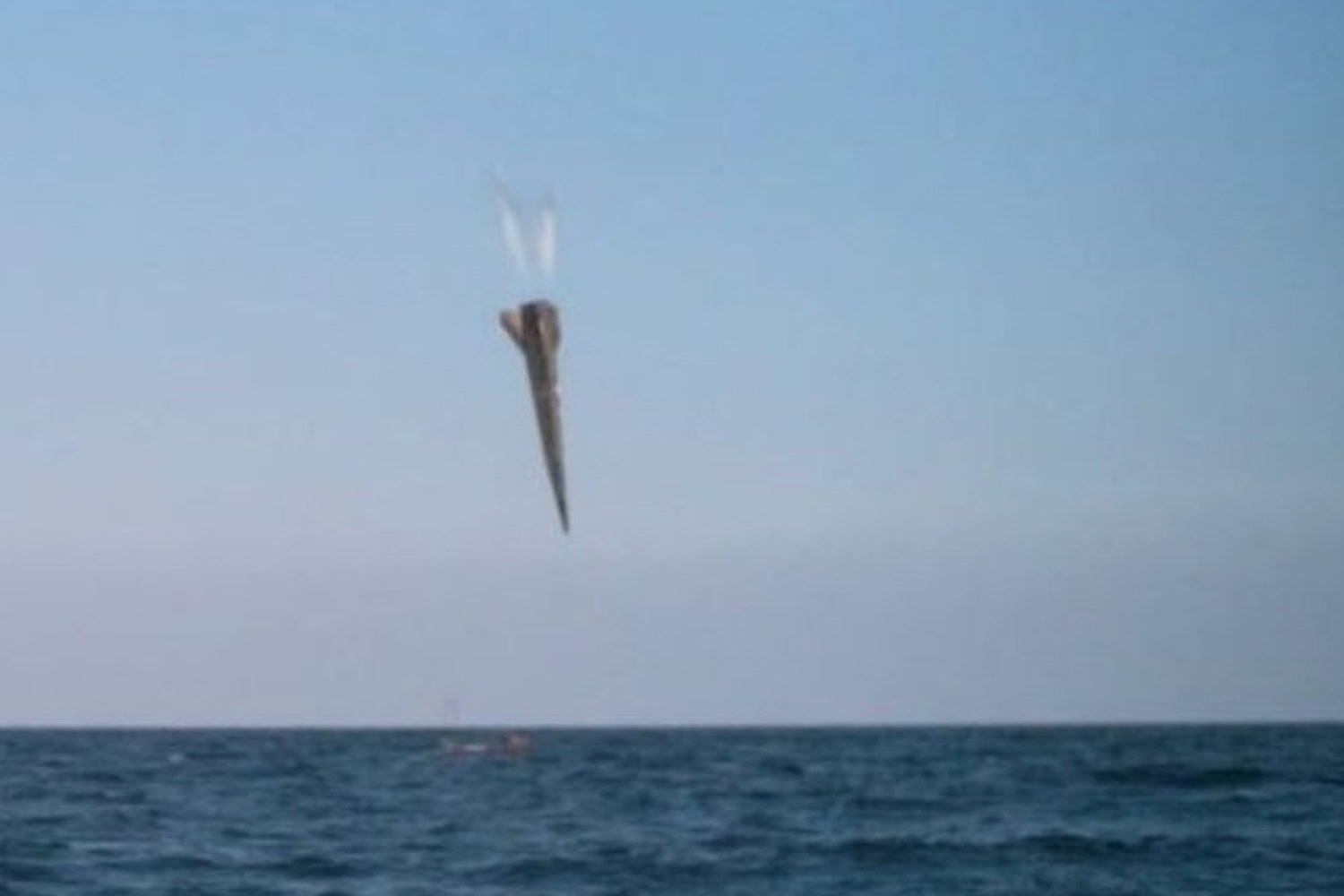
The test was announced by the Blue House, South Korea’s presidential office, in a press release issued on 8 October 2026. It included photographs of President Lee Jae Myung observing the test, alongside images showing the launch and the vehicle’s impact in the sea.
The press release stated: “The test was designed to validate, for the first time, critical technologies required for hypersonic glide, including ultra-high-temperature, heat-resistant materials, guidance and control systems, and the vehicle’s ability to perform irregular manoeuvres at low altitudes.”
Low-resolution photographs show that the HGV features a wedge-shaped design with stabilising fins at its base. No official name or designation for the missile has yet been disclosed.
The test was overseen by the Agency for Defense Development (ADD), the defence research and development arm of South Korea’s Defense Acquisition Program Administration.
The launch was reportedly conducted from a transport-erector-launcher (TEL) sitting on a barge at the ADD’s Yellow Sea test site to ensure safety and allow greater control over the test environment.
Overhead photographs released by the Blue House showed a TEL from the Hyunmoo family of ground-launched ballistic missiles launching the HGV. The test may also have used the first-stage booster from the missile family, with the HGV replacing its original re-entry vehicle.
According to the Blue House, the HGV reached its target altitude and successfully separated from the booster during the test. It then followed its planned flightpath at hypersonic speeds, before descending, manoeuvring vertically and horizontally, and accurately striking the designated target.
No further details of the test were disclosed, including the distance travelled by the HGV, its flight speed or the maximum altitude reached. Hypersonic speeds are generally defined as those exceeding Mach 5.
Typically, HGVs use a rocket booster to accelerate an unpowered glide vehicle to the required speed and altitude before releasing it to travel towards its target along a relatively shallow trajectory within the atmosphere.
The vehicle can manoeuvre in flight, potentially making unpredictable changes in direction. This combination of hypersonic speed, low-altitude flight and manoeuvrability presents significant challenges for existing missile defence systems.
“Hypersonic glide vehicles are a key strategic asset capable of changing the course of the battlefield by surprise attacks against key strategic targets during a crisis, owing to their unpredictable flight trajectories and overwhelming speeds,” the Blue House added.

Further tests are expected as South Korea refines the HGV design and matures its underlying technologies ahead of potential deployment with the country’s Strategic Command.
The 8 October test of the HGV comes as South Korea pursues hypersonic weapon programmes, including the Hycore hypersonic cruise missile being developed by the ADD in partnership with Hanwha Aerospace. It has also undergone testing.
Unlike HGVs, hypersonic cruise missiles use air-breathing engines to maintain hypersonic flight, and they usually fly at lower altitudes.
South Korea’s HGV test comes amid North Korea’s continued ballistic-missile activities. On 3 October, Pyongyang tested what it described as a hypersonic, medium-range ballistic missile, before launching multiple ballistic missiles four days later.
North Korea is also pursuing HGV-based weapons, including the Hwasong-11Ma that it reportedly tested on 20 September 2026.
On the same occasion, Lee was also shown a TEL for South Korea’s relatively new Hyunmoo-5 short-range ballistic missile, although no direct link has been made between that missile and the test event.
by Roy Choo
