

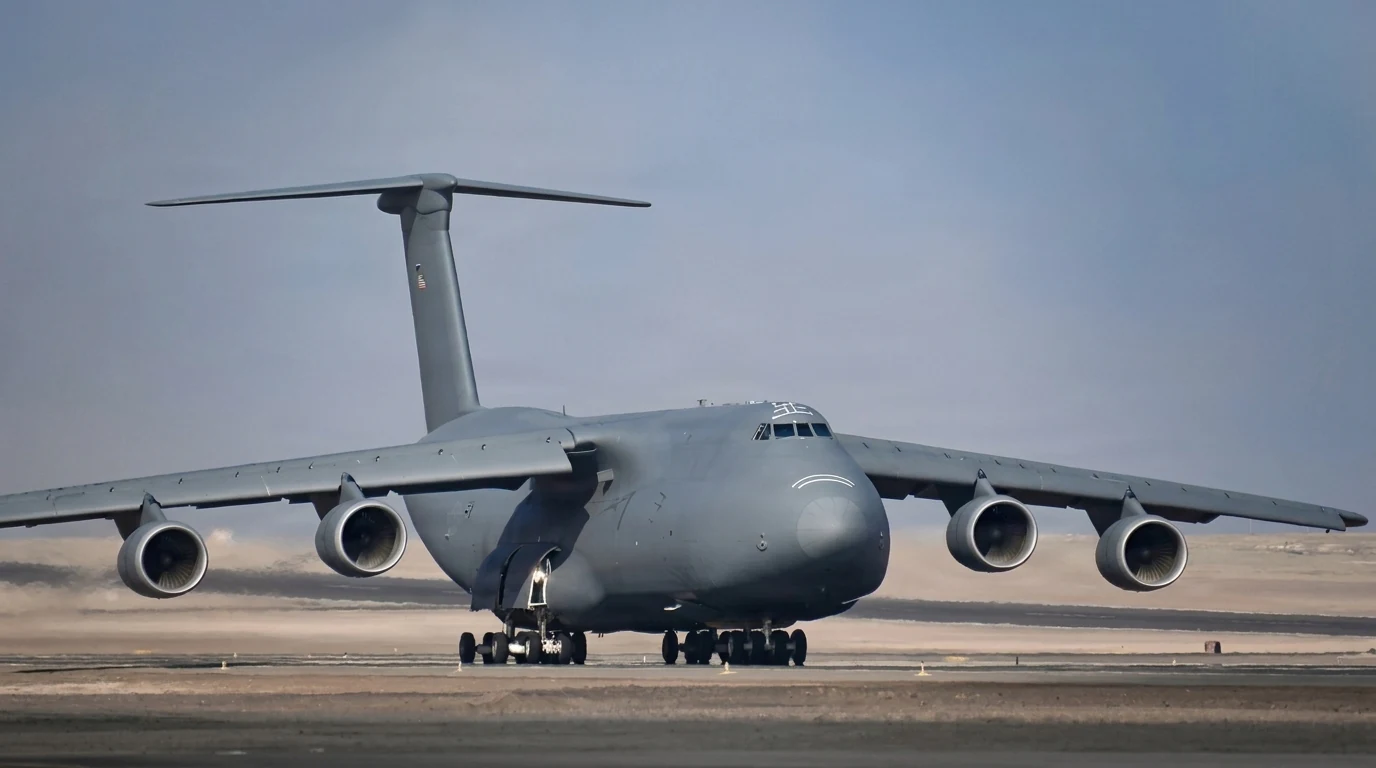
The C-5M Super Galaxy can carry up to 281,001 pounds of cargo. That’s enough capacity to move some of the largest pieces of military equipment by air, including vehicles and oversized loads that smaller transport planes struggle to accommodate.
But raw lifting power doesn’t tell the whole story.
The U.S. Air Force still relies on the C-5M Super Galaxy to move heavy cargo across long distances. Its huge cargo bay, front and rear loading doors, and four powerful engines make it a key part of American military logistics. The aircraft also received major upgrades to its engines and flight systems, giving an older design a new lease on life.
Here’s the problem: an aircraft can be powerful on paper and still fall short when maintenance keeps it on the ground.
Keeping the C-5M Super Galaxy ready for duty means dealing with spare parts, aging components, and the time needed for major repairs. Those issues matter when military operations depend on moving equipment quickly between continents.
The real test for the C-5M Super Galaxy isn’t whether it can carry a huge load. It already can. The question is whether the Air Force can keep enough of these giant aircraft ready when that capacity is needed most.
What Is the C-5M Super Galaxy?
The C-5M Super Galaxy exists to solve a problem that ordinary cargo planes can’t always handle: moving very large military equipment across long distances without taking it apart first.
Built by Lockheed, the original C-5 Galaxy first flew in 1968 and entered U.S. Air Force service in 1970. The C-5M Super Galaxy is the modernized version, developed to improve the older aircraft’s performance and reliability. Rather than replace the entire fleet with a new design, the Air Force upgraded key systems and kept the huge cargo platform in service.
That decision makes sense when you look at what the aircraft can carry.
A standard transport plane can move pallets, troops, and routine supplies. The C-5M Super Galaxy can handle much larger loads, including heavy military vehicles and bulky equipment. Its cargo bay is built around the needs of strategic airlift, where the challenge isn’t just moving cargo, but fitting it inside an aircraft that can reach the required destination.
The C-5M Super Galaxy also has a feature that makes loading more practical: both the nose and the rear cargo doors open. Ground crews can load equipment from either end, which helps when a vehicle or other large item needs a clear path through the aircraft.
Read also: Top 5 Largest Military Transport Aircraft in the World
The distinction between the C-5M Super Galaxy and the C-17 Globemaster III is worth understanding. Both support U.S. military transport, but the C-5M Super Galaxy offers greater maximum payload capacity. The C-17, by contrast, is designed to combine strategic transport with the ability to operate from smaller, less-developed airfields.
Neither aircraft makes the other obsolete.
The C-5M Super Galaxy fills a specific role in American logistics. It gives the Air Force a way to move outsized cargo that might otherwise require a different transport plan, more flights, or partial disassembly. Its value comes from that ability, not simply from being one of the largest military aircraft ever built.
C-5M Super Galaxy Specifications and Design
The C-5M Super Galaxy’s size is impressive, but its design matters more than its appearance. Every major feature serves the same purpose: carrying heavy, bulky cargo that other aircraft may struggle to accommodate.
The aircraft measures nearly 248 feet long, with a wingspan of almost 223 feet. Its maximum takeoff weight reaches 840,000 pounds, including the aircraft, fuel, crew, and cargo. The maximum allowable payload is 281,001 pounds, a figure that describes cargo capacity rather than total aircraft weight.
Here are the key C-5M Super Galaxy specifications.
| Specification | C-5M Super Galaxy |
| Manufacturer | Lockheed Martin |
| Length | 247 ft 10 in |
| Wingspan | 222 ft 9 in |
| Maximum takeoff weight | 840,000 lb |
| Maximum allowable payload | 281,001 lb |
| Engines | 4 GE F138 turbofans |
| Maximum speed | Approximately 518 mph |
| Crew | 7 |
These figures come from U.S. Air Force aircraft information. Actual payload and range depend on the mission, fuel load, and operating conditions.
The C-5M Super Galaxy’s cargo bay is just as important as its weight limit. Its large doors at both ends let crews move oversized equipment through the aircraft without relying on a single loading point. That helps when transporting long vehicles or bulky military systems.

Its landing gear is another clue to the engineering challenge. The aircraft has 28 wheels across five landing-gear sets, spreading its enormous weight across the runway. That arrangement supports heavy loads, although it doesn’t mean every runway can handle a fully loaded C-5M Super Galaxy.
And that’s a common misconception about giant airlifters. Being able to carry a load doesn’t mean the aircraft can land anywhere. Runway strength, length, weather, and ground support still shape where it can operate.
The C-5M Super Galaxy was built for heavy strategic transport, not to ignore those limits.
How Much Can the C-5M Super Galaxy Carry?
The C-5M Super Galaxy can carry up to 281,001 pounds of cargo, but the more useful question is what that weight allows the Air Force to move. Its large cargo bay can accommodate heavy vehicles and oversized military equipment that may not fit inside smaller transport aircraft.
Think about moving a main battle tank overseas. The challenge isn’t just the tank’s weight. Its height, width, length, and loading requirements all matter. The C-5M Super Galaxy was designed around this kind of problem, giving military planners more options when equipment must travel by air rather than by ship or road.
Its nose and rear cargo doors make a real difference here. Both can open, allowing ground crews to load cargo from either end. This arrangement can help crews position long or bulky items and move equipment through the aircraft more efficiently.
The C-5M Super Galaxy can transport cargo such as:
- Military vehicles: Heavy vehicles and other large ground equipment, subject to loading limits.
- Helicopters: Aircraft that require substantial internal space and careful handling.
- Oversized military systems: Large components and equipment that would be difficult to move in smaller cargo planes.
- Palletized supplies: Bulk loads needed to support forces deployed far from their home bases.

But maximum payload figures need context. The aircraft can’t always carry its maximum cargo weight on every flight. Fuel requirements, distance, weather, runway limits, and the specific cargo configuration all affect the usable load.
A long-distance mission may require more fuel, leaving less capacity for cargo. A shorter flight can present different tradeoffs. That’s why comparing airlifters using payload alone can be misleading.
The C-5M Super Galaxy also supports aerial refueling, which can extend its operational reach when the mission and available support allow it. That doesn’t make range unlimited, but it gives planners another option when moving equipment between distant bases.
The real advantage is flexibility. When a military system is too large for a smaller aircraft, the C-5M Super Galaxy can provide a way to move it intact. That can simplify the transport plan, even before the aircraft reaches its destination.
How Did New Engines Transform the C-5M Super Galaxy?
The C-5M Super Galaxy shows what a major upgrade can do for an older aircraft. Instead of replacing the entire airframe, the U.S. Air Force improved its engines and flight systems to make the existing fleet more capable and easier to support.
The original C-5 relied on older engines that limited its performance and added to its maintenance burden. The C-5M Super Galaxy modernization program addressed those problems through the Reliability Enhancement and Re-engining Program, known as RERP. The upgrade replaced the older powerplants with four General Electric F138-GE-100 turbofan engines, derived from the commercial CF6 engine family.
The difference goes beyond thrust.
The newer engines provide more power, improve climb performance, and allow the aircraft to take off over shorter distances under comparable conditions. They also support a higher maximum payload across a wider range of operating conditions. For an airlifter, those changes can affect how much cargo it carries and which routes it can use.
The C-5M Super Galaxy also received updated avionics and other flight systems. These changes help modernize the cockpit and improve the aircraft’s ability to operate within today’s air transport system.

But engine upgrades cannot solve every problem.
A new powerplant won’t prevent corrosion in an older airframe, eliminate shortages of replacement parts, or remove the need for major depot work. The aircraft still depends on a large maintenance network, trained crews, and parts that must arrive when needed.
That’s where the C-5M Super Galaxy’s story gets complicated. Modernization can extend the useful life of an aircraft and improve its performance, but it doesn’t make the airframe new again.
The Air Force chose to retain a proven cargo platform rather than start from scratch. That approach preserves a rare heavy-lift capability, yet it also leaves the service responsible for maintaining aircraft whose original design dates back decades.
The engine upgrade made the Super Galaxy more capable. Keeping that capability available is a different challenge entirely.
What Is the C-5M Super Galaxy’s Readiness Problem?
The C-5M’s biggest weakness isn’t its ability to lift heavy cargo. It’s the gap between what the aircraft can do and how often the Air Force can actually use it.
In April 2026, Air Force Chief of Staff Gen. Kenneth Wilsbach cited a 37% mission-capable rate for the C-5 fleet. That figure deserves attention, but it needs context. Mission capable means an aircraft can perform at least one assigned mission. It doesn’t mean the aircraft is ready for every task, nor does it mean the remaining aircraft are all permanently grounded.
Still, a rate that low creates a real planning problem.
The C-5M Super Galaxy carries loads that are difficult to move using smaller aircraft. When several aircraft are unavailable, the Air Force has fewer options for transporting oversized equipment on short notice. Planners may need to adjust schedules, use other aircraft where possible, or wait for a C-5 to return to service.

Maintenance is a major part of the challenge. The C-5 fleet includes airframes that have been in service for decades. Older aircraft need inspections and repairs, while worn or outdated parts can take time to source. A repair may be straightforward in theory, yet remain unfinished while a needed component is unavailable.
This is why spare parts matter as much as engine power. A modernized aircraft still cannot fly its mission if a critical component is missing.
The Air Force has pursued its Drive to 55 effort to improve aircraft availability through better maintenance, supply support, and reliability. The name reflects a readiness goal, not proof that the fleet has already reached it.
And the C-5’s problem isn’t unique to this aircraft. Military airlift depends on a chain of aircraft, crews, maintenance teams, spare parts, and suitable airfields. A weak link can slow the whole process.
For the C-5M Super Galaxy, the test is practical: can the Air Force make enough aircraft available when heavy cargo needs to move? A maximum payload figure cannot answer that question. Readiness data can.
What Upgrades Will Keep the C-5M Super Galaxy Flying?
The C-5M Super Galaxy needs more than powerful engines to stay useful. Its long-term value depends on keeping its flight systems current, repairing aging structures, and making sure maintenance teams can get the parts they need.
Some of that work happens inside the cockpit. Modern avionics help crews manage flight information and communicate with other aircraft and ground systems. The C-5M Super Galaxy program already brought major improvements to the aircraft’s engines and flight systems, but ongoing upgrades and repairs remain part of keeping the fleet operational.
Maintenance can also be an opportunity to improve the aircraft while it is already in the hangar.
In July 2026, work at Dover Air Force Base included a C-5M Super Galaxy flight-deck refurbishment effort. Such projects show how scheduled maintenance can support longer-term fleet needs, although one refurbishment does not mean every aircraft receives the same work at the same time.
The harder problem is managing several needs at once.

An aircraft may require structural repairs, replacement components, software updates, or inspections before it can return to service. Each task takes time and skilled labor. If a critical part is unavailable, even a well-planned maintenance period can run longer than expected.
That creates a difficult tradeoff for the Air Force. Spending money on the current fleet can preserve a unique heavy-airlift capability, but every aircraft also has a finite service life. Modernization makes sense only if the aircraft can continue to meet operational needs at a reasonable cost.
There is no single upgrade that fixes every weakness. Better avionics won’t resolve a parts shortage, and new engines won’t remove the need to inspect an aging airframe. The improvements have to work together.
For the C-5M Super Galaxy, the most useful measure of progress isn’t the number of upgrades announced. It’s whether those upgrades reduce maintenance delays and help more aircraft return to duty. That is what turns a modernization program into a real operational gain.
Can the C-5M Super Galaxy Remain Relevant for Another 20 Years?
The C-5M Super Galaxy can remain valuable for years to come, but its future depends on more than its enormous cargo bay. The Air Force must keep the fleet reliable enough to deliver the heavy-lift capacity that other aircraft cannot always replace.
The C-17 Globemaster III is the clearest comparison. It offers strong cargo capacity and greater flexibility when operating from smaller airfields. The C-5M Super Galaxy, however, can carry a heavier maximum load and accommodate some oversized equipment that won’t fit inside a C-17. The two aircraft fill different needs, which is why replacing one with the other isn’t a simple swap.

That difference matters during a large deployment. Moving heavy vehicles, aircraft components, or bulky support equipment may require the C-5M Super Galaxy’s larger cargo bay. When that aircraft is unavailable, planners have to find another way to move the load, if another suitable option exists.
But the C-5M Super Galaxy’s age creates a growing challenge. Its engines and avionics have been modernized, yet the underlying airframes still need inspections, structural work, and replacement parts. Keeping an aircraft in service longer can preserve a valuable capability, but it also demands sustained investment in maintenance and support.
The Air Force therefore faces two linked decisions: how much to invest in the current fleet, and how to prepare for future strategic-airlift needs. A replacement aircraft would take time and money to develop or acquire. Continuing with the C-5M Super Galaxy also carries costs, especially if maintenance delays keep aircraft unavailable.
There’s no sound reason to judge the Super Galaxy by age alone. The better test is whether it can move cargo that the Air Force needs transported, when the mission requires it, at a cost the service can sustain.
For theC-5M Super Galaxy, maximum payload is only half the measure of success. The other half is having an aircraft ready to carry it.
