

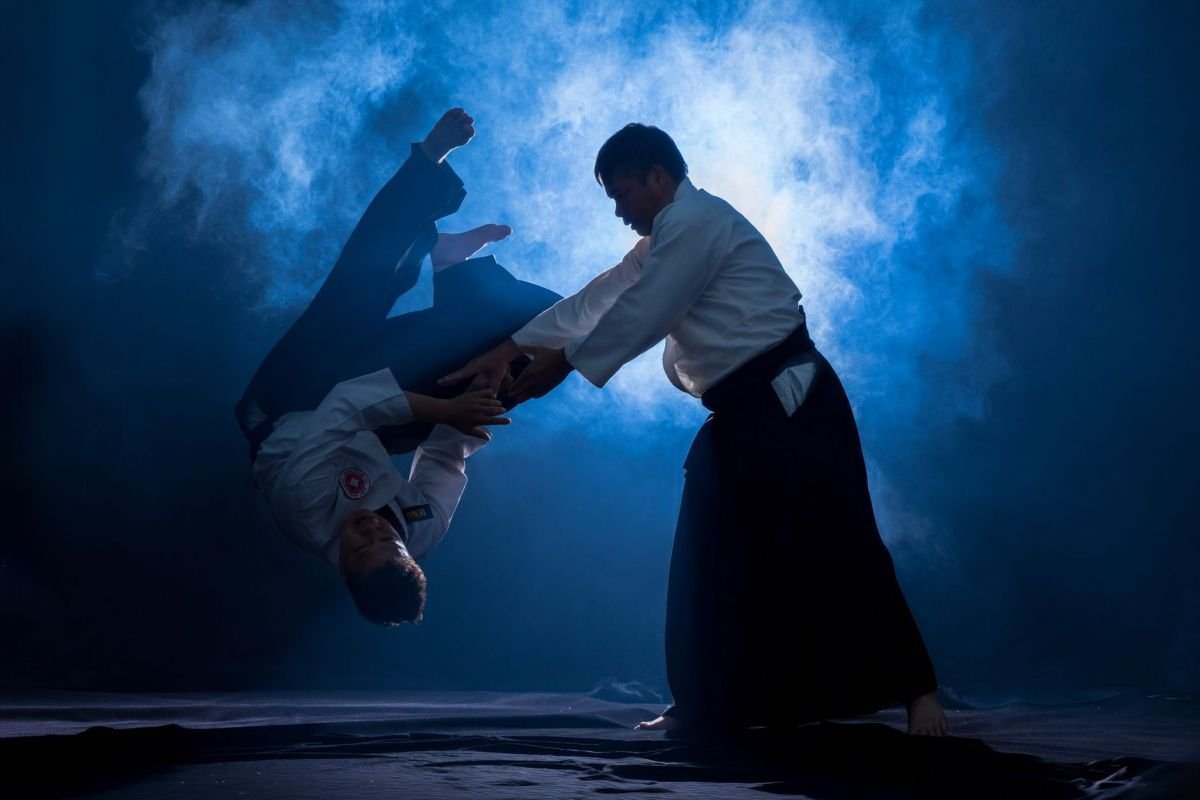
After many attempts from a friend to try out aikido, Donna Carlson finally stepped onto the mat when Koichi Tohei came to New York City in 1975. Though she only signed up for three days, she was immediately hooked and attended the rest of the week-and-a-half long seminar, bringing her friends and acquaintances over the course of the week. From then, she followed the teachings of Shizuo Imaizumi since then, even keeping a training space open for his students when Imaizumi left for Japan in 1987. Currently, she teaches sporadically at Shin Budo-Kai in New York City, transmitting the ki training she learned from Tohei and Imaizumi. This interview was conducted in November of 2022. This interview also appears in Aikido’s Hidden Gem!
Martial Arts of Yesterday, Today, and Tomorrow: Welcome Donna Sensei! Thank you for joining us to talk about your experience with Imaizumi!
Donna Carlson: Thank you.
MAYTT: How and when did you come to find aikido and Shizuo Imaizumi?
DC: I came upon aikido through an American named Jay Gluck, who lived almost entirely in Japan. He was an American who wrote a book called Zen Combat and a couple of magazine articles. He was the first American to write about aikido in Black Belt Magazine. I was a personal friend of Jay. He had tried for several years to study aikido and I had said, “I do not need to study another thing.” But Jay was a very interesting person. He was extremely well-educated in Japanese culture. He wrote tour guides in Japanese; he wrote for the newspaper. His wife was in one of the two major branches of bonsai work. Jay knew everybody in Japan. He had seen O-Sensei with the MPs and the famous historical events. Jay was there and wrote about them.
Jay was trying to get me to go to aikido and I was not interested. He would come through New York once a year or once every two years, for about eight years. I was not interested in studying aikido. I had no interest in the martial arts. But jay was very diligent and one year in February, he sent me a telegram at my job. Before that, he would send me letters saying, “Oh, Tohei Sensei is going to be in Hawaii; Tohei Sensei is going to be in France!” Something like that. I would say back, “I have no money, Jay. I’m not taking what little vacation time I have form my job and going to study anywhere!” But finally, he sends this telegram in February [1975] and said, “Tohei Sensei is going to teach a seminar at St. John’s University in July, and I hope this is enough notice for you.” [Laughs]
Then I tried to find this damned seminar. I called [New York] Aikikai; of course, they didn’t want to speak to anybody who wasn’t a student and looking for a seminar who they didn’t want to see in New York come at all. But I finally perused aikido schools in long-distance phone book and found a school in Philadelphia and they were sponsoring this seminar at St. John’s. So, St. John’s is in one of the other boroughs [Queens] and not near the center of New York City at all. The seminar was going to be a week and a day – something like that. I wasn’t going to sign up for a week and a day. I was going to sign up for three days: Friday, Saturday, and Sunday. I signed to take the seminar.
When the date of the seminar came – it was in July – there was a terrible heat wave. Awful weather. I had two or three jobs, and I cancelled the activities and around 3:30 pm, I headed out to St. John’s. for me, that meant taking a but to grand central station to take a train to take another bus, then another bus to the end of the line, at which time, I had to wait about forty-minutes for a little tiny bus that took me out a neighborhood. The bus driver let me out and said the campus was that way; there were some blocks to walk. And the campus was deserted – it was summer vacation, and it was already early evening.
Anyway, I saw some buildings off in the distance and wandered over there and could not find a door to get in the building. I walked around this enormous gymnasium and finally found a door that led me to the basement that led me inside the building. Once I got inside the building, wandering around, I finally here voices. I walk into the gym, and I see people in hakamas. I went the gentleman at the desk who was Imaizumi Sensei, but I didn’t know at the time. I said that I signed up for the seminar and they directed me to the changing room upstairs. I wandered around this building to find this changing room. I was used to doing lots of workshops, so I had these little costumes that I wore. They were loose-fitting garments that we all took our yoga in, and Esalen studies. The one that I had that day had very pale pink enormous abstract flowers on it, loose baggy sleeves and loose trousers. I wandered back in the gym where only three people didn’t have a hakama, whereas everyone had a hakama. And there I was in my little pink flowers to take class. And that was my first class with Tohei Sensei and with aikido.
MAYTT: How did the seminar go for you then?
DC: So, I took these three days I could see what it was about. I was a dancer – I studied lots of therapy work. I could see what it was. I didn’t have any trouble seeing what was ki, how it worked – I could see it. I took these three days, and I said that I would take the whole seminar – the whole week and I took people with me then, every day. I was good friends with Wataru Ohashi, who was the great shiatsu person here in this country. He wrote many books and had a school. He was quite influential in this country and brought over Japanese masters in shiatsu and herbal medicine. I took him out there a couple days; I took friends of mine; I took another psychotherapist, Ilana Rubinfeld who was a well-known person in the field. I took people out every day to introduce them to Tohei and to aikido.
After the seminar, Jay had written me a letter and said, “Imaizumi Sensei and Maruyama Sensei” – there are several Maruyama Senseis, one of whom is in Philadelphia but the Koretoshi Maruyama Sensei from Japan and Imaizumi Sensei were called the right and left hand of Tohei Sensei. They were friends, but they taught together also at Ki no Kenkyukai Hombu. Maruyama Sensei came from Japan and taught seminars here either two or three times. And he taught an instructors’ seminar in Denver that I attended. Even when I was with Tohei Sensei, it was always “Ima-san” for Imaizumi Sensei. Jay had written me a letter and said, “Imaizumi Sensei is highly regarded in Japan and if you can do anything to help him, please do so.” And they have been so good to friends of mine that had gone to Japan.
MAYTT: What happened after the seminar?
DC: The Philadelphia school had rented a small ground floor space on Waverly Place. There was ceremony where Tohei Sensei did the opening ceremony, which I found riveting. Imaizumi Sensei opened the school. Then I was saying to myself, I gotta find room to study this subject. So, I rearranged my life so I could take class. I went to class one night, and it was terrible! Imaizumi Sensei was nervous. He taught twenty-one techniques in one hour. I said to myself, “Well, I’ll study until my arm is broken and then I’ll have to quit.” [Laughs]
As I was leaving that night – there were five of us in the first class – there was a Chinese monk and there was someone else that spoke to Imaizumi Sensei, and he said to Imaizumi Sensei in English: “If I hear of anything, I’ll let you know.” Something like that. I spoke to Imaizumi Sensei then and said, “What is it that you’re looking for? What is it that you need?” Imaizumi Sensei said to me, “I have to find a school. Philadelphia had only rented that space for one month.”
I left there and I was walking up the street, but I told myself that I had to go back. So, I went back and banged on the door. Imaizumi Sensei peers at me through the crack in the door. I asked, “Do you have plans for dinner? I’ll take you to dinner and we can talk.” And so, typically of Imaizumi Sensei – he has a very confounding personality – he slammed the door in my face, and I sat on the stoop and waited for Imaizumi Sensei to change clothes. He came out and I took him to dinner at which time I found out that Imaizumi Sensei only had the school for three more weeks – they had already been there for a week.
I found out during the dinner that Imaizumi Sensei was here on the wrong visa. He had no way of getting a bank account because he had no Social Security card. He had no place to live; he was sleeping on the mat at the dojo. His passport was no good; his visa was no good, he had no money. What money he did have, he had it in a cardboard box. He had never been to New York; he did not know anyone in New York. There were no previous students of Tohei Sensei here. The Philadelphia students had all left and gone to Philadelphia. To survive, he knew no one; no place to live. He had no school. He had nothing.
On the other hand, Jay had said to me, “Imaizumi Sensei is one of the handful of people that will carry forth O-Sensei’s aikido.” And he does represent that.
MAYTT: Sounds like an immediate crisis. How was he ultimately able to stay in the United States?
DC: I did a lot for him. First of all, I had to find him a place. I had a challenging job then, but I called my job and said that I had to take a week of vacation time. They didn’t care what hours I worked, as long as I got it out. I had bosses that understood me then. I didn’t have to be there nine to five. The newspapers had ads then, particularly on Wednesdays, the Village Voice would come out and it had ads for lofts, living lofts, things to rent. Pages and pages. So, Tuesday night you would go down to the Village Voice and standing front there and it would hit street around ten o’clock. In the daytime, I would go look at places that I had circled. I would pick up Imaizumi Sensei in the early afternoon around one o’clock and I would show him anything that I thought that might be a possibility. But communication with Imaizumi Sensei is very difficult. It’s just very difficult. We would go look at space and he would say “yeah,” “no,” or he would say nothing and say, “Let’s go have a beer.” Then he would go to class to teach his class. He would go to the dojo even if no one came, he would go to the dojo when he posted he would have a class.
But finally, we found a place to rent. But I rented it. I had gotten my CD [certificate of deposit], my first CD. I bought it for ten days. I had to turn it in, so I had money to rent the place. Only I could rent it because I had a Social Security card; I’m an American citizen, so I had all these things. We rented this loft on the third floor of an antiques building. It was owned by a Persian rug dealer, who was scum. But he would rent to us, which was pretty unusual. Actually, you could in those days, find somebody who was a single-own. Nowadays, you couldn’t find a loft to rent, I don’t think.
Anyway, I found a loft and rented it. And then there was Imaizumi Sensei, me, and two other people who showed up to help get the space ready. The space had been a telephone answering service and it was filled plasterboard walls to make little cubicles, and endless miles of telephone cable because there were fifty telephones in this little space. All that had to be ripped out and we had to get a dumpster from the city. I had had business and loss in the city before. I had some experience to cope with landlords and real estate agents.
We got a space, and we walked up the few little mats we had – I think we had fifteen mats. We walked them up from Waverly Place to 10th Street on the third floor. And Imaizumi Sensei opened the school.
MAYTT: At that point, what year was it when Imaizumi opened the dojo?
DC: I don’t know. That’s something you have to get from Warren Wynshaw or Andrew Bordwin or somebody. It was in the 1970s.
MAYTT: When he opened up the dojo, how would you characterize the training you experienced? Was it rough and tumble or was it a refined sort of training?
DC: No, it was real training! It was serious training! Imaizumi Sensei was a serious aikidoist! It wasn’t polluted with anything else. We didn’t get karate or yoga or anything else. It was aikido training. And it was the same as Tohei Sensei had taught it at the seminar. It was the real stuff.
Sometimes we would get some students that would come – Imaizumi Sensei would call them gypsies – to check him out; he would say, “Oh, the gypsies are coming to check me out!” and they were people who had studied with everybody, and they did come to check Imaizumi Sensei out. But they’re not serious students. If you studied enough in the martial art world, you would know this.
The fragility of aikido, I believe, now in terms of its future, is that almost no one is willing to put in the time and energy and thoughtfulness to teach ki.
MAYTT: How important do you think ki is to the training of aikido?
DC: I think ki training is everything. I think everything is ki.
MAYTT: Could you explain how you arrived at that conclusion?
DC: Well, I think that was O-Sensei and Tohei sensei; I think they put themselves out to the world on the basis of ki. That’s what distinguishes them from the other martial artists.
MAYTT What does ki mean to you then?
DC: I’m not going to try and talk about that in two minutes. Certainly, some of the advanced people in tai chi have a very good understanding of ki. Very few aikido people have a good understanding of ki, and they don’t give a damn.
MAYTT: What is it to you that makes Ki-Aikido and Shin Budo-Kai aikido unique compared to the other styles of aikido?
DC: The emphasis on ki.
MAYTT: How did Ki-Aikido and Shin Budo-Kai train yourselves to “extend ki” into the technique?
DC: That’s why you take thousands of classes – thoughtful classes. You can do a lot of self-defense. You can do an enormous amount of self-defense; you can do an enormous amount of aikido techniques really well because you understand stepping and circularity and exercise. You understand the techniques, but it could be judo, it could be sword work, it could be many other things. But there’s a certain thoughtfulness. Some tai chi people have a very good understand of what subtle energy is. But nowadays, the Americans have a lot of trouble with that. They don’t want to slow down. They don’t want to slow to get better – they always want to accomplish the deed.
If you become a good Zen student, you understand. In Zen, if you go to the monastery, for example, and you’re going to take care of the yard. You go out and you pick the grass, and you pick the grass by hand. So, that’s ridiculous; why don’t you buy a mower to mow the grass? But the roshi will say to you, “No. This is your experience with picking the grass.” And it grows back in a week, and you have to pick it again. But the idea is that goal is not the pick the grass. The exercise, the mental exercise, is to pick the grass. So, the riddles can drive you crazy, but the subject is elusive in that same way and so is the energy.
You want to use strength; you want to use other things to accomplish your tasks, to throw this person. But your task shouldn’t be the throw the person, the task is to help that person fall down. I want to help him. I don’t want to think about him as an enemy I have to throw. Can I help you? There’s a nice place you can fall here. A different mindset.
MAYTT: And that mindset all originated from Tohei, correct?
DC: I don’t know; I don’t know about the origins with Tohei Sensei and O-Sensei. I know that they both did some Zen reading and both of them studied an enormous amount of sword work. And a great deal of aikido does come from the study of the sword. People who are good at iaido also have a good understanding of ki. I don’t know how much was extracted by them. I didn’t see enough of them. I saw Tohei Sensei, some. I felt Tohei Sensei, some, but not as much. I felt Imaizumi Sensei a lot, but I was very privileged because after a while, Imaizumi Sensei hardly touched any of the Americans. He would take them as uke and throw them, but he didn’t demand practices that I did in the early years with him. But that also made me thankful. I was very lucky that I got stuff from the beginning that he doesn’t teach anymore.
He thinks Americans want results all the time. You say to him, “Sensei, why…” He’ll say, “Americans, they want easy results!”
MAYTT: What were the things that he was teaching you in the early years?
DC: I don’t think it does any good to enumerate them or talk about them over the phone. I don’t see any purpose in that. I don’t see how it helps you understand it.
I’m so very lucky that I got in at the beginning. I saw these guys when they were fresh. The ideas were fresh; they were new. I got to be a part of that, so I feel quite privilege in that. But I am an old timer, I am a traditionalist I’ve been with Imaizumi Sensei since he started the school. I’m not trying to do a different style at all. I was never trying to be an innovator. I’ve been a traditionalist; I’ve been trying preserve and pass on Tohei’s training, O-Sensei’s training, and Imaizumi Sensei’s training to the best that I can understand it. So, I’m not trying to do anything stylistically different.
And many people would say, over the years, “Oh I studied at Hombu! I was there when Tohei Sensei was there.” Imaizumi Sensei would say, “No, he never studied with him. He came for two weeks and left.” We’re talking about the horse’s mouth here when we’re talking about Imaizumi Sensei. So, I’m skeptical of quite a few people who were in at the beginning. Some of them were and some of them weren’t. a lot of them get a black belt and open a school and think they’ve arrived. A black belt’s nothing. A black belt is the beginning of training.
[Andrew, Warren, and Mel Arslan] opened up a new school; I’ve been over there about half a dozen times maybe and I’m still teaching ki. I’m still trying to teach ki because I feel it is more important than anything else. But the other students are more interested in results. Warren is more interested in his own thinking of aikido. He’s very bright – Warren is very intelligent, and his ideas are very interesting, but he’s now trying to teach his own style of aikido. His own thinking about it. I’m not pretending to have a rethink on it, and particularly not now because I’m not very totally moveable anymore. I’m eighty-six years old, I’m not moving well. I’m not talking well because they gave me a new jaw because cancer. They made a new jaw. They took a bone out of my leg, and they carved a new jaw. So, I had to learn to talk again and to eat again and all those good things. But I’m still alive and I feel kind of honored, so I’m doing okay.
MAYTT: September of 1987, Imaizumi resigned from the Ki Society to attend some family matters. I recall talking to Warren that it was you that kept the dojo open and held out for everyone to train. How did you come to assume that role?
DC: I know Imaizumi Sensei very well, but again I’m saying, Sensei is extremely difficult person to get along with. He’s not a good communicator and now his hearing terrible, now it’s really difficult.
We had various crises at the school – we thought we were going to close the doors and were going to go bankrupt. We would have enough students to get by a little bit. we never had a calm period. Our lease was going to be up. We had a school, at that time, on 5th Avenue and 20th Street. It was a great address, and the windows faced the street – oh, it was wonderful location. However, we had this Brazilian woman own this building and she was going back to Brazil and was going to sell the building and we couldn’t renew our lease – we had to get out. So, Warren and I looked; we spent hours on the search for a space in New York. We found a space over near the Fashion Institute of Technology (FIT) and we had asked Imaizumi Sensei, on a Sunday, to go look at the space. He agreed but on Saturday, Imaizumi Sensei called me and said, “I need to meet with you and warren tomorrow.” I thought that was weird and I called Warren; Warren drove into the city. We met Imaizumi Sensei, who said, “I want to leave in a week and go back to Japan.” What? I’m knocking myself out to move this school and he’s going to go back to Japan? Anyway, there was no warning about this decision.
When he was going to go, he said goodbye to the students at the school. I lived on 17th Street, and I had found Imaizumi Sensei an apartment on 19th Street, so two blocks apart. We’re walking and we get to the stoplight across from his building and I say to him, “Don’t you have anything to say to me?” because he hasn’t said anything during our walk. And he whipped around at this light and said, “I’m going to give you a piece of advice: no one wants to study with a woman. Break the school.” I came home and had a good cry. I thought about it; Imaizumi Sensei cannot make it in Japan. He cannot do it. In some ways, he’s a misfit – a very talented misfit, accomplished misfit of society. I said to myself, he can’t go back to Japan and that rigidity; he’s had freedom over here to walk the street, read a book, and whatever else – he can’t live like that in Japan.
Another clue was that Atsuko wasn’t going back with him. I said to myself, I don’t think this is going to last. I said to myself I was going to keep the school open. So, I looked again for another space. We couldn’t take the space at FIT because it was no way to afford it. I found a space on 14th Street and 9th Avenue – between 9th and 10th Avenue. That area is very fancy now, but then, it was a meat market and totally an undesirable neighborhood. I found somebody who owned a building, Neiman Brothers – they’re big butchers. They owned this building, and the top floor hadn’t been used since World War II. They used to kill the horses in the basement and, with these great huge hooks and chains hoist them up to the top floor where they were bled and carved up. There were trap doors where they would move them down to the next floor. On the second floor, there were big, huge ice chests to keep them preserved.
So, this place on the fourth floor since the second world war when they were making horsemeat. But there were students to help then. There were students to help – it was a massive job to do. There were overhead chains where they would take the horses. Anyway, we made a very nice school there. It was big with a big floor and doors the lead to the roof outside. Hot as hell in the summer because we were under a stamped tin roof. No air conditioning of course. But we had a big school there. It was a wonderful big space. We were there for a few years.
Imaizumi Sensei had gone to Japan, and I was teaching Saturdays and two weeknights, if I recall. Warren taught one night. George Simcox, he taught one night, driving down from Connecticut. And then I rented the school out to a ninja teacher for one night. I managed to pay the rent. After a year, Imaizumi Sensei came back and walked onto the mat, and there was a class to teach.
Don’t worry; Imaizumi Sensei never said thank you. [Laughs] It’s not in his bones. But there was a school for him to walk into. I was only able to teach that much because I was putting in extra hours, doing freelance project and other stuff for more money to pay the rent. But warren must have some memories of that time.
Those years are such a blur because I did was work, teach, sleep. I don’t have clear memories of that timer. I remember students I taught. I like teaching; I love teaching. I remember students then.
But Imaizumi Sensei came back from Japan and class continued. We always had a sword class once or twice a week. And we had practiced forms Tohei Sensei introduced called taigi. They’re like kata for karate students. They’re a sequence of six techniques, done on both sides, right and left side, so you’re thrown twelve times. You start with bowing at each other, and you finish with a bow. At certain times, they would have a stopwatch on you, and you were supposed to do taigi one in fifty-four seconds, or something like that. You’re ukemi gets to be very good because you gotta keep getting up and down – you can’t have a daydream down on the ground.
I rarely taught taigi. I understand the usefulness of them now than I did then. I thought they were an intrusion. Tohei Sensei had introduced them really to help his tax situation in Japan. I didn’t feel they were totally honest. But, if you practice them, you can get a lot out of them. I couldn’t see that then. A part of it I know, only because I was in this rut of trying to teach people what I knew.
The school had a tough life. There were years where I stepped aside and didn’t do anything to help with its survival because other students stepped up and watched out for its survival. Marc Abrams, he committed a lot of the school at one time. At various times, students have stepped forward. Warren used to come twice a week and he seemed to get everything quick. Then he was gone a whole bunch of years, but he raised a family. He raised his sons, he graduated from law school. He moved out of New York City. Then, when they grew up, he moved back to the city. A lot of people come and go. They go someplace to help their career or get their marriage started. People come and go. There were years where I had nothing to do with maintaining the school and trying to keep it alive. So, I guess those were good years form my position. [Laughs]
But there were people who stepped forward. I was not the only person to step forward. The first eighteen years, I probably had quite a bit to do with the survival of the school. Then I stepped aside. But I always taught; I always continued to teach. That’s how it should be with the school; various step forward at various times and pick up the reigns and get the place to go again. Just like Mel, and Andrew, particularly now, trying to pick up the reigns and kick some life into the place again. Imaizumi Sensei rented another space. And that’s how it should be.
MAYTT: When I talked to Andrew Bordwin earlier [October 2022], he mentioned that Imaizumi retired a couple of weeks ago, the future seems to be uncertain for now. What does the future look like to Shin Budo-Kai without Imaizumi at the helm?
DC: Andrew and Mel have rented the space. They do have the website out that says Shin Budo-Kai on it. They’re trying to continue it, not withdrawing the name Shin Budo-Kai from the dojo. Imaizumi Sensei, in the retirement seat said that he felt good about retiring now because he felt that they were going to continue, that the school was going to continue. I feel that it’s going to hobble forward in some fashion. I could be wrong. They’re both well-intentioned, they’re both very able teachers and I felt that they have the intention to carry it forward. They opened up the school in a loft and it reminded me of a haiku that I’d seen in the Brooklyn Botanical Gardens decades ago. I don’t remember it exactly word for word, but haiku was about this water was a big water once, and now it looks like a little water, but that little water has the big water in it. The idea is that the big waterfall is in those little drops of water.
So now we have this case of Shin Budo-Kai, which is from O-Sensei to Tohei Sensei to Imaizumi Sensei; it’s this big flow of water and now it seems like we’re down to some little, teeny bits of water. But they have the big water in them – they have the big training in them. The problem is its just so hard to make any martial arts school survive in this country. The economics are a given.
MAYTT: Especially after we experienced during Covid and everything that we are currently experiencing in post-Covid.
DC: Right. And it’s the nature of the art because aikido basically is an art where you want to be close to the person and here, we’re trying to stay away at a distance from people. So, I don’t know what’s going to happen in the future but that’s just my thinking.
MAYTT: Let’s back up a bit; since we talked about the future of Shin Budo-Kai, let’s talk about the beginning of Shin Budo-Kai. By 1988, Imaizumi returned from Japan and Shin Budo-Kai was born. How did he come to form his organization?
DC: That’s just a piece of paper and an announcement. No big deal. Imaizumi Sensei had a meeting or something or something or other, and he said he wanted to make a new organization. Imaizumi Sensei always liked, or used to really like, organizations. He doesn’t anymore. So, since he was no longer a member of Ki Society, and since the school had resigned itself, Imaizumi Sensei felt that he should make a new thing for everybody to belong to. So, he just made an announcement and there might be by-laws somewhere with Shin Budo-Kai. We printed out new brochures. That was no big deal. Certainly, the teaching didn’t change. It was not like he wasn’t going to teach this and now teach that – teaching didn’t change.
However, I think the key is, that I said now, I think now the teaching is changing. For example, I’ve been at least forty-five years, maybe fifty, the Four Principles were also emphasized in every class: they’re all about ki. But the four principles that Andrew and Mel teach have vanished. The brand-new students at the school cannot tell you what the Four Principles are. When I started, the four principles we something that you kind of learned in the first or the second class. And then, if you were teaching, you could refer to them all the time. In that degree, the basics are slowly vanishing. It’s like if we were ballet students, all of a sudden, they’re not going to stop and teach the pleat anymore or how to stretch at the bar. That doesn’t mean you can’t do it – you can do it on your own. My problem with it is they think its for the body and I think its for the mind. And it’s okay. Aikido’s not going to vanish. It’s been around long enough that it’s got its toenails into martial arts history. It can survive. And now there’s a thousand of martial arts.
There’s too many. I think there’s too many. I think if you want to get really good at something, you gotta do that something. Its hard. You can be a generalist or can be develop expertise. Andrew is primarily interested in weapons. So, he’s gathered up a vast inventory or knowledge on weapons.
MAYTT: When I talked to Andrew and Warren, they mentioned that when Imaizumi created Shin Budo-Kai, he really expanded the weapons curriculum. Did you notice that when he came back from Japan?
DC: It might have been. I think they [Andrew and Warren] would have noticed it more because they’re men and interested in weapons. Maybe he developed more weapons then. I can’t affirm or deny that. He did do a few weapons. He loved weapons though. They all did. O-Sensei loved weapons. They all had a tradition; they all understood judo. So, they all had a tremendous understanding of judo and iaido. And lots of the techniques came from iaido right away. If you analyze the technique, you can show this is the iaido technique that ikkyo came from. You don’t have to be mystic – you can see it, its right there.
MAYTT: Thank you again for joining us; this was a great conversation!
DC: You’re welcome.
Learn more about Shizuo Imaizumi, Donna Carlson, and more in Aikido’s Hidden Gem!
