

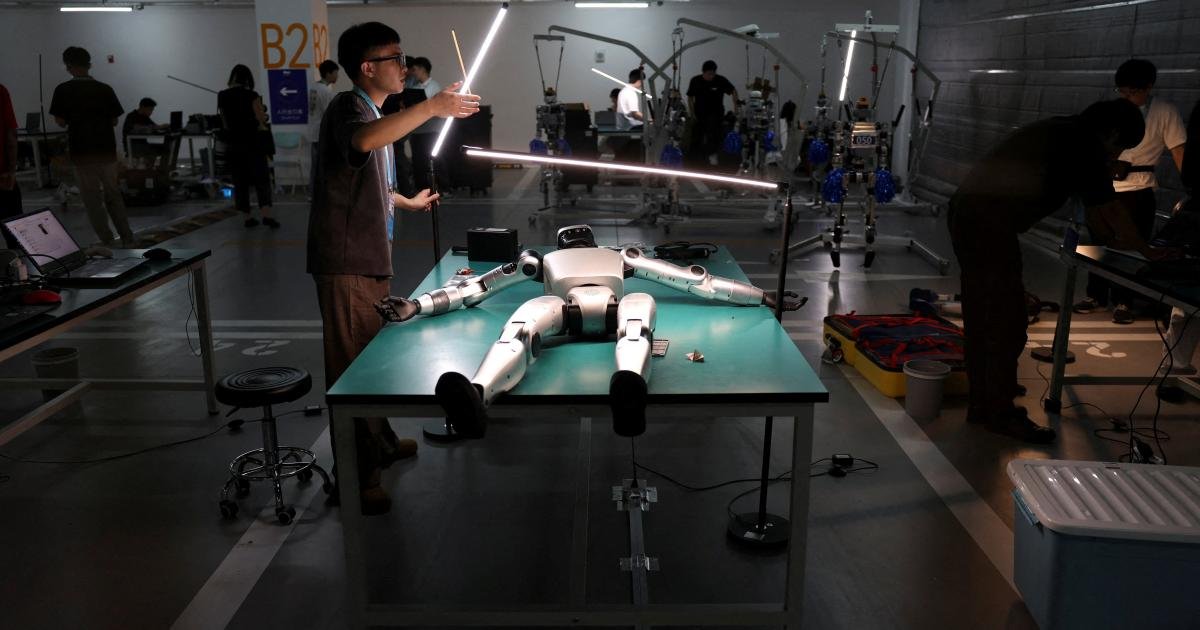
The fastest track and field athlete is no longer the Jamaican sprinter Usain Bolt. In fact, it is not a person at all: it is the Chinese humanoid robot Tiangong Ultra, which in August ran 100 meters in 9.39 seconds, nearly two-tenths of a second faster than Bolt’s world-record time and more than twice as fast as its own time a year ago. The race made global headlines and spread on social media in large part because of what it revealed robots still can’t do—in this case, slow down, as Tiangong Ultra ran right through the finish line and slammed into a safety wall. But it also showcased the incredible progress China’s robotics industry has made and the narrowing gap between human capabilities and new technology.
China’s robotics achievements have become central to its evolving national AI strategy. Whereas Washington and Silicon Valley focus primarily on scaling large language models and digital AI applications, Beijing is concentrating on combining its strengths in software and hardware to develop robots that incorporate the advanced cognition of AI with autonomous physical movement. These robots, often described in China as “embodied AI,” could eventually operate factories, perform manual labor, and even replace human soldiers on the battlefield. If AI-powered robots develop enough autonomy to carry out sophisticated tasks in the real world, they could become a general-purpose technology, like electricity or the Internet, that is able to transform physical work across broad swaths of the economy.
For Beijing, a powerful AI-driven robotics industry could serve several of its economic and strategic goals. It could ease demographic pressures from an aging population by reducing the need for workers and providing eldercare. It could also supercharge Beijing’s military capabilities by automating its reconnaissance, logistics, and combat operations. Most notably, some leading Chinese thinkers believe robotics could be the key to unlocking artificial general intelligence—systems capable of performing as well as or better than humans across most tasks. China’s investments in AI-powered robotics could be especially consequential if today’s leading AI companies in Silicon Valley, which are focused on scaling the data and computing power used to train large models, struggle to translate their digital gains into advancements in the physical world.
Skeptics might think that AI-powered robots are the stuff of science fiction. But as robotics technology rapidly develops, China is betting that some of the most consequential advances in AI will hinge on mastery of the physical world. If that bet is right, even only partially, the United States’ lead in frontier models would matter far less than many in Washington assume. What would matter instead is the capacity to build robots, deploy them in sectors such as manufacturing and logistics, and generate enough data to continuously train them—all areas in which the United States currently underinvests. To compete, Washington needs to expand its own manufacturing sector and work with partners around the world that have developed advantages in key parts of the robotics supply chain. As China sprints ahead, the United States needs to get serious about AI-powered robots or it risks getting left behind.
EMBODIED POSITIVITY
The Chinese government is determined to lead the transformation toward a world of AI-powered robots. Beijing has placed embodied AI among what it calls the “industries of the future,” alongside 6G and quantum technology, and named it a priority in the 15th Five-Year Plan—the country’s socioeconomic blueprint through 2030. Facing high youth unemployment, a property market still in crisis, sluggish domestic consumption, and an aging and shrinking population, Beijing sees embodied AI as a new growth engine that could offset these headwinds while also pushing technological frontiers.
Innovations aimed at addressing domestic challenges could quickly create a geoeconomic advantage. China already controls key chokepoints in the emerging supply chain for embodied AI. Chinese companies, for example, produce about 80 percent of the world’s LiDAR (Light Detection and Ranging) sensors—the technology that underpins three-dimensional mapping and autonomous navigation in self-driving vehicles, warehouse robots, and precision agricultural tools. If AI-powered robots become as foundational to the global economy as Beijing hopes, countries would be as dependent on Chinese robotics supply chains as they are today for critical minerals, which has given Beijing enormous leverage over the global economy.
The strategic benefits of AI-powered robots extend to the military. In February, the Chinese Institute of Command and Control, a state-connected national scientific society, assessed that embodied AI could enable networks of unmanned systems operating across air, land, sea, and space to share information, anticipate battlefield developments, and carry out precision strikes in real time. This could significantly enhance the ability of the People’s Liberation Army to coordinate joint operations across varied terrain, such as around the disputed islands and outcroppings in the South China Sea.
Beijing is combining its strengths in software and hardware.
Most important, a growing number of prominent scientists in China have argued that embodied AI could offer a potentially neglected pathway to building artificial general intelligence. Zhang Bo, the founding dean of Tsinghua University’s Institute for Artificial Intelligence and a pioneering AI researcher, has written that intelligence relies not only on cognition but also on the ability to learn from and make decisions in the physical world. Embodied AI, he argues, can overcome the shortcomings of traditional AI and accelerate progress toward AGI. Zhou Bowen, the director and chief scientist at Shanghai AI Lab, one of the country’s leading AI research institutes, has similarly argued that AI models need robotics to understand the physical world. China’s unmatched manufacturing base can become a training ground for artificial intelligence as real-world data feed back into AI systems. The more data these systems acquire on how to navigate complex real-world settings, the better they will perform in new environments and the quicker they can develop.
Beijing’s bet on embodied AI is not a turn away from software or a concession in the software race with Washington. China’s leading labs such as DeepSeek and Z.ai are scaling large language models as aggressively as their American counterparts. Many have begun using AI to automate AI research in the same way U.S. companies have, bringing them closer to what technology experts call “recursive self-improvement”—when highly capable AI is able to continuously build ever more capable AI, which could create a potential intelligence explosion. What sets Beijing apart from Washington is the simultaneous efforts it is making in developing AI in the physical world, where it is far outpacing everyone else.
FROM THE BOT UP
To accelerate the development of AI-powered robots, Beijing has directed local officials to experiment with ways to boost innovation and expand production. Provincial governments, adept at interpreting and carrying out the central leadership’s priorities, have responded rapidly. Wealthy provinces and cities with established high-tech ecosystems, including Beijing, Guangdong, Shanghai, and Zhejiang, have jockeyed aggressively to position themselves as national front-runners. They have established dedicated venture capital funds, introduced subsidy schemes, and set up specialized training facilities to support local AI-powered robotics companies.
This approach mirrors the strategy Beijing successfully used to develop technologies such as electric vehicles and solar energy. Acting on broad policy direction from Beijing, provincial and city officials offered companies generous subsidies, tax breaks, and preferential leases on land. These local governments’ efforts to outdo one another in carrying out Beijing’s strategy yielded widespread overcapacity and huge amounts of waste. Yet it also helped cultivate globally competitive firms, including BYD, which has emerged as the world’s leading electric carmaker.
Financing a boom for AI-powered robots, however, will be more difficult than it was to finance a boom for electric vehicles and solar panels. The property market downturn, which has now lasted five years, has strained local budgets. Governments can no longer rely on selling land-use rights to developers to fill their coffers, taking away one of their main sources of revenue and limiting the funds available to encourage the growth of new industries. Aside from the wealthiest areas, there is not much money available for robotics.
With government funding hard to come by, AI-powered robotics companies have turned to public markets. In August, Unitree, one of China’s largest producers of humanoid robots, went public on the Shanghai Stock Exchange. The company raised nearly $1 billion in its initial public offering, and shares were so oversubscribed that they jumped more than 450 percent on the first day of trading. But although public markets can help fill some of the gap left by shrinking state support, their reach is limited. Only a handful of robotics companies have gone public, and Chinese regulators are making it harder to do so by requiring firms to demonstrate stable revenue and commercial sales before they can list. Regulators are cautious in part because the technology is not yet commercially viable at scale.
Still, there are signs that the technology is becoming more appealing and could spread quickly. Although most of Unitree’s humanoid robot sales in the first nine months of 2025 were for education and research, more than two-thirds of the sales of its four-legged robots (essentially robotic dogs) were for consumer and industrial uses—patrolling industrial sites for safety hazards, for instance, or accompanying lonely seniors—up from less than one-third in 2022. If robotics companies channel the money they raise from government support, initial public offerings, and sales, more AI-powered robots will enter commercial use in the next few years. As that happens, manufacturers across China could begin to buy them for their production lines, generating the revenue and real-world data that embodied AI firms such as Unitree need to improve their products even faster.
GETTING PHYSICAL
Silicon Valley has largely concentrated on a single approach to developing AI: self-reinforcing improvements in software (especially AI agents) that complete increasingly sophisticated digital tasks. Improved coding has allowed large language models to act more autonomously and to solve harder problems, including seemingly impossible mathematical proofs. But despite enormous progress, there is limited investment in incorporating AI into the physical world. Instead, the assumption is that software advances will eventually translate into real-world capabilities.
That assumption may be mistaken. Even if AI models can perform the work of software engineers, accountants, consultants, and lawyers, they may not be able to easily perform tasks in the real economy. Digital systems alone cannot work production lines, harvest fields, extract minerals, or fight wars, nor can they easily capture data that reflect how these physical tasks are done. Automating these sectors likely requires both the most advanced software models and enormous quantities of data about physical interactions. Even if Washington continues to lead the world in software, therefore, China may be able to rapidly gain ground on or even surpass the United States by deploying AI across the physical economy and collecting greater amounts of real-world data.
The longer that Washington neglects its own robotics sector, the further behind it will fall. American firms lead the world in certain segments of the AI-powered robotics supply chain: Nvidia, for instance, designs the chips that serve as the “brains” of these systems. But compared with China, the United States has far fewer companies building complete robots, and these companies face higher production costs and more acute shortages of engineering talent. Fortunately, the investments Washington says it wants to make in the foundations of American manufacturing are essential to strengthening U.S. competitiveness in AI-powered robotics. The U.S. government could set up training programs in mechanical engineering, automation, and robotics to develop a talent pipeline, as well as offer tax incentives for manufacturers who produce in the United States.
China’s manufacturing base can become a training ground for AI.
The U.S. robotics industry is also growing increasingly reliant on Chinese hardware components, a problem that will become more severe over the long term. This dependence raises the risk that Chinese suppliers could gain access to U.S. users’ sensitive data, and it leaves Washington vulnerable to the weaponization of economic chokepoints. As AI-powered robots become more integrated into the American economy in the coming years, any Chinese restrictions on exports of key components could halt U.S. assembly lines and ripple across every industry that depends on these systems.
Policymakers are aware of the dangers of overreliance on Chinese supply chains. In July, the U.S. Federal Communications Commission banned the import of advanced foreign robots, hoping to create market space in which U.S. companies can compete with China. Notably, the FCC rule exempts imports of robots for U.S. product development and does not fully ban imports of Chinese components. This is a good start, but more challenging policy questions await, especially if Washington tries to more forcefully cut China out of the U.S. robotics industry. Any rapid decoupling from Chinese hardware could disrupt domestic robotics production in the United States by limiting access to some necessary components, including key sensors and batteries. A better solution is for Washington to selectively import essential Chinese components while developing alternatives and deepening cooperation with countries that have long-standing strengths in industrial robotics, such as Germany and Japan. Agreements could be connected to or modeled on Pax Silica, a U.S.-led initiative focused on cooperation in AI and semiconductor supply chains, which would ensure that American manufacturers can obtain their hardware on competitive terms from trusted sources.
The United States also needs its partners to help it increase its access to training data. Chinese companies can draw on real-world data from the country’s vast manufacturing base and widespread deployment of robots, giving them a data advantage that none of their competitors alone can match. But some U.S. partners hold unique datasets. Ukraine, for example, has amassed millions of annotated battlefield images and video frames from its war with Russia. Earlier this year, Kyiv signaled its willingness to share this data with its partners to help them train their AI systems. Washington could work with Kyiv on a framework for sharing this data with American companies, helping them accelerate the development of robots for national defense.
Integrating artificial intelligence into the physical world will likely unlock profound economic, technological, and military advantages for whichever country can best do so. As it stands, those advantages will accrue primarily to Beijing. If Washington wants to keep up, it will have to make leadership in this transformative technology a national priority rather than an afterthought. Otherwise, the United States may soon find itself developing the world’s best AI models while China reaps the benefits of bringing the models to life.
Loading…
