

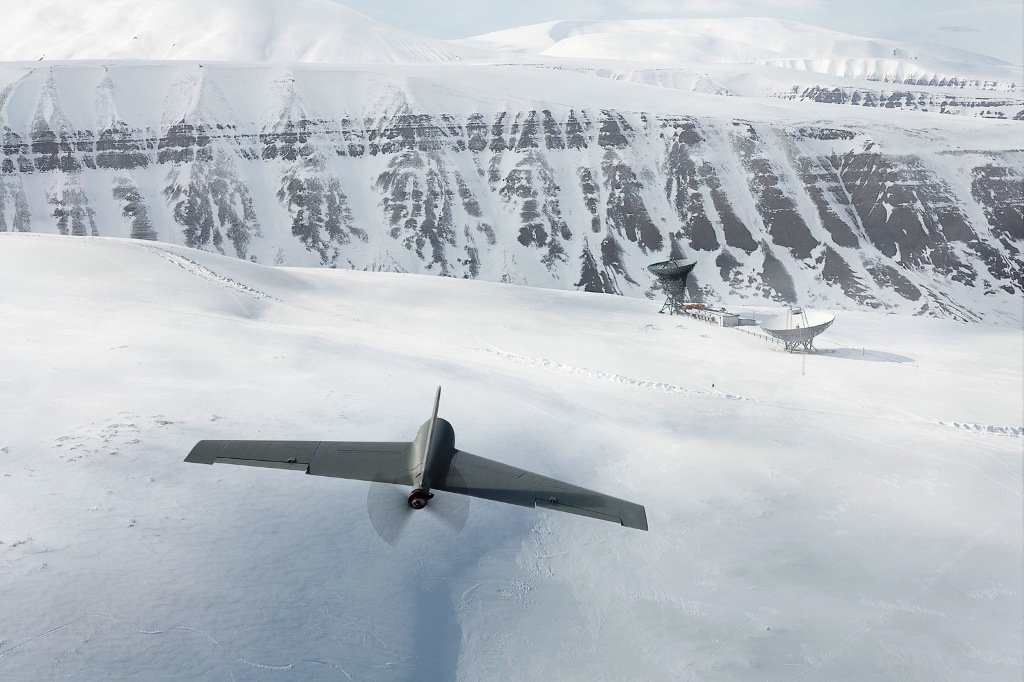
A newcomer in the military world, California-based Heaviside Industries unveils at AUSA its Tyr, a miniaturised fixed-wing loitering munition which can carry four different types of warheads at 40 km distance, providing low echelon formations a medium-range indirect hit capacity
A very recent start-up which appeared in May this year, Heaviside Industries is based in Los Angeles, California. The first product to appear in its portfolio was the Moth, a passive radio frequency spectrum analyzer operating in the 5 MHz-6 GHz spectrum, which can be easily carried by the individual soldier thanks to its low mass, only 448 grams with antennas and battery, and dimensions,147x84x46 mm. The Moth gives the warfighter full situation awareness on radiofrequency activity in the surroundings; its man-machine interface is kept as simple as possible to allow non-specialised EW personnel to acquire the information needed at the lowest tactical level. The company emerged in May 2026 when it obtained a US$ 28 million Series A financing, which was followed by a Series B financing worth US$ 60 million in late August.

At AUSA 2026 in Washington DC Heaviside Industries is unveiling the second product of its portfolio, the Tyr, a miniaturised fixed-wing loitering munition. EDR On-Line talked to Nils-Andreas Haagenrud, the company President.
The Tyr is destined to equip the lower echelons, giving them a long range strike capacity, the munition range being around 40 km, which is the maximum range for the dual-band data-link when operating in a fully contested environment. Considering the over 60 minutes endurance and the around 100 km/h optimal cruise speed, it is clear that the Tyr can spend quite some time loitering over the target area searching for the most valuable objective, before diving on it.

It features an aerodynamically shaped fuselage, which maximum diameter at the front, while at the back we find the electric motor which activates a two-blade pushing propelled. The Tyr is 790 mm long, and is fitted with swept wings with a 1,000 mm wingspan, batteries being located in the wings. Its mass at launch is 2.3 kg; for infantry use a reusable ground launcher is available. This comes in the form of a nearly rectangular box capable to contain the Tyr, the impulse is given by a crossbow-like mechanism, the propeller being activated as soon as the airframe leaves the launcher. The solution adopted allows to reuse it several times. “The mass of the overall system including munition, radio link, ground control station and launcher is around 6.8 kg. When the wings are disassembled from the fuselage the system can be fitted in a rucksack, one man being able to carry more than one munition within a reasonable load,” Mr. Haagenrud told EDR On-Line.
Once airborne the Tyr navigates towards the target area via waypoints using GNSS signals, however the munition is fitted with a much smarter navigation system which exploits the images provided by four sensors, a day camera and a thermal imager located at the front and two similar sensors installed under the fuselage, as well as information provided by magnetometer and gyroscopes; all those information are fused and allow to minimise the drift of the inertial navigation system which is used in GNSS-denied areas. Although such a solution requires a considerable amount of computing power, EDR On-Line understood that today on the civilian market very powerful processors are available at a reasonable price. The computing power is also used to fuse the images provided by the four cameras. “When doing so we obtain what might be defined a ‘virtual gimbal’, saving mass and money. Not only, we can zoom-in on an object while keeping all the peripheral view,” Nils-Andreas Haagenrud explained.

The Tyr flies autonomously to the target area. At this point it starts loitering, searching for a target, and when it identifies one it warns the operator. “We have an automatic target recognition on board. To fully understand what is needed to recognise a target and to lock onto it, and how far away from the target we can lock onto it so to avoid losing the radio link, I have personally been several times to Ukraine in the last four year,” the company President told us. At this point the automatic tracking system locks on the target and the Tyr starts diving on it. Not before having received the green light for the attack from the operator, who sends the signal that arms the warhead. “Right now, considering western countries legal issues, we have the man in the loop, it is him the one that presses the button and engages the target. However, the Tyr can be used as a fire-and-forget munition, should a government decide that this is acceptable,” we were told, a solution that would obviously be better used against static targets rather than against armoured vehicles.
The dive angle will depend very much on the type of target; EDR On-Line understood that the munition can go from a horizontal hit to a vertical one, top attacks at different angles being the preferred options against many types of targets, static and on the move. Typically it is easier to destroy a main battle tank hitting the top of the turret or the powerpack at the rear, something which is done at high angles of attack. Soft target in the open may be dealt with overflying the area, therefore flying a much more flat path.
Considering the Tyr lethality package, in August 2026 Heaviside Industries inked a partnership with Nammo of Norway, the latter becoming its warhead supplier for multi-domain precision munitions platforms, of which Tyr is the first example. Four different types of warheads are made available: shaped charge, against tanks and armoured vehicles; explosively formed penetrator, also against heavy armoured targets; fragmentation, against light armoured targets and personnel in the open; enhanced blast, against protected structures.

“The beauty with NAMMO is that they can tailor these warheads as we want them, the Tyr having a maximum payload of around 700 grams, although we are trying to use as much off-the-shelf payloads as possible. For example, the shaped charge solution is was developed by NAMMO together with the Norwegian armed forces, it is a very capable system and we are testing it right now. The three other warheads are now undergoing initial testing,” Mr. Haagenrud said. Depending on the type of target and warhead, not only the angle of attack must be optimised, but also the distance from target at which the warhead detonates. In the front section of the Tyr we find three windows, two of them hiding the day and the thermal cameras, the third hiding a laser rangefinder. “It gives you the information on how far you are from the target, which in case of a shaped charge warhead will allow to detonate it at the optimised stand-off distance, usually well under one metre, while in case of the fragmentation warhead you may want to detonate it from 3-4 metres all the way up to 20-30 metres, depending on the type of target and the fragment density you want to obtain,” the Heaviside Industries co-founder detailed. EDR On-Line understood that in the final dive, especially at high angles, the munition accelerates mostly under the effect of the force of gravity, reaching a speed limit of over 250 km/h.

Until now we mentioned only the use from the ground. The company has already done tests dropping the Tyr from helicopters and light aircraft, and some more will be carried out soon. The use from mid-size UAVs is also conceivable as well as that from naval platforms, in the latter case using a similar launch system to the one used from the ground.
Heaviside Industries Tyr has completed live-firing tests, and is currently under contract with US Department of War customers.
“We are in low rate initial production right now. We are testing and making sure we get away with all the teething problems. We know that it takes time to get the system up to the level where it becomes extremely reliable, because this is the most important thing,” Nils-Andreas Haagenrud stated.

A loitering munition in the class of the Tyr is destined to be produced in great numbers. Considering cost and production issues, Heaviside Industries adopted a mix of 3D printing and conventional composite material production technologies. “We adopted a mix of the two, as with 3D printing only we cannot obtain the performances we need for our system,” we were told.
Coming to the production issues “We try to have a supply chain that is not too big, which is also based on commercial industry or partners with whom we worked for many years, such as NAMMO, that can build in great numbers at a low cost. We have a production facility in Norway that we are moving into right now, where we will have the capability to produce in mass, and which will allow us to have a fully ITAR-free product,” Mr. Haagenrud told EDR On-Line, adding that his company is also looking for international partners. “We are now looking to pick up probably a couple of production facilities around the world, where we will produce this system in mass, just to make sure that we have a more strategic partnership with these countries. As for the export market, I think we will definitely succeed, as our competitors are right now four to five times more expensive than what we are, with the same kind of capabilities,” the Heaviside Industries President and co-founder concluded.
Photos and graphics courtesy Heaviside Industries
.
