

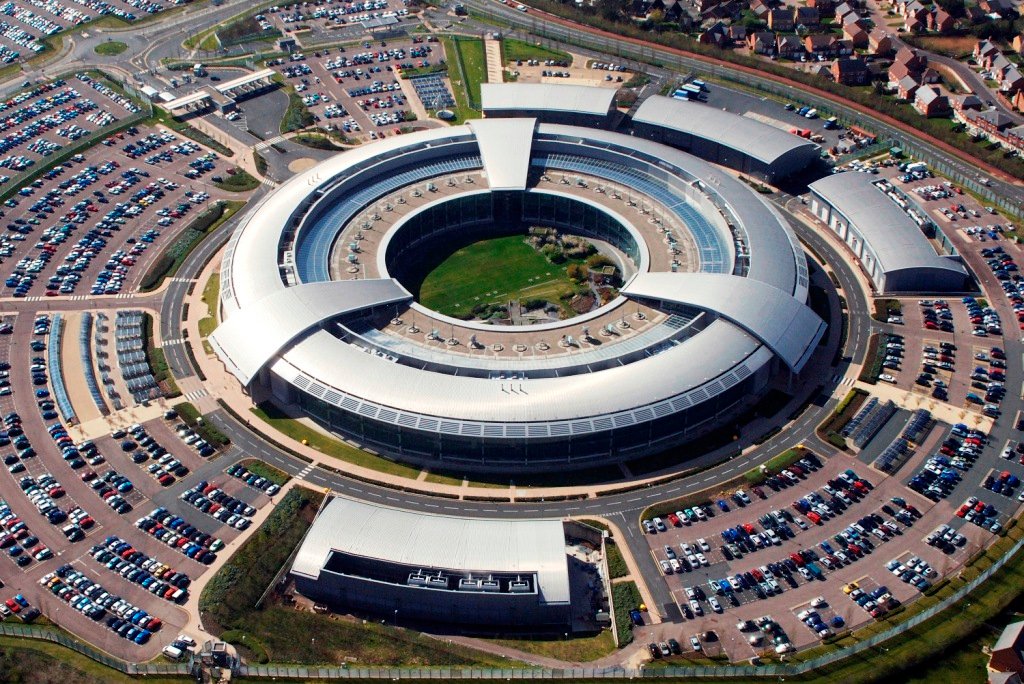
Usually referred to with its acronym, GCHQ, or with its location, Cheltenham,Gloucestershire, a 110,000 inhabitants townsome 150 km north-west of London, the UK Government Communications Headquarters is one of the most secretive agencies of the country
Recently EDR On-Line had the rare opportunity to attend a recent briefing by GCHQ’s Director and Director of Technology. Government Communications Headquarters is an intelligence and security organisation responsible for providing signals intelligence and information assurance to the government and the armed forces of the United Kingdom. It specialises in signals intelligence (SIGINT) and protecting the nation’s digital infrastructure. It employs people in areas including human resources, finance, communications and cyber security, as well as in specialist technical roles, languages, analytics, intelligence reporting and mathematics. GCHQ’s Director is Anne Keast-Butler who was appointed in May 2023. She joined GCHQ from MI5 [1], where she was Deputy Director General, responsible for MI5’s operational, investigative, and protective security work. This has included MI5’s, and allies’ preparation for and response to Russia’s illegal invasion of Ukraine. In this previous role, she was Director General Strategy, leading the enabling functions that support MI5’s operational activities.
Keast-Butler said that we are at a “moment of consequence” where we’re seeing increasingly brazen behaviour from adversaries. She warned that “Russia is scaling up its daily hybrid activity against the UK and Europe” and highlighted GCHQ’s role in “seeing around corners” to help the UK prepare. She warned that we are in a new era of radical uncertainty, contested geopolitics and rapidly changing technology: “in a world where technology is moving as fast as it is, I’m focused on the capabilities we need to navigate through this age of disruption.”
She said that the AI revolution is now fully upon us, with ever faster pace of model releases, increasingly sophisticated agents, and greater system autonomy transforming the world with both promise and peril. GCHQ is facing the challenge of AI in partnership with the United States “The challenge is how can we trust it and how can it be used in an ideal world with no uncertainties.”
GCHQ is working harder than ever with industry, academia and start-ups to bring cutting edge tech inside the Intelligence Community and to use our insights and strong security focus to strengthen products for all. However, she added there is a need for more integration and to bring capabilities on line faster. “We need assured access to data, not only from the UK, but we must ensure it is protected and know where it is going.”

GCHQ is working closely with the chief of the newly established MoD command structure, Cyber and Specialist Operations Command (CSOC), Lt.Gen. Sir Rob Magowan, that brings together all of the UK’s cyber and specialist capabilities under one roof. He told EDR On-Line, “that working together to deliver technical intelligence to the British Army, GCHQ provides its Digital Targeting Web which is an interconnected ecosystem of systems, processes, and capabilities designed to enhance the UK’s targeting effectiveness.” Informed by lessons from Ukraine, the digital targeting web would connect ‘sensors’, ‘deciders’, and ‘effectors’. This creates choice and speed in deciding how to degrade or destroy an identified target across domains and in a contested cyber and electromagnetic domain. GCHQ also supports the UK Integrated Global Defence Network.
It also works with His Majesty’s Government Communications Centre (HMGCC), the little known UK government’s centre for national security engineering. It brings together engineers, scientists and technologists to develop specialist tools and technologies that support national security, defence and law enforcement. It develops highly classified technologies aimed at GCHQ.
Another spoke of the UK’s security capability with links to GCHQ is the National Security Strategic Investment Fund (NSSIF) which is the UK Government’s deep tech venture capital fund for National Security and Defence that backs pioneering dual-use technologies with both commercial and strategic potential.
Also building the UK national security technology pipeline is Hannah Lim, Director General of Technology (CTO) who is responsible for GCHQ’s technical capability. She looks after a team of technical specialists including software developers, data scientists, researchers and AI specialists tackling some of the most complex challenges at the intersection of technology and national security. She said that the UK is facing ever changing threats and that the next step has to be a cultural change.

To stay ahead of such risks, GCHQ needs advanced technology, talented people, and strong teamwork with partners around the world and in industry. Hannah Lim said, “Everyone is very passionate about what we’re doing to help keep the country and the world safer.” She adds that her team uses an important mix of technical and creative skills. They need to have the technical ability and the vision to foresee ways in which that technology could be used.
However, Lim is afraid that some of these talented people now working in GCHQ may not stay in the UK. “We must compare our position to that of the 1930s when rearmament was a priority. Finding a way into government is a problem but we have to move on at pace and we have to do it faster.” She also sees space as the future but says, “I’m worried about the bias in AI, but it’s not more intelligent than humans… yet!”
Photos courtesy Crown Copyright
[1] MI5, officially known as the Security Service, is the United Kingdom’s domestic counter-intelligence and security agency
