

The 26th Marine Expeditionary Unit (MEU) will soon deploy again after recently completing a composite, but this time it will have some new aircraft on its side.
The MEU completed its composite Sept. 28, according to the U.S. Marine Corps, bringing together its command, ground, aviation and logistics combat elements as a Marine Air-Ground Task Force (MAGTF).
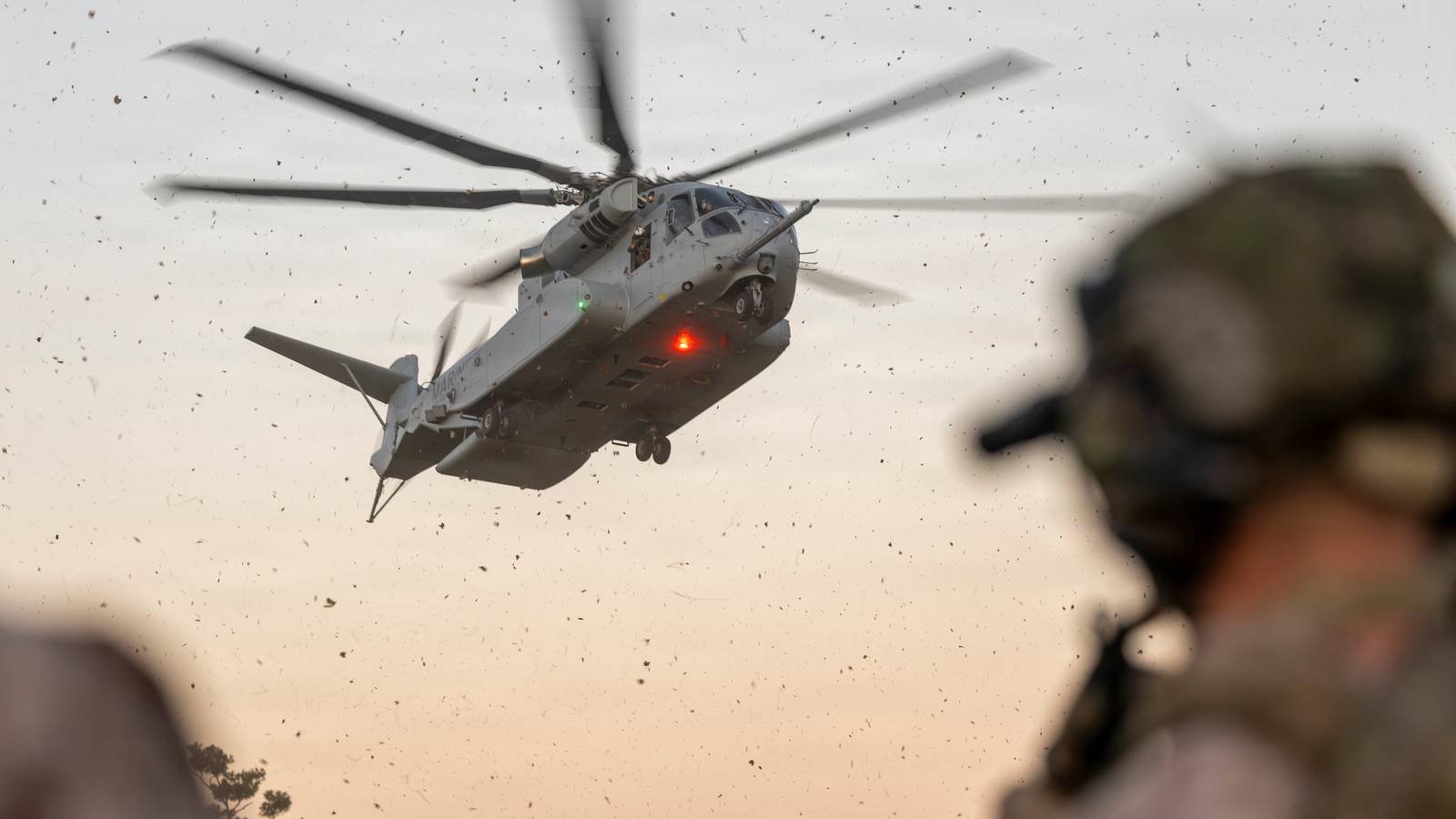
Its next upcoming deployment with the Kearsarge Amphibious Ready Group will include some new additions: the Amphibious Combat Vehicle, the Sikorsky CH-53K King Stallion and F-35B Lightning II. It marks the first time these all will be deployed with the 26th MEU.
“Our responsibility at the MEF is to ensure the MEU has the right personnel, equipment, capabilities and training to accomplish its mission,” Lt. Gen. Robert C. Fulford, commanding general of II Marine Expeditionary Force, said in a statement ahead of the upcoming deployment and ensuring proper training and equipment.
“The pre-deployment training program is a time-tested process. We must trust that process while remaining flexible enough to address emerging opportunities and challenges,” Fulford added.
The MEU will also employ Organic Precision Fires-Light, which provides infantry formations with a portable loitering munition capability that combines reconnaissance, surveillance and target acquisition with precision strike.
King Stallion Specs and Purpose
The CH-53K King Stallion is an optimized vertical, heavy-lift, sea-based, long-range solution for the naval force, with officials telling Military.com that it provides three times the lift-range capability of the CH-53E.
It also offers a greater external payload of a maximum 36,000 pounds, more than any current or emerging rotorcraft at sea level and high-altitude conditions.

Officials describe it as “the heavy-lift, long-range logistics support backbone for the U.S. Marine Corps.”
“The Marine Corps heavy-lift community provides commanders the mobility needed to mass combat power anywhere on the battlefield,” Marine Corps Capt. Jacob Sugg told Military.com. “It provides logistical support by moving the heavy equipment and supplies needed to sustain a force in environments where surface connectors are not feasible.”
“Demand for the CH-53K is surging because it is the only platform capable of certain high-priority missions. By conducting long-range aircraft recovery and supporting expeditionary bases, the CH-53K demonstrates its strategic importance,” Sugg added.
26th MEU ‘Grew as a Family’
The recently completed composite brought together the Battalion Landing Team 1st Battalion, 8th Marines, serving as the ground combat element; Marine Medium Tiltrotor Squadron 261 (reinforced), serving as the aviation combat element; and Combat Logistics Battalion 22, serving as the logistics combat element.
Together, all operating under the 26th MEU Command Element aligned four cohesive elements for the greater MAGTF: command and control, ground combat, aviation and logistics capabilities.

“The 26th MEU, call sign Proteus, grew larger as a family after compositing the command element, ground, aviation and logistics Marines and Sailors as one integrated MAGTF,” Col. Michael Stansberry, commanding officer of the 26th MEU, said in a statement.
“We look forward to the pre-deployment program, where we will integrate with our naval counterparts at PHIBRON 4 to build war fighting readiness and capabilities to provide combatant commanders an all-domain, adaptable and lethal sea-based force. Team Proteus will come to fight and win and live up to our mantra: ‘A Certain Force in an Uncertain World,'” he added.
Ahead of the deployment, Marines and sailors across the MAGTF will train together “through progressively complex events designed to build interoperability and prepare” the MEU for deployment.
The 26th MEU will continue its pre-deployment training program and future deployment, in part, by increasing naval integration while aboard the USS Kearsarge (LHD 3), USS Arlington (LPD 24) and USS Tortuga (LSD 46).
