

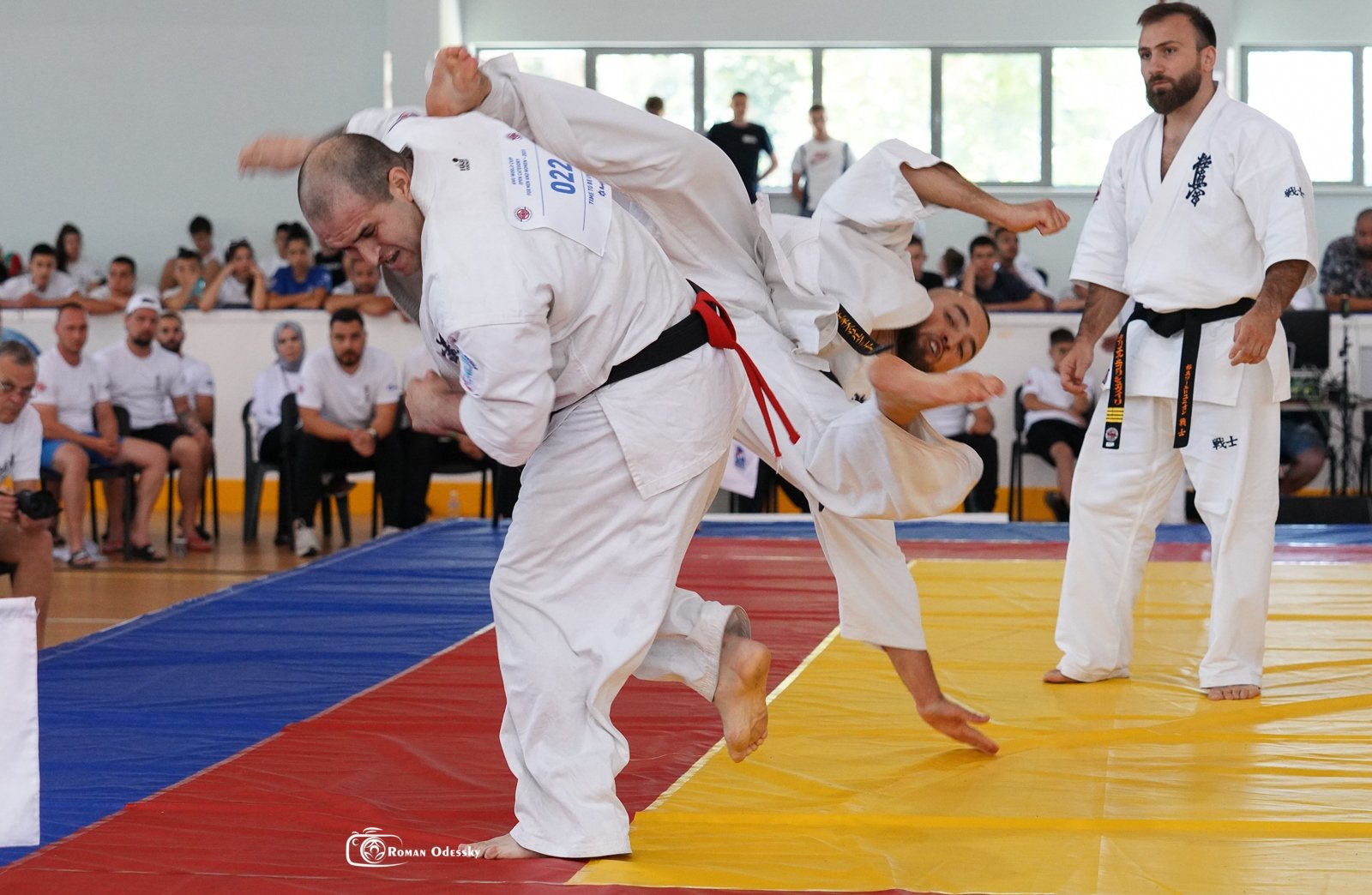
Kihon is often translated simply as “basics.”
For beginners, that can make it sound like something temporary — a stage you complete before moving on to the “real” part of karate.
But in Kyokushin, kihon is not something you leave behind when kumite begins.
It is the foundation underneath almost everything that happens in a fight.
The stance may change.
The movement becomes less formal.
The techniques become shorter, faster and more practical.
But the mechanics remain.
Kihon Teaches the Body How to Move
Basic training develops the fundamental movements that later appear under pressure.
Through repeated practice, karateka learn how to:
- generate power from the hips
- maintain balance while striking
- coordinate the upper and lower body
- transfer weight efficiently
- recover after a technique
- control distance
- maintain posture while attacking
In kihon, these movements are often exaggerated.
That is intentional.
Large, clear movements make it easier to understand the mechanics before those mechanics are adapted to faster and more compact fighting situations.
The Technique Will Not Look Exactly the Same
This is one of the most important points.
A technique performed during kihon will rarely look identical in kumite.
Take a basic seiken chudan tsuki.
During kihon, the punch may be performed from a stable stance with strong hip rotation, hikite and a clearly defined finishing position.
In kumite, the same movement becomes shorter and faster.
The fighter may be moving forward, absorbing an attack or immediately following with another punch.
The hand may not return all the way to the traditional hikite position.
But the important elements remain:
rotation, structure, alignment and power generation.
Kumite does not replace kihon.
It compresses it.
Seiken Tsuki: From Basic Punch to Fighting Combination
Body punching is one of the clearest examples of kihon appearing in Kyokushin kumite.
A fighter throwing combinations to the ribs or solar plexus still relies on the same principles developed through basic punching practice.
The hips rotate.
The shoulder follows.
The body weight moves into the strike.
The fist lands with correct alignment.
Experienced fighters simply perform these actions faster and with less visible preparation.
What looks like a simple short punch in a fight may be the result of thousands of repetitions of basic technique.
Mawashi Geri: The Same Mechanics at Higher Speed
The same principle applies to kicks.
A mawashi geri practiced in kihon develops:
- balance
- chamber
- hip rotation
- correct striking surface
- control of the supporting leg
- recovery after the kick
In kumite, the kick may become much more compact.
There may be almost no visible preparation.
A fighter can throw it from close range, after a punching combination or while the opponent is moving.
But the power still comes from the same mechanics.
Without the foundation built in basic training, speed alone rarely produces an effective technique.
Gedan Mawashi Geri and the Importance of Balance
The Kyokushin low kick is another good example.
In competition, gedan mawashi geri may look brutally simple.
Turn the hip.
Attack the thigh.
Repeat.
But effective low kicking requires excellent balance and body positioning.
If the supporting leg is poorly positioned or the hips are not engaged correctly, the fighter loses power and can become vulnerable to a counterattack.
The basic mechanics developed in kihon make it possible to attack hard without losing control of the body.
Hiza Geri: Structure at Close Range
Knees are often used at extremely close distance.
There is little time to prepare the technique.
The fighter must create power in a very small space.
That requires good posture, hip movement and balance — exactly the qualities trained through basic technique.
A fighter with poor structure may still lift the knee.
A fighter with strong kihon can drive the entire body behind it.
Blocks Become Smaller in Kumite
Traditional blocks are another area where the connection is sometimes misunderstood.
In kihon, techniques such as gedan barai, soto uke or uchi uke are usually practiced with large and clearly defined movements.
In kumite, those movements become much smaller.
A fighter rarely performs a full textbook block while standing in front of an opponent.
Instead, the basic movement may appear as:
- a small deflection
- a forearm shield
- a check against a body attack
- a movement that redirects a kick
- a short defensive action combined with footwork
The purpose of kihon is not to teach fighters to perform large formal blocks in competition.
It teaches the correct direction, structure and body mechanics behind defensive movement.
Stances Also Change
Nobody fights an entire kumite match from a deep formal stance.
But that does not make stance training irrelevant.
Traditional stances develop leg strength, balance and awareness of weight distribution.
In kumite, the stance becomes more natural and mobile.
The fighter needs to move forward, backward and sideways quickly.
Yet every transition still depends on the same fundamental question:
Where is your weight, and are you balanced enough to attack or defend?
That awareness starts with stance training.
Kihon Builds Habits Before Pressure Arrives
During a fight, there is no time to consciously think:
“Rotate the hip.”
“Keep the wrist aligned.”
“Move the supporting foot.”
The body must already know.
That is why repetition matters.
Kihon turns technical principles into physical habits.
When fatigue appears, when the opponent increases the pressure and when decisions must be made in fractions of a second, the fighter falls back on what has been repeated most often.
Good basics do not guarantee good kumite.
But weak basics usually become visible very quickly under pressure.
From Form to Function
Kihon and kumite should not be seen as two separate worlds.
Kihon teaches the movement.
Kumite tests whether that movement still works against resistance, timing, distance and pressure.
The technique becomes less formal, but the principles remain.
That is the real transition from basics to fighting:
the shape changes, but the mechanics survive.
A strong Kyokushin fighter does not abandon kihon when entering kumite.
He carries it into every punch, every kick, every defensive movement and every step.
