

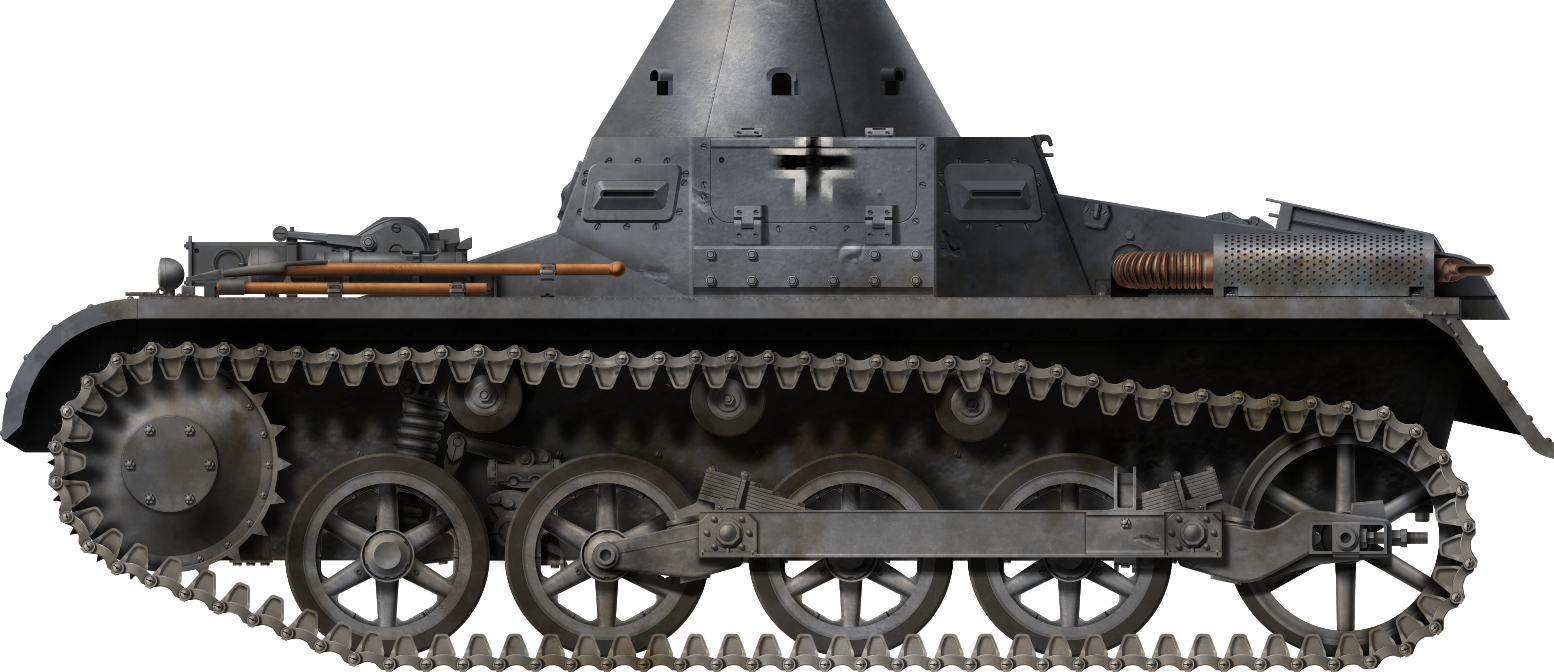
German Reich (1938-1945?)
Training Vehicle – At least two converted
Fighting a war on several fronts and being outnumbered by the Allies, the Germans were forced to modify their armored vehicles to fulfill various tactical roles. One of the more important aspects was creating training tanks. This was often done by simply removing the turret and superstructure. In some pre-war and early Second World War photographs, at least two modified Panzer I Ausf.As can be seen fitted with mock-up turrets. While their purpose is not fully known, nor their precise design or history, or even names, there is some evidence that could lead to an educated guess that these vehicles were intended as training tanks employed by the Germans in the early stages of the war.

Source: eBay

🔥What’s inside?
✔ All 12 issues in one bundle
✔ Available in PDF and EPUB formats
✔ Enjoy instant access to articles prepared by our team of dedicated writers and illustrators, covering the history of armoured vehicles from the 19th century to the present day, in-depth armored warfare analysis, rare vehicles, prototypes, and much more.
👉 Visit our online store and grab your bundle for only $46, and save $12 off the regular price of $57.89!
Context
Following their defeat in World War One, the Germans were forced to sign the Treaty of Versailles. This treaty imposed strict regulations on the size of the German Army and forbade the development of various military technologies, including tanks. This did not prevent the Germans from secretly experimenting with such vehicles during the 1920s. Early designs, such as the Leichttraktor (Eng. Light Tractor) and Großtraktor (Eng. Large Tractor), were little more than experimental testbed vehicles used to explore different ideas and concepts.

Source: Tank Archives
By the early 1930s, things began to change with the rise of Adolf Hitler, who openly argued for the expansion of German armed forces. At the time, the Western Allies (France and the United Kingdom) were dealing with their own internal problems and, for the most part, allowed Germany to proceed unchecked, failing to enforce the restrictions imposed by the Treaty of Versailles.
Even with support from the government and increased funding, designing a tank from scratch with little to no prior experience was not an easy task. As a result, German Army officials decided that early vehicles should be light and inexpensive to produce. After considerable development work, they introduced a vehicle known today as the Panzer I Ausf.A. This was a small two-man tank, lightly armored and armed. While far from a perfect vehicle, with its rather unreliable engine, weak armament of two machine guns, and thin protection, it was considered sufficient for mass production. It became the first German tank to be adopted prior to the outbreak of World War Two.

Source: panzernet
Nearly 1,200 Panzer I Ausf.As were built, and although it was not an impressive vehicle in terms of armor or firepower, it formed the backbone of early German armored forces. More importantly, it provided vital experience in the production, design, and operation of armored vehicles, experience that would prove instrumental for the development of more advanced tanks in the years that followed.
Modification Based On Panzer I Ausf.A Chassis
The German Army was quite aware of the Panzer I’s limitations as a combat vehicle, so these vehicles were often refurbished to perform other tasks. This went in two directions. The first involved official modifications and the reuse of the Panzer I chassis. The earliest attempts, predating the actual Panzer I tank, included omitting the turret and superstructure to create training vehicles. Another more common official modification was the maintenance tank variant, which in many cases involved reusing training tanks for that purpose or simply removing the turret. There were also other variants, such as using them as light anti-aircraft platforms.

Source: Panzernet
The second option consisted of numerous and often unclear field modifications carried out by frontline troops. By 1941, the Panzer I was hopelessly outdated in all aspects, and the surviving vehicles were often sent back to Germany or remained in small numbers at the frontline.
The troops that continued to use them, recognizing their limited usefulness in frontline combat, sometimes made extensive modifications to adapt them for various secondary and often non-combat roles. However, many of these modifications were poorly documented, if at all, and in numerous cases, their original purpose remains unknown.

Source: eBay
Among the various field and official modifications made to the Panzer I chassis, many are often poorly documented, either due to the loss of wartime documentation, a lack of interest from postwar authors, or simply because no one bothered to record their existence. Often, such modified vehicles would have been completely forgotten were it not for surviving photographs that provide evidence of their existence. One such rather unusual and undocumented modification involved a Panzer I Ausf.A that had its turret replaced with a new design equipped with several observation ports.
Source: eBay
Known History
This interesting vehicle is unfortunately not recorded in any available sources. The photograph itself, however, gives us a clue that this was a pre-war or at least an early-war modification. The image shows the vehicle located at what appears to be some sort of military barracks or warehouse. A German tank crew member can be seen standing next to an aging MG 08 machine gun.
Despite the somewhat common misconception that, by the outbreak of the Second World War, the German infantry was fully equipped with the new and modern MG 34, this was not the case. While this weapon was revolutionary, as it represented a light machine gun capable of combining several different roles into a single platform (use in tanks, as a light anti-aircraft weapon, infantry support, etc.), it was also fairly expensive to produce and could never fully equip all German units. As a supplement, older pre-World War One machine guns, such as the MG 08, had to remain in frontline service. The MG 08 was also issued to rear-area, second-line troops and used extensively for training purposes.
Another indication that this was a pre-war modification was luckily discovered by the author. During research on this vehicle, the author accidentally came across not one, but two such vehicles being used by the 1st Panzer Regiment of the 1st Panzer Division on training grounds. The photograph was published in the book Panzer IV written by T. Anderson. According to the author, the photograph was taken in 1938, which at least gives some timeline to work with. Unfortunately, apart from this, nothing else is mentioned about this vehicle.

Source: T. Anderson (2021) Panzer IV
A Possible Training Tank Variant
While there may be a historical timeline indicating when these vehicles were constructed, their purpose is not immediately apparent. If they were not built during the war, then it must be assumed that they were not intended as direct frontline modifications. This would suggest that they were not designed to perform any combat role, but rather to serve in a supporting capacity instead.
There are several possible reasons why such conversions were made. They may have served either as command or observation vehicles. While Germany was not the first nation to use command tanks, nor the first to experiment with such vehicles, the Germans were among the first to produce them in greater numbers and issue them to their armored divisions. These early designs were based on the Panzer I Ausf.A and Panzer I Ausf.B (referred to simply as the Befehlspanzer I).

Source: www.facebook.com
If these modified vehicles were intended for such a role, their design was rather unusual. While the overall shape of command tanks based on the Panzer I changed over time, they were most commonly fitted with an enlarged superstructure to provide additional room for radio equipment. The modified Panzer I in question only appears to have received a new turret and does not seem to feature any visible radio antenna mounts, indicating that it was likely not intended to serve as a command tank.
An alternative explanation is that they may have been intended for use as artillery observation vehicles. The Germans employed such vehicles later in the war, based on larger Panzer III chassis. The purpose of these vehicles was to follow advancing German tanks and, with specialized equipment, identify and relay information about enemy strongpoints that needed to be neutralized with supporting artillery fire. Once again, the modified Panzer I was simply too small for such a role. Furthermore, at this stage of the war, the Germans lacked sufficient mobile self-propelled artillery, and the concept of such coordinated operations had not yet been fully developed or implemented.
Probably the simplest explanation is that these were intended as training tanks. The German Army had early on recognized the importance of properly training its tank crews and took steps to develop suitable training vehicles for this role. Early training tanks usually consisted of modified Panzer I vehicles with no superstructures and turrets. At some point, crews would need to train on real, fully-equipped vehicles, and these modifications may have served the purpose of easing the transition from open-topped trainers to fully-enclosed combat vehicles.
There is another aspect to this point. Using a fully-equipped tank for training would have required valuable fuel. While this may seem like a trivial concern, the Germans at the time viewed it very differently. When designing tanks for training purposes, they wanted to make them as light as possible. The reduction in weight helped decrease fuel consumption to some extent. Even before the outbreak of war in Europe, Germany faced serious fuel shortages that affected tank crew training. Because of this, training vehicles were sometimes equipped with mock-up turrets made of wood instead of fully-functional steel ones.
This is confirmed by author W. Fleischer (Fahrschulpanzer der Wehrmacht 1935–1945), who described larger Panzer IV vehicles being utilized in the same training role. Some of them were modified with multi-sided mock-up turrets fitted with observation ports. This design appears somewhat similar to the modified Panzer I, suggesting that they may have been employed for the same purpose.

Source: W. Freischer Fahrschulpanzer der Wehrmacht 1935-1945
VK 20.01 (D)
An interesting side note to point out is that the Panzer I training tanks were sometimes, during the war, outfitted with mock-up turrets that were intended to resemble larger tanks, such as the Panzer III. Due to fuel shortages, these were often powered by gas or wooden generators.

Source: Reddit
Name
The precise designation of these modified vehicles was never recorded, and the exact one remains unknown. If these were indeed modifications intended to create training vehicles, they would most likely have been designated as Fahrschulpanzer I (Eng. Driving school tank). Since early training tanks were generally based on modified tanks (from the Panzer I to Panzer IV) that lacked a turret or superstructure, the addition of a mock-up turret would likely have resulted in a somewhat modified designation, such as Fahrschulpanzer I mit Attrappen-Turm (Eng. Driving school tank with mock-up turret).
For the sake of clarity, this vehicle will be referred to as Fahrschulpanzer I mit Attrappen-Turm from this point onward, even though it cannot be stated with complete certainty that they were designed for this role. Nevertheless, this remains the most likely explanation for their intended use.
Production
As these were probably not official modifications, it is very unlikely that any record of their conversion was made. Thus, it cannot be certain how many were actually converted in this manner or whether they were used by other units. What is known, based on surviving photographs, is that at least two vehicles appear to have been modified in this way.
In general, the conversion would have been relatively simple, requiring only the removal of the original turret and the installation of the new mock-up turret. The mock-up turret was possibly built out of wood, which would have made its construction fairly inexpensive.
Design
Chassis
The overall design of this vehicle would have been similar to that of the standard Panzer I Ausf.A. This meant that its chassis design would have remained the same, featuring a front-mounted transmission, a centrally positioned crew compartment, and a rear-mounted engine.
Armor
The Fahrschulpanzer I mit Attrappen-Turm armor consisted of welded rolled homogeneous hardened plates, with the thickest sections reaching 14.5 mm. The glacis was 8 mm thick, while the bottom was only 5 mm thick. It can be assumed that the new turret was not armored, given that it was likely a mock-up. Realistically, for such a training vehicle, there was no need to use armored plates, as it would only have added unnecessary cost, and simple wooden panels could perform the same role much more cheaply and easily.
Suspension
The Fahrschulpanzer I mit Attrappen-Turm used an unmodified Panzer I Ausf.A suspension. It consisted of five road wheels on each side. The last road wheel, which was larger than the others, acted as the idler. The first wheel used a coil spring mount with an elastic shock absorber in order to prevent any outward bending. The remaining four wheels (including the last larger wheel) were mounted in pairs on a suspension cradle with leaf spring units. There was one front drive sprocket and three return rollers per side.

Source: worldwarphotos
Engine
The Fahrschulpanzer I mit Attrappen-Turm was powered by the same Krupp M 305 four-cylinder engine, producing 60 hp at 2,500 rpm. Its overall performance would have remained largely unchanged, with a maximum speed of 37.5 km/h. While the standard Panzer I weighed around 5.4 tonnes, the removal of the turret would very likely have resulted in some weight reduction, although the precise figure remains unknown. This reduction in total weight may have led to only a negligible improvement in maximum speed and overall performance.
Superstructure
The superstructure was yet another aspect left unchanged, as there was no need to modify it. It retained the same eight-sided design, with the driver’s front-mounted vision port. On the left side, there were two smaller vision ports and an escape hatch for the driver. Two additional observation ports were located at the rear and on the right side.
One unusual minor feature was the positioning of the Balkenkreuz marking. It was painted on the left side of the vehicle, but instead of being placed at the center of the side armored plate, it was positioned off-center, closer to the top.

Source: Private Collection of Christian Ankerstjerne

Source: eBay
Turret
The turret of the Fahrschulpanzer I mit Attrappen-Turm was the most noticeable change made to the vehicle from a base Panzer I Ausf.A. The original Panzer I turret with its twin machine guns was removed, possibly for training purposes. In its place, was what appears to have been a six- or eight-sided, possibly fixed, mock-up turret, mounted on top of the superstructure. Each of its sides (at least those visible in the photograph) appears to have been fitted with an observation port and a small round cap positioned above them. The top of the turret was either open or fitted with an escape hatch, with the latter seeming more plausible. The new turret was possibly made of wood or thin sheets of metal.

Source: eBay
Armament
Given that Fahrschulpanzer I mit Attrappen-Turm was used as a training vehicle intended mainly to teach the crew how to properly operate a Panzer I, no armament was provided for this vehicle. There also appears to be no place where a weapon could be positioned in the new turret. It was simply too cramped and impractical to use the port as any kind of firing position, as there would be very little room to operate a machine gun or other weapon.
Crew
Given the unclear purpose of the vehicle and the scarcity of records and sources on it, it is hard to establish the number of crewmembers. Had the Fahrschulpanzer I mit Attrappen-Turm been intended for training purposes, as suggested in this article, then at least a driver would have been present. On a Panzer there would have also been a commander, who, aside from commanding the tank, would have had to operate the armament inside the turret. It is possible that on the Fahrschulpanzer I mit Attrappen-Turm this position would have been for an instructor. It remains uncertain if a third person would have fit inside the small vehicle, allowing for full crew instruction.
Fate
The final fate of these Fahrschulpanzer I mit Attrappen-Turm is unclear. Luckily, once again, the surviving photograph of one of these vehicles gives a clue about their fate. One of the vehicles shows a German Balkenkreuz on its side. When the war broke out in 1939, German tank formations received a completely white Balkenkreuz for friendly identification. This, however, proved to be a poor choice, as it presented Polish gunners with an excellent aiming point. So after the Polish Campaign ended, the Germans added a large black cross inside the Balkenkreuz. This configuration became the standard marking for German armored ground vehicles throughout the war. This helps indicate that at least one vehicle remained in service in this configuration after 1939, and possibly even beyond that.

Source: worldwarphotos
Source: eBay
Eventually, the Panzer I remained in frontline service as a combat tank until 1941, largely because there were not enough more modern tanks available. By that point, it was hopelessly outdated in all aspects. Those that survived were often sent back to Germany or converted to other roles in the field, mostly as ammunition supply vehicles. Among these auxiliary roles, the Panzer I (Ausf.A and Ausf.B) would continue to serve as a vital training vehicle in various configurations, mostly without its upper superstructure, until the final days of the war.
The importance of training tanks to the German Army would grow throughout the war, with nearly all types of tanks having a suitable training variant. These mostly consisted of prototypes or vehicles returned from the frontline for major overhauls.

Source: worldwarphotos
Conclusion
While the history and purpose of this vehicle remain unclear due to the lack of sources, it can be assumed, based on the design of the turret, that it was intended for use as a training vehicle. While there is no concrete evidence regarding their effectiveness or their ultimate fate, the Fahrschulpanzer I mit Attrappen-Turm would most likely have played a vital role in training German tank crews.
Germany’s strong focus on preparing crews to an optimal standard played a more important role than the overall design and firepower of its tanks. Training and coordination within the crews gave the German tank forces an edge over the Allies in the early stages of the war. Thus, it can be said that the few produced Fahrschulpanzer I mit Attrappen-Turm likely played at least some part in this training system.

| |
| Crew | 2 (driver and instructor) |
| Weight | 5.4 tonnes (based on Panzer I Ausf.A) |
| Dimensions | Length 4.9 m, Width 2.7 m, Height 2.41 m (based on Panzer I Ausf.A) |
| Engine | 60 hp at 2,500 rpm. Krupp M 305 four-cylinder engine |
| Speed | 37.2 km/h (road) |
| Armament | None |
| Armor | 5-14.5 mm |
