

Story
October 02, 2026

The Combined Joint All-Domain Command and Control (CJADC2) initiative is changing how U.S. and allied forces operate across every domain: land, sea, air, space, and cyber. Its success depends on networks that stay secure under pressure, supporting faster, unified decisions in contested environments. In the emerging quantum era, where adversaries are racing to surpass U.S. cryptographic strength, maintaining that security has become a front-line priority. Every CJADC2 function, from sensor feeds to coalition links, relies on the integrity of information. Defense organizations should develop transition roadmaps, complete cryptographic inventories, train personnel, and work with vendors to accelerate deployment of proven, secure solutions.
Combined Joint All-Domain Command and Control (CJADC2) systems must perform in denied, disrupted, intermittent and limited (DDIL) environments, where bandwidth drops, latency spikes, and communications falter. U.S. Department of Defense (DoD) planners describe CJADC2 as a mesh of capabilities built to persist through degraded conditions, keeping forces connected even when parts of the network fail. On the ground, warfighters are already testing low-Earth-orbit satellites, mesh networking, and tactical cloudlets to keep decision data moving despite jamming and interference.
Quantum computing adds a new layer of risk. Adversaries use “harvest now, decrypt later” tactics, storing encrypted data today with the expectation that future quantum systems will unlock it. Long-lived classified information faces the greatest risk. Even if scalable quantum computers are years away, the tactic makes quantum-ready protection an immediate operational requirement.
Legacy systems compound the challenge, as these older approaches lack the resilience and speed today’s missions demand. Encryption is often hard-coded deep in fielded platforms, IoT [Internet of Things] devices, and weapons systems, making the need for modernization unavoidable.
Quantum-resistant clouds and zero-trust frameworks
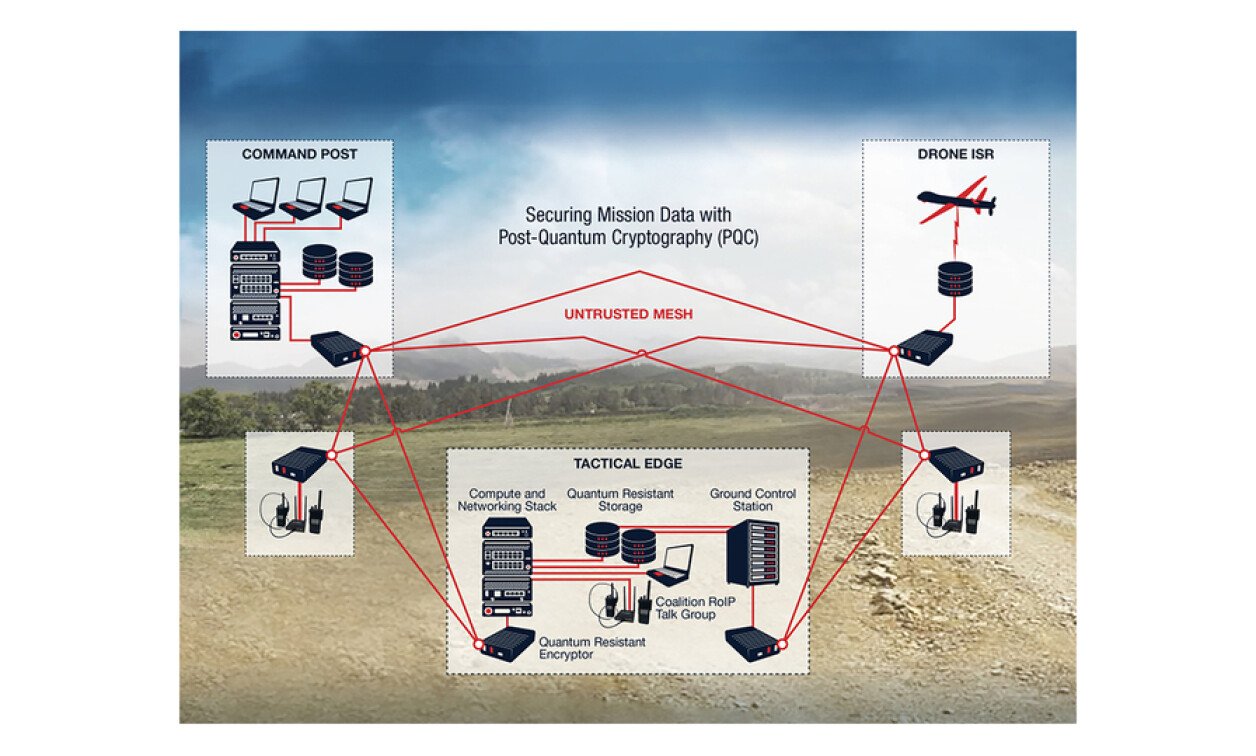
A layered approach that pairs quantum-ready encryption with zero-trust architectures that scale from the tactical edge to enterprise clouds provides a path forward.
At the edge, operators must encrypt data before it reaches storage to preserve confidentiality in harsh DDIL conditions. NIST [National Institute of Standards and Technology] post-quantum cryptography standards (CRYSTALS-Kyber for encryption, CRYSTALS-Dilithium for signatures) and the NSA [National Security Agency] Commercial National Security Algorithm Suite (CNSA) 2.0 now guide the DoD’s migration road map. Even if adversaries harvest data today, quantum-ready algorithms can defend it from future decryption attempts.
Zero-trust eliminates implicit trust inside networks, continuously verifying every user, device, and workload, no matter the location or privilege level. The DoD’s Zero Trust Strategy targets full component implementation by fiscal year 2027. Automated key management and microsegmentation reduce the blast radius of any intrusion and simplify coalition interoperability, where trust must be verified across national and organizational boundaries.
Integrated AI-based automation enhances this model by detecting anomalies in real time, enforcing policy at machine speed, and reducing operator workload at the tactical edge. Systems must scale from body-worn sensors to mobile data centers, operating seamlessly across all domains. Edge-to-cloud scalability ensures that operators can maintain mission continuity even under infrastructure or connectivity constraints.
Preparing for the quantum era
Quantum security is no longer theoretical: NIST finalized its first set of Post-Quantum Cryptography (PQC) standards in 2024, and the White House has directed federal agencies to complete migration by 2035. The NSA has mandated PQC adoption for all national-security systems. Across the DoD, cryptographic inventories are underway to identify vulnerable systems, and planners anticipate major retrofit challenges where algorithms are hard-coded into deployed hardware.
Practical steps include:
- Conduct cryptographic inventories to identify vulnerable systems.
- Develop quantum-readiness roadmaps that prioritize PQC transitions in high-value networks.
- Implement recovery capabilities to restore compromised or deleted data without operational delays.
- Provide continuous operator training so cyber defenders, commanders, and tactical units can apply PQC and zero-trust procedures under realistic, contested conditions.
Current DoD and NIST guidance emphasizes recovery as central to resilience. Compromised or deleted data must be restorable with minimal disruption to sustain command continuity in degraded or contested networks. Yet technology alone cannot guarantee protection; encryption and zero-trust architectures are only as strong as the people applying them. Routine exercises that reinforce credential
management, cyber hygiene, and recovery drills turn doctrine into habit, building the muscle memory needed to stay effective against quantum-era threats.
Readiness in multidomain operations
Securing CJADC2 depends on consistent execution across services and partners as much as on technology. Continuous training – reinforced through live/virtual/constructive (LVC) environments – ensures that operators understand both
the technology and doctrine of quantum-ready, zero-trust operations. Such integration reduces errors, sharpens reaction speed, and supports secure execution across the joint force.
Training should also aim to reduce human error and establish clear, repeatable procedures that coalition partners can execute consistently, supporting secure collaboration and interoperability across national boundaries.
The result: preserved decision advantage, reinforced coalition trust, and sustained operational superiority. A commander at the tactical edge can still issue secure orders under jamming, a coalition partner can share intelligence without fear of compromise, and a joint task force can keep tempo against a peer adversary intent on exploiting every vulnerability.
Industry momentum
Across the defense industry, quantum readiness and zero-trust have moved from abstract goals to field demonstrations. Joint exercises now show resilient, encrypted, and scalable architectures functioning in contested environments. Service initiatives continue to validate secure multidomain data fusion, any-sensor-to-any-shooter integration, and autonomous edge operations.
Momentum has shifted from research to field validation. Quantum-ready encryption, zero-trust enforcement, and scalable cloud architectures now appear in live demonstrations, operational trials, and emerging doctrine. The foundation for securing CJADC2 is taking shape in practice, not theory.
Securing the tactical edge
The quantum era has arrived. In that environment, quantum-resistant encryption, zero-trust frameworks, and continuous operator training are mission requirements, not merely options. Defense organizations should develop transition roadmaps, complete cryptographic inventories, train personnel, and work with vendors to accelerate deployment of proven, secure solutions.
Acting now enables CJADC2 to scale securely across all domains, protect sensitive data for decades, and preserve U.S. and allied advantage at the tactical edge..
Anthony Verna is Senior Vice President and General Manager of Cubic DTECH Mission Solutions at Cubic Defense. Before assuming his current role, Anthony spent nearly 10 years leading strategy and business development for Cubic Mission Solutions. He previously held senior leadership roles at CACI, ManTech, and Comptek. Anthony studied information systems at Thomas Edison State College (N.J.) and completed The Wharton School’s General Management Program as an Aresty Scholar.
Cubic DTECH Mission Solutions
Featured Companies

Cubic
San Diego, CA 92123
