

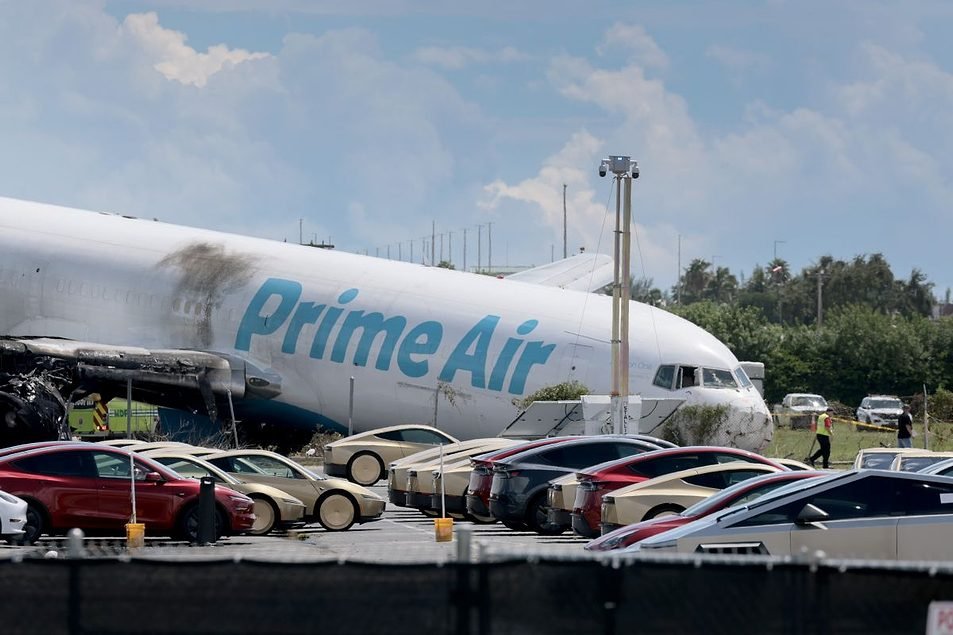
An air traffic controller didn’t provide an Amazon.com Inc. cargo plane with wind information prior to it crashing at Miami International Airport last month, killing five people on the ground, according to accident investigators.
The controller who was responsible for arrivals and departures on the runway the Amazon jet was approaching gave the aircraft clearance to land but didn’t disclose that information, according to the preliminary report released by the U.S. National Transportation Safety Board on October 1. U.S. Federal Aviation Administration procedures require controllers to provide wind direction and velocity when a tailwind exists.
About four minutes prior to giving landing clearance to Flight 7598, operated by Amazon subcontractor 21 Air LLC, the controller did supply information on the wind when asked by another flight, but the Amazon jet was not on the controller’s frequency.
The cargo plane overran the Miami airport’s runway after arriving from Luis Muñoz Marín International Airport in San Juan, Puerto Rico, on September 6. The Boeing Co. 767 jet continued past the paved runway surface, striking airport navigational equipment before plowing into two vehicles.
“We are reviewing the information in the NTSB preliminary report closely, alongside our own internal safety and operational protocols, and we will take all appropriate action to improve our safety based on the facts as they are established,” 21 Air said in a statement.
“We remain committed to supporting the NTSB’s ongoing investigation and ask that any questions related to it be directed to them,” Amazon spokesperson Kelly Nantel said.
One of the pilots cautioned that the plane was “too fast” as it approached the runway, according to audio captured by the aircraft’s cockpit voice recorder and previously released by the NTSB. The audio also recorded a pilot calling for a go-around — a procedure in which a plane aborts a landing attempt and climbs back into the sky — after registering a sound similar to the aircraft touching down.
In the preliminary report, the NTSB said the captain who was flying the aircraft had about 7,267 total hours of flight experience, of which 150 hours were in the same make and model as the airplane that crashed. The first officer, the pilot monitoring, had about 2,800 total hours.
It’s not clear from the voice recorder information released by the agency which individual was speaking at different points in the transcript.
Amazon suspended its work with 21 Air following the crash. “After the tragic incident last weekend, we’ve spent time supporting the investigation and reviewing some of the surrounding circumstances, and we’ve decided to pause our operations with 21 Air,” the company said last month.
