

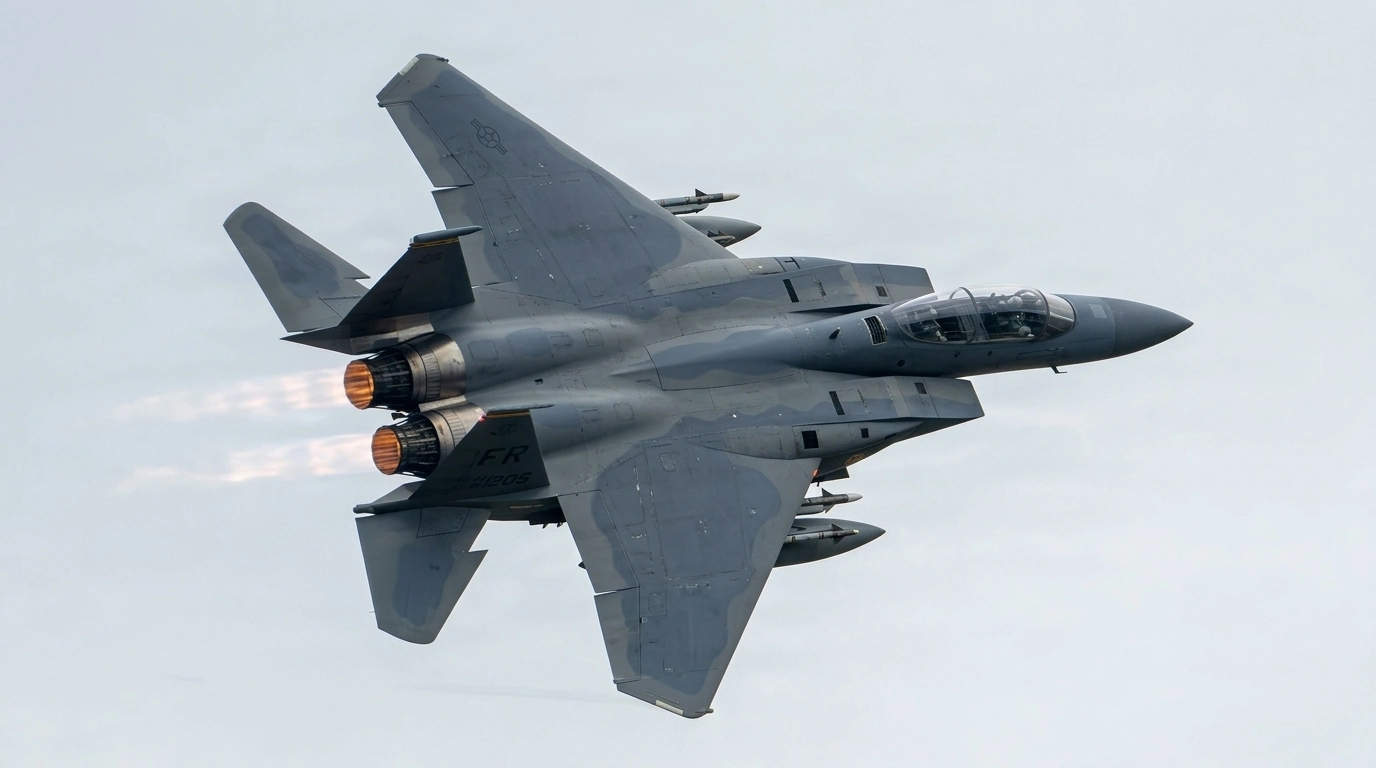
The F-15C Eagle was built around one goal: air superiority.
Its formula was straightforward. Two powerful engines, a large wing, a strong radar and enough weapons to engage targets at different ranges. The design gave the fighter speed and acceleration without sacrificing the ability to turn and retain energy.
The F-15C Eagle entered service in 1979 as an improved single-seat version of the Eagle. It carried more internal fuel than the earlier F-15A and became the main air-superiority variant for the U.S. Air Force.
Then came the combat record.
During Operation Desert Storm, U.S. F-15Cs flew 5,685 sorties and accounted for 36 of the 42 Iraqi aircraft defeated in air-to-air combat.
So what made the F-15C Eagle so effective?
The answer wasn’t one feature. It was how the engines, airframe, radar and weapons were designed to work together.
What Is the F-15C Eagle?
The F-15C Eagle was the version that turned the original F-15 concept into the USAF’s main single-seat air-superiority fighter.
The basic F-15 had already entered service in the 1970s, but the C model brought useful changes rather than simply repeating the first design. Production of the F-15C and two-seat F-15D began in 1979, with improvements to fuel capacity, weight, range, weapons and avionics.
That extra fuel mattered.
Air superiority isn’t just about how fast a fighter can fly. The aircraft needs enough endurance to reach its patrol area, search for targets and still have fuel available when the fight develops. The F-15C Eagle’s increased internal fuel helped give the Eagle more room for that mission.
The C model also remained a dedicated air-combat aircraft. It wasn’t designed around carrying bombs first and fighting second. That focus shaped almost everything about the aircraft, from its large wing to its powerful twin-engine layout.
And the numbers tell part of the story.
The F-15C Eagle had a maximum takeoff weight of about 68,000 pounds, while its twin Pratt & Whitney F100 engines provided the thrust needed for high acceleration and climb performance. Its radar and missile systems also allowed it to engage targets beyond visual range.
But calling the F-15C Eagle simply a “fast fighter” misses the bigger picture.
The aircraft was designed to preserve energy. It could accelerate, climb and maneuver while keeping enough performance in reserve for the next move. That’s a major reason the Eagle became such a difficult opponent in air combat.
The result was a fighter with a very clear job.
Find the enemy, gain the advantage, and keep enough speed and energy to control what happens next.
F-15C Eagle Specifications and Design
The F-15C Eagle’s specifications make one thing clear: this was a large fighter built around performance, not compactness.
| Specification | F-15C Eagle |
| Crew | 1 |
| Length | 63 ft 9 in |
| Wingspan | 42 ft 10 in |
| Max takeoff weight | 68,000 lb |
| Maximum speed | About Mach 2.5 |
| Service ceiling | About 65,000 ft |
| Engines | 2 × Pratt & Whitney F100 |
| Internal cannon | M61A1 20 mm |
| Primary role | Air superiority |
The numbers only become useful when you connect them to the design.
Two F100 engines gave the F-15C Eagle the thrust needed for rapid acceleration and climb. Its large wing also provided plenty of lifting area, helping the aircraft retain strong performance during maneuvering.
That combination was unusual for a fighter of its era.
The Eagle was big, but it wasn’t simply a heavy aircraft with powerful engines. The airframe was shaped to turn that engine power into speed, climb performance and maneuverability. The National Museum of the U.S. Air Force notes that the Eagle could accelerate during a vertical climb because of its high thrust and favorable airframe design.
Its speed was another major advantage. The F-15C Eagle could reach roughly Mach 2.5, although that figure does not mean pilots routinely flew at maximum speed during combat.

That’s a common mistake when reading fighter specifications.
Maximum speed is only one part of the equation. For an air-superiority fighter, acceleration, climb rate, turn performance and the ability to retain energy can matter more than the top number on a specification sheet.
The F-15C Eagle also carried an internal M61A1 20 mm cannon, while its external stations allowed it to carry a mix of air-to-air missiles.
So the specifications don’t explain the Eagle’s reputation by themselves.
They show the ingredients. The real advantage came from how those ingredients worked together.
How Did the F-15C Eagle Become So Maneuverable?
The F-15C Eagle was powerful in a dogfight because it could keep its energy while maneuvering, not simply because it could turn hard.
That starts with the engines. Two Pratt & Whitney F100 turbofans gave the Eagle enough thrust to accelerate quickly and climb aggressively. The large wing then helped the aircraft generate lift without forcing the pilot to trade away all of that speed during a turn.
This combination gave the F-15C Eagle a useful advantage: energy could be regained quickly.
A fighter that turns tightly but loses too much speed can become vulnerable on the next move. The Eagle’s high thrust-to-weight ratio helped reduce that problem. The pilot could pull into a maneuver, lose some speed, then use engine power to rebuild energy.
The airframe had another trick.

The F-15 was designed with a large wing and relatively low wing loading for its size. That helped it generate strong lift during maneuvering. The National Museum of the U.S. Air Force notes that the Eagle could turn tightly without rapidly losing airspeed and could accelerate during a vertical climb.
The famous Streak Eagle program demonstrated just how much performance was built into the design. In 1975, the test aircraft set eight time-to-climb records, reaching 98,425 feet in 3 minutes and 27.8 seconds from brake release.
That wasn’t a normal F-15C Eagle combat mission, so it shouldn’t be treated as a direct measure of operational performance. But it exposed something important about the underlying airframe.
The Eagle had serious excess power.
And that’s the part I find more interesting than its Mach 2.5 top speed. Maximum speed looks impressive on a specification sheet. Excess power is what helps a fighter control the fight.
The F-15C’s maneuverability came from the whole package: thrust, wing area, airframe balance and control authority working together. Remove the engines or the wing, and the famous performance story changes dramatically.
What Radar and Weapons Made the F-15C So Effective?
The F-15C Eagle’s radar and weapons turned its raw speed into a real air-combat advantage.
The original Eagle used the AN/APG-63 radar, a pulse-Doppler system designed to detect and track aircraft against ground clutter. That look-down capability mattered because an enemy flying low could otherwise disappear into the radar return from the terrain. The radar fed target data into the aircraft’s central computer, which then helped the pilot manage the engagement through the cockpit displays.
The weapons fit the same idea.
The F-15C Eagle could carry AIM-7 Sparrow, AIM-9 Sidewinder, and AIM-120 AMRAAM air-to-air missiles, along with an internal M61A1 20 mm cannon. Later upgrades made the aircraft far more capable with newer versions of those weapons and improved mission computers.
The AIM-120 was especially significant because it gave upgraded F-15Cs an active radar-guided missile option for beyond-visual-range combat.
In 2021, an F-15C used an AIM-120 during a test at Tyndall Air Force Base and set what the Air Force described as the longest known air-to-air missile shot at the time.

The radar story also changed over the aircraft’s long service life.
Some F-15C Eagles received the APG-63(V)3 AESA radar, replacing the older mechanically scanned antenna. The upgrade improved reliability and radar performance while giving the aircraft stronger multi-target capabilities.
And there’s a useful example of how far the old Eagle could be pushed.
In 2021, an F-15C Eagle fitted with a Legion Pod infrared search and track system combined IRST data with the APG-63(V)3 radar to guide an AIM-120 against a QF-16 target. The test showed that the aircraft could build an engagement using passive infrared tracking rather than depending entirely on radar emissions.
That’s the real story behind the F-15C Eagle’s weapons suite.
The airframe supplied speed and maneuverability. The radar found the target. The computer organized the information. The missile then extended the fighter’s reach far beyond what the pilot could see with the naked eye.
How Did the F-15C Eagle Perform in Combat?
The F-15C Eagle’s combat record matters because it shows what the design could actually do outside a test range.
The clearest example came during Operation Desert Storm in 1991. According to the U.S. Air Force, F-15C Eagles accounted for 34 of the 37 Air Force air-to-air victories during the conflict.
Those numbers are impressive, but they don’t tell the whole story.
The Eagle entered combat with a strong mix of radar detection, beyond-visual-range missiles and high-end flight performance. That allowed pilots to find and engage Iraqi aircraft before many fights became close-range turning battles.
The aircraft also benefited from the larger air campaign around it. AWACS aircraft helped track coalition and opposing aircraft, while the F-15C Eagle brought its own radar and weapons into the engagement. The result was a fighter operating as part of a much larger information network.
Then came Kosovo.

On March 26, 1999, Capt. Jeff Hwang flew an F-15C during Operation Allied Force. He detected what first appeared to be a single radar contact, then identified two MiG-29s. Within 90 seconds, he launched two AIM-120 missiles from about 16 miles and scored two victories.
That’s a useful example because it shows the F-15C Eagle doing more than simply turning faster than another fighter.
The pilot had to detect the targets, sort the contacts, maintain the engagement and employ the missiles correctly. The aircraft’s radar, computer, cockpit displays and weapons all had to work together.
The Eagle’s famous 104-to-zero air-to-air record is often presented as proof that the aircraft was unbeatable. The number comes from official U.S. Air Force records, but it should not be read as a pure measure of aircraft design. Training, tactics, support aircraft, weapons and the wider battle environment all mattered.
Still, the record is hard to dismiss.
The F-15C Eagle repeatedly gave pilots the tools to detect, position and engage opponents effectively. That’s where its reputation was really earned.
How Was the F-15C Eagle Upgraded Over the Years?
The F-15C Eagle stayed useful because the Air Force kept replacing its electronics while keeping the proven airframe.
That distinction matters. The Eagle’s basic shape dates back to the 1970s, but its combat systems did not remain frozen in that era.
One major step was the Multi-Stage Improvement Program, or MSIP. The program added improvements to the aircraft’s central computer, radar, electronic warfare equipment and weapons control systems. The first production MSIP F-15C entered service in 1985.
Then the radar became a major upgrade path.
Some F-15C Eagles received the AN/APG-63(V)2 AESA radar, followed by the more advanced APG-63(V)3 on other aircraft. Unlike the original mechanically scanned radar, AESA uses many small transmitter and receiver modules, allowing the radar to perform multiple tasks with faster electronic beam steering.
Weapons changed too.

The arrival of the AIM-120 AMRAAM gave upgraded F-15Cs an active radar-guided missile for beyond-visual-range engagements. That changed the aircraft’s combat options far more than simply adding another missile to the weapons list.
Later upgrades also added passive sensing. Some F-15Cs were tested with the Legion Pod, an infrared search and track system that could detect and track aircraft without relying entirely on radar emissions. In 2021, an F-15C used Legion Pod data with its APG-63(V)3 radar during an AIM-120 test against a QF-16.
But there was a limit no software update could solve.
The airframe itself was aging.
Many F-15C Eagles had accumulated decades of flight hours, and structural fatigue became a growing concern. The Air Force eventually began retiring aircraft that required costly structural work, even though their combat systems could still be useful.
That’s the interesting part of the F-15C Eagle story.
The aircraft didn’t stay relevant because the 1970s design was left untouched. It stayed relevant because new radar, missiles, computers and sensors kept changing what that old airframe could do.
Why Is the F-15C Eagle Being Retired?
The F-15C Eagle is being retired for a simple reason: the airframe is getting old, even if the basic fighter design still works.
Some F-15C Eagles have spent decades flying demanding missions. Routine depot inspections eventually began finding structural fatigue and cracks in critical parts of the aircraft. In several cases, the Air Force chose retirement rather than paying for extensive structural repairs.
That distinction matters.
The F-15C’s retirement isn’t a verdict on its engines, maneuverability or combat design. It’s mainly a question of age, maintenance cost and how much useful life remains in the airframe.
And the replacement isn’t a completely unrelated fighter.
The F-15EX Eagle II keeps the basic Eagle concept but adds modern avionics, electronic warfare systems, fly-by-wire controls and an open mission architecture that makes future upgrades easier. The Air Force’s FY2026 budget identifies the F-15EX as the aircraft replacing the F-15C/D fleet.

The transition is already visible.
At Kadena Air Base in Japan, the Air Force is preparing to replace its F-15C/D fleet with F-15EX aircraft. The first F-15EX designated for Kadena left Boeing’s St. Louis facility on August 28, 2026, with permanent arrivals scheduled to begin in fiscal year 2027.
That makes the F-15C Eagle’s story more interesting than a simple retirement notice.
The Eagle proved that a fighter built around air superiority could remain useful for decades when its radar, weapons and computers were repeatedly upgraded. But no software patch can erase metal fatigue.
That’s the lesson.
The F-15C Eagle isn’t disappearing because its original design failed. It’s leaving because the airframe eventually became the limiting factor. The F-15EX is essentially the next chapter, keeping the Eagle’s large, powerful airframe while replacing much of the technology and structure around it.
