

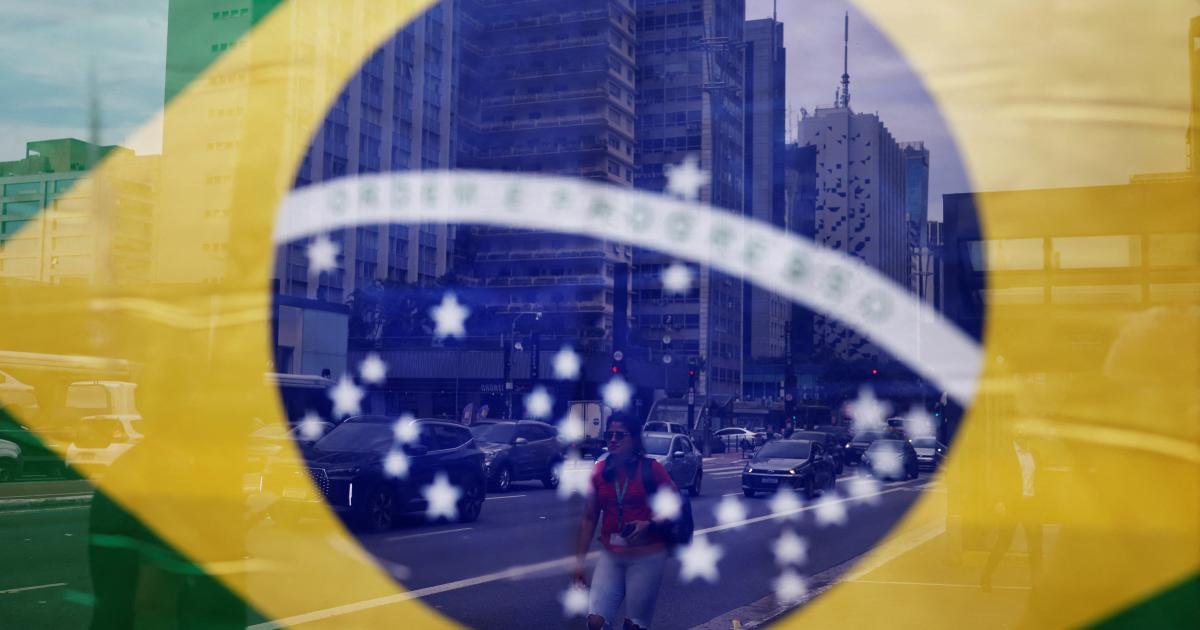
The Brazilian presidential election, which kicks off with a first round of voting on October 4, gives citizens a choice between radically different visions of politics. Luiz Inácio Lula da Silva, known as Lula, the standard-bearer of the Latin American left, seeks a fourth presidential term against Flávio Bolsonaro, the son of Jair Bolsonaro, the hard-right former president who was sentenced to 27 years in prison for attempting to overturn the results of the previous presidential election. The race is also a contest over how Brazil should conduct its foreign affairs: Lula emphasizes strategic autonomy, including through growing ties with China and other partners, while Flávio Bolsonaro favors close alignment with the Trump administration in the United States.
What unites the two candidates is the assumption that Brazil still has the freedom to choose its foreign policy strategy. Brazil’s vast resources, distance from active conflict, and influx of foreign direct investment should position it well to manage current global upheaval and great-power competition, and to effectively bargain for what it wants. But despite these valuable geopolitical assets, Brazil is losing global influence, and its autonomy to act is at risk. Major powers, including both China and the United States, are increasingly able to dictate their terms of engagement with Brazil. The country is also becoming isolated in South America, where it had until recently led the creation of regional institutions such as the trading bloc Mercosur. Its relationship with Argentina, for instance—which had helped underpin four decades of regional stability—has deteriorated to the point that neither country has an ambassador in the other’s capital.
Brazil is largely responsible for its waning sway. Much of the country’s influence depends on whether foreign partners believe that the deals it strikes today will be implemented tomorrow. That credibility, in turn, rests on the state’s capacity to commit—that is, its ability to mobilize the resources needed to fulfill its promises, coordinate public institutions effectively, and ensure that the bargains it makes survive democratic political turnover. A raft of domestic problems, including mounting fiscal constraints, a political system at war with itself, and widespread corruption, has made it harder for the state to deliver. A major scandal has now engulfed the Supreme Court, an institution meant to enforce rules impartially and which is therefore essential to the durability of Brazilian commitments. The Trump administration’s open meddling in Brazil’s domestic politics has compounded the country’s vulnerabilities by making any deal controversial and partisan and raising the likelihood that future administrations in both Brasília and Washington might try to reverse it.
Whoever wins the upcoming presidential election will inherit these sources of weakness. So far, the candidates have not offered any clear plan to address them. Neither a tilt toward Washington nor an embrace of multilateral diplomacy will solve the deeper problem that is eroding Brazil’s foreign policy autonomy and keeping it from turning its assets into real strength.
RUNNING WILD
Brazil has not always struggled to project credibility to the world. In the 1990s, the country’s economic stabilization plan brought down runaway inflation, its leaders consolidated and strengthened its democracy, and it signed agreements with Argentina on economic integration and nuclear safeguards that improved regional security. All these commitments persisted through multiple leadership transitions. In the eyes of powerful players such as Europe and the United States, Brazil was an appealing place for investment and a growing force in multilateral diplomacy.
Today, however, what partners see is a country beset by dire fiscal problems, deeply fragmented domestic politics, and endemic corruption. Brazil’s economy is roughly the size of Canada’s and larger than Spain’s, and the government has a formidable capacity to tax its citizens and bring in revenue. But more than 90 percent of the federal government’s noninterest spending is mandatory, giving it little room for discretionary spending on areas such as infrastructure, which the country sorely needs to make use of its vast reserves of critical minerals. At the same time, the International Monetary Fund has projected that Brazil’s government debt will reach about 98 percent of GDP by the end of 2026. With real interest rates at about ten percent, servicing that debt is extraordinarily expensive, consuming resources that might otherwise be used to strengthen the country’s security forces or fund other strategic priorities.
The country’s fiscal constraints are making it harder to curb the transnational expansion of homegrown criminal gangs, a failure that forces other countries to manage Brazilian problems and further undermines the country’s credibility as a partner. Brazilian authorities do not have enough money to keep up with the vast criminal networks that operate over 1,500 clandestine airstrips across the Amazon River basin; illegally transport drugs, gold, weapons, and other goods across borders between Brazil and its ten neighbors; and exploit a permeable, nearly 5,000-mile coastline. As Brazil’s finances tighten, the threat is evolving far faster than the Brazilian state can direct resources to combat it.
Partners see a country beset by dire problems.
Brazil is also struggling to make government agencies work together. These agencies are staffed by highly professional officials who must pass exams to serve; the agencies themselves, however, compete for authority and resources, which means they viciously fight and undercut each other. Responsibility for security policy, for instance, is fragmented among federal police, highway police, an intelligence agency, individual military and civilian police forces in all 26 states and the federal district (which contains the capital city of Brasília), the armed forces, a federal revenue department, and independent federal and state prosecutors. Attempts to coordinate the different agencies under a central authority to fight organized crime have failed in Congress, where professional associations representing those agencies have resisted anything that would reduce their power. As a result, no single authority can set priorities or quickly mobilize resources, and criminal organizations have proliferated in the bureaucracy’s seams.
Brazil’s internal fragmentation hinders international cooperation, too. Different agencies claim overlapping authority and do not coordinate when pursuing their priorities, making it difficult for the state to act as a unified entity. Even with neighboring countries such as Paraguay and Uruguay, where Brazilian criminal networks have proliferated but which lack the resources to fight them alone, Brazil has not found ways to build sustained mechanisms for intelligence sharing, joint operations, and coordinated enforcement.
As Brazil has lost the ability to control its own security agenda, decisions about how to handle criminal gangs operating from its territory are increasingly made outside the country. The Trump administration has designated the Primeiro Comando da Capital and Comando Vermelho, Brazil’s two most prominent criminal organizations, as terrorist groups, granting the United States new financial and legal tools to fight them. Several governments in Latin America have joined Washington in its anticartel policy. As a result, Brazil is becoming the object of other countries’ security policies rather than the author of its own.
NOTES ON A SCANDAL
Although corruption has long dogged some of Brazil’s most ambitious foreign policy projects, recent public scandals have dealt a blow to the country’s reputation. Major scandals involving Petrobras, the state oil company, and construction giants financed by the national development bank BNDES upended large deals that Brazil had secured across Latin America. These scandals, which included massive bribes and kickbacks on projects across the continent, contributed to a political crisis that, in 2016, ended Dilma Rousseff’s presidency and, in 2018, sent Lula to prison. (His convictions were later annulled.) Later in 2018, the scandals fueled the anti-establishment backlash that carried Jair Bolsonaro to power. Judges and prosecutors who had uncovered and investigated the corruption emerged from that period with extraordinary political authority, presenting themselves as a check on a political class that had failed the Brazilian people.
Starting in late 2025, however, the public began to learn how deeply parts of the judiciary had become entangled in corruption. The owner of Banco Master, a bank that offered above-market interest rates, is alleged to have given side payments and lucrative contracts to families of Supreme Court justices and loaned his private jets to justices for personal travel. A court whose authority rested in part on its ability to stand up to elected governments is now under suspicion, raising doubts as to whether it can hold the next administration to account.
The scandal has overtaken the upcoming election and raised the stakes of its outcome. Flávio Bolsonaro is himself under investigation over alleged links to Banco Master; he has promised to confront the court that convicted his father, including by pardoning him. Lula has not been directly implicated in the scandal, but figures close to his government have been drawn into the investigation. Whoever wins the election will also be able to appoint at least three of the court’s 11 justices, effectively granting him the power to reshape the institution.
Corruption has an outsize effect on Brazil’s foreign policy. The country’s scandals have repeatedly brought down the companies and institutions that were able to project Brazil’s influence abroad. At the beginning of the twenty-first century, Petrobras and large construction firms were building Brazil’s regional clout through development; the scandals of the 2010s undercut their influence. Today, it is the courts, meant to ensure that rules remain above politics, that are losing authority. Partners cannot tell which agreements will be ensnared in the next scandal, which encourages them to hedge. Governments and firms considering large, long-term investments in Brazil in areas such as critical minerals, energy, agriculture, or infrastructure are likely to pursue stronger investment guarantees, demand greater control over deal terms, or simply pursue less ambitious arrangements with lower risk.
NOWHERE TO TURN
For decades, Brazil increased the credibility of its commitments by tying its hands internationally. Adherence to World Trade Organization rules, for example, made it harder for protectionist politicians at home to oppose trade openness, and signing on to human rights treaties helped constrain domestic security forces that wanted to continue practices such as torture and extrajudicial violence that they had inherited from the era of military rule. Agreeing to global banking standards strengthened the Brazilian central bank’s ability to impose tough rules on the financial system. These external constraints gave Brazilian leaders the leverage to overcome domestic opposition, and they also gave Brazil’s foreign partners greater confidence in the country. Now, with global rules under heavy attack, there are fewer bulwarks against domestic interests seeking privileged access to public contracts, regulatory favors, or political protection.
The Trump administration has made the problem far worse. Washington’s attempt to influence domestic politics in Brazil has raised the cost to Brasília of going against U.S. preferences. If the United States can force Brazil to undo its previous promises, Brazil’s standing in Washington might go up but its credibility would plummet with every other partner. It cuts the other way, too: if U.S.-Brazilian relations depend on arrangements that the White House makes contingent on political results or ties to personal relationships, future U.S. administrations will have more reason to dismiss them as partisan and may try to undo or change them.
Meanwhile, competition among great powers has become more zero-sum, putting every one of Brazil’s partnerships under constant scrutiny. Whether Brazil is deciding which country should supply its 5G telecom networks or which country’s technology should underpin its emerging AI infrastructure, its partners must believe that Brasília will honor its commitments even when a rival power pressures it to back away. The weaker Brazil’s credibility, the less room it has to sustain close ties with multiple competing powers.
In the battle over critical minerals, Brazil dominates global production of niobium, a metal used in high-strength steel production, and has major reserves of rare earths, but China dominates rare-earth processing. The United States, worried by this dominance, is trying to push supply chains away from Chinese-controlled companies. Producers are already being squeezed between competing supply chains. Viridis Mining & Minerals, an Australian company developing the Colossus rare-earth project in the Brazilian state of Minas Gerais, has said it plans to sell only to U.S. and European buyers despite Chinese interest. Yet China buys nearly 30 percent of Brazil’s total exports and has become a major investor in electricity, mining, automobiles, oil, and other strategic sectors. Brazil needs to be able to reassure multiple sides, but doing so is increasingly difficult when both the United States and China, for example, think Brasília might cave to pressure from the other.
A lack of credibility may also drive potential partners away. Brazil experienced this situation before when, after discovering offshore oil deposits, it rewrote the rules governing its most valuable oil fields to empower the federal government. When it auctioned the rights to develop the enormous Libra oil field, in 2013, only one consortium made a viable bid—and it offered the minimum allowed under the revised terms. Brazil thought it would make more money from its newly valuable assets, but abruptly changing the rules of the game cost the country the power to set the terms of a new deal.
STREET CRED
Countries like Brazil have multiple ways to make their commitments credible. In Gulf Arab states, for example, the solution to a credibility gap is concentrated authority. Foreign counterparts have confidence that Gulf countries will implement their side of any bargain because political power is centralized enough for leaders to ensure that state bureaucracies follow through. Strong democracies, by contrast, rely on impersonal institutions that protect state promises from day-to-day political interference and on budgets large enough for these institutions to carry them out.
Brazil has neither the concentrated authority of an autocracy nor democratic institutions strong enough to serve the same function. It struggles to make credible state guarantees, and its fiscal position limits the resources to uphold them.
The two presidential candidates offer different solutions for restoring credibility. Flávio Bolsonaro wants to borrow credibility from Washington through closer alignment with the United States, including greater openness to U.S. critical minerals plans that call for keeping supply chains outside Chinese control. That may reassure the Trump administration, but it would alarm Beijing and put Brazil at the mercy of a single patron whose foreign policy is highly transactional. Agreeing to terms that squeeze out China or others might make it possible to sign more deals with the United States, but it would come with an even higher cost—making Brazil less credible as an independent partner to other major powers.
Recent public scandals have dealt a blow to the country’s reputation.
Lula proposes preserving Brazil’s autonomy by simultaneously strengthening ties with all major powers and engaging in multilateral diplomacy as much as possible. This would ensure that the country is not solely reliant on Washington, but it puts an even greater strain on Brazil’s already overstretched institutions by multiplying the relationships Brazil must sustain and invest in. The strategy works only if different partners believe that Brazil can honor several commitments at once, even when forces pull it in different directions.
Neither strategy does much to restore Brazil’s credibility because neither rebuilds the capacity on which that credibility rests. Brazil may still find some ways to work with partners abroad, but it will only be able to do so at higher cost. This creates a vicious cycle in which each new arrangement leaves Brazil with less room to maneuver and makes subsequent deals even more difficult. This cycle is taking hold just as Brazilian resources, exports, and investments are becoming more valuable to the rest of the world, which is the moment when the country’s leverage should be growing rather than declining.
The vote that begins on October 4—and the likely runoff three weeks later between the top two vote getters—will not break this cycle on its own. Doing so requires a long-term effort to ensure that Brazil has the funding, cohesion, and trustworthy institutions needed to make ambitious agreements and get them to stick. What voters will decide instead is how Brazil manages its credibility deficit and whether the country can start the long process of closing it.
Loading…
