

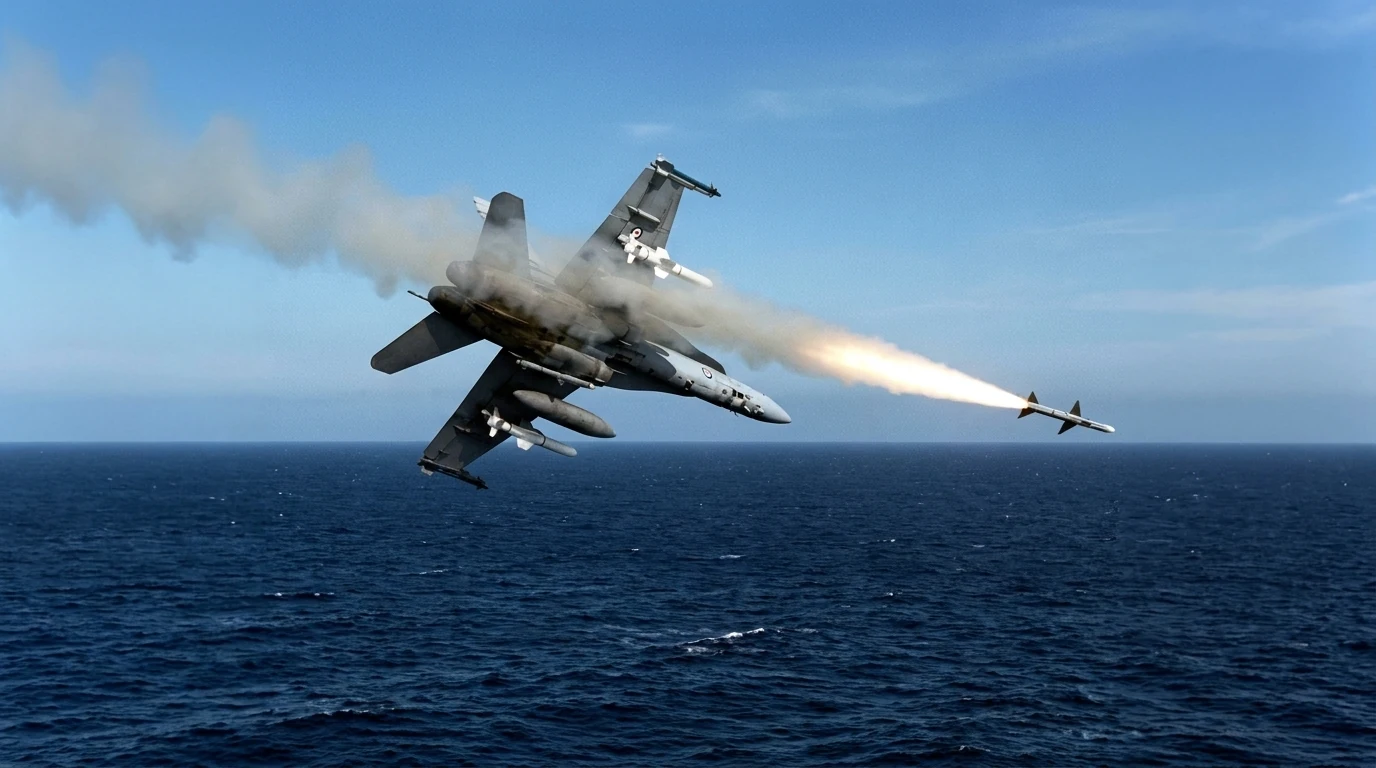
The AIM-7 Sparrow didn’t become famous because it worked perfectly. It became famous because the missile kept getting better.
That distinction matters. The Sparrow began as an ambitious attempt to give fighter pilots a way to attack aircraft beyond gun range. Its roots go back to 1946, when the U.S. Navy started the “Hotshot” project. The first Sparrow firing came in December 1952, followed by initial operational capability in 1953 and service entry in 1956.
The basic idea was simple on paper. A fighter’s radar found the target, the missile used that reflected radar energy to home in, and the pilot could attack without getting into a turning gunfight.
In practice, that setup placed a lot of trust in the aircraft’s radar, the missile’s seeker, the crew’s training, and the rules governing the engagement.
Vietnam exposed those weaknesses in a hurry.
The AIM-7 Sparrow developed a poor reputation during the war, and some of that criticism was deserved. Yet the easy claim that the missile was simply a failure misses the harder story. U.S. Air Force history credits the AIM-7 with 50 MiG kills in Southeast Asia, more than any other U.S. air-to-air missile in that record.
That’s what makes the Sparrow worth studying.
It wasn’t a finished answer to air combat. It was a weapon repeatedly rebuilt to solve problems exposed in actual fights. The AIM-7E became the F-4 Phantom’s main radar-guided weapon over Vietnam, while later versions such as the AIM-7F and AIM-7M added major changes in propulsion, electronics, guidance, and resistance to jamming.
The common mistake is to judge the Sparrow by its early failures alone. Its real story is the long correction that followed.
How the AIM-7 Sparrow Was Developed
The AIM-7 Sparrow was born from a problem that guns and early heat-seeking missiles could not solve: how do you hit a fast aircraft before you are close enough to see it clearly?
The answer started with radar.
In 1946, the U.S. Navy began the Hotshot project, looking at ways to create a guided weapon that could attack aircraft at longer ranges. The timing made sense. Jet fighters were arriving, speeds were climbing, and the old idea of closing in behind an enemy before firing was becoming harder to rely on.

The first Sparrow was not the missile most people picture today.
Sparrow I, later designated AIM-7A, used beam-riding guidance. The launch aircraft had to keep the target inside a radar beam, while the missile followed that beam toward the target. It was clever, but it had a major weakness: the attacking aircraft had to maintain a useful radar solution throughout the engagement.
Then came Sparrow II.
That version tried to give the missile its own active radar capability, allowing it to guide itself toward the target. The concept was attractive, but the technology of the time was not ready for the job. Sparrow II was canceled before becoming an operational weapon.
The real breakthrough came with the shift to semi-active radar homing.
Instead of carrying a full active radar, the missile could use reflected energy from the launching aircraft’s radar. The fighter did the hard work of illuminating the target. The Sparrow followed the reflected signal.
That sounds like a small change. It wasn’t.
It made the missile far more practical while keeping the onboard seeker smaller and lighter than a full radar system. The tradeoff was obvious, too. If the launching fighter stopped supporting the target with its radar, the missile could lose the guidance information it needed.
The Sparrow entered service in the 1950s and eventually became closely tied to the F-4 Phantom II. But its early design was never the final answer.
That became a recurring pattern.
Each major Sparrow version was less a clean-sheet weapon than a response to something pilots, engineers, and crews had learned the hard way. Vietnam would expose those weaknesses more brutally than any test range could.
AIM-7 Sparrow in the Vietnam War
Vietnam is where the AIM-7 Sparrow’s promise met reality, and reality was rough.
The missile arrived with an appealing idea: let a fighter engage an enemy aircraft at radar range instead of waiting for a visual gunfight. But the conditions over Vietnam made that concept far harder to execute than the brochure suggested.
The biggest problem was not one broken component. It was the whole engagement chain.
U.S. crews often had to identify enemy aircraft visually before firing because of rules of engagement. That mattered enormously. A weapon designed for long-range radar combat loses much of its advantage when the pilot must close the distance first.
Then came the missile itself.
Early Sparrow versions suffered from reliability problems involving guidance, fuzes, motors, and other components. The tropical environment did not help. Maintenance and storage conditions could affect equipment, while combat crews were dealing with targets that did not politely fly straight into a missile’s path.

The AIM-7E became the main Sparrow variant used by F-4 crews during much of the war. Later, the AIM-7E-2 introduced changes intended to improve performance in the close-range fight. The goal was practical: reduce some of the problems that had become painfully obvious during earlier missions.
And the numbers tell a more complicated story than the usual “Sparrow was a failure” line.
U.S. Air Force records credit Sparrow-equipped aircraft with 50 MiG kills in Southeast Asia. That is a substantial combat record, even though the missile’s reliability and hit performance were far from what its designers wanted.
One reason the Sparrow struggled was the gap between missile capability and engagement conditions. A semi-active radar missile needs a good radar track. Vietnam frequently gave crews short detection windows, difficult target identification, restrictive rules, and targets that could maneuver hard once engaged.
There was also a human factor.
An F-4 crew did not simply press a button and forget about the missile. The aircraft’s radar, the pilot, the weapons officer, and the missile all had to work as one system. If the radar track broke, the target changed position, or the engagement moved into an awkward geometry, the Sparrow could lose its chance.
That is why Vietnam should not be treated as a simple failure story.
The war exposed weaknesses that engineers could measure, crews could report, and later Sparrow versions could attack. The AIM-7 that fought over Vietnam was not the same weapon that later equipped U.S. fighters in the Gulf War.
Vietnam was the harsh test that forced the Sparrow to grow up.
The Major AIM-7 Sparrow Variants Explained
Calling the AIM-7 Sparrow one missile hides how much it changed over four decades.
The early AIM-7A and the later AIM-7M shared a name, but their guidance, electronics, propulsion, and combat ability were very different. Treating every Sparrow as the same weapon is one of the easiest ways to misunderstand its history.
| Variant | What changed | Why it mattered |
| AIM-7A | Sparrow I, beam-riding guidance | Established the basic concept |
| AIM-7B | Sparrow II, active radar concept | Tried to remove dependence on launch-aircraft illumination |
| AIM-7C/D | Improved semi-active radar designs | Moved the family toward a more practical operational weapon |
| AIM-7E | Major Vietnam-era version | Became a key F-4 Phantom weapon |
| AIM-7E-2 | Improved close-range employment | Addressed problems exposed in Vietnam |
| AIM-7F | New propulsion and electronics | Increased capability and extended the missile’s useful service life |
| AIM-7M | Improved seeker and guidance | Better low-altitude and electronic-countermeasure performance |
| AIM-7P | Further guidance and software changes | Kept the Sparrow useful against newer threats |
The AIM-7E deserves special attention because it became so closely linked with the F-4 Phantom during Vietnam. It was built around semi-active radar homing, so the aircraft had to maintain radar support for the target after launch. That made the missile dependent on both its own hardware and the radar system carrying it.
The AIM-7E-2 was a response to combat experience. It was not simply an AIM-7E with a new label. Changes were made to improve its performance in the kinds of engagements crews were actually seeing.
Then came the AIM-7F, which marked a much deeper upgrade. Its propulsion system and electronics were changed, giving the Sparrow more room to operate at longer ranges and making the weapon better suited to newer fighter radar systems.
The AIM-7M pushed the redesign further. Its inverse-monopulse seeker improved guidance against electronic countermeasures, while changes to low-altitude performance addressed one of the nastier problems of radar missile combat: separating a target from the ground.

The AIM-7P followed with additional improvements, including updated guidance functions.
So the Sparrow’s story is not really “old missile replaced by new missile.” It is closer to an aircraft receiving repeated major upgrades.
That distinction matters when comparing its combat record across different wars. A Vietnam-era AIM-7E and a later AIM-7M belonged to the same family, but judging them as if they had identical capabilities would be like comparing two generations of fighter radar simply because both carry the same basic name.
How the AIM-7 Sparrow Improved After Vietnam
Vietnam did something that no test program can fully reproduce: it showed engineers exactly how the Sparrow could fail in a real fight.
The answer was not to abandon the missile. The U.S. instead kept rebuilding it.
The AIM-7F was one of the biggest steps. It replaced older technology with a new propulsion system and updated electronics, giving the missile better reach and making it more useful with the newer radar systems appearing on American fighters. This mattered because air combat was changing. Fighters were flying faster, radars were improving, and the missile had to keep pace.
The Sparrow also had to become better at the low-altitude fight.
A target flying high against a clear sky gives a radar seeker a relatively clean problem. A target close to the ground is different. Radar energy can bounce off terrain, buildings, and other objects, producing clutter that makes the target harder to separate.
That is why improvements to the later Sparrow’s low-altitude capability mattered more than a simple maximum-range figure.

The AIM-7M went further. Its inverse-monopulse seeker improved the missile’s ability to track a target in the presence of electronic countermeasures. The U.S. Air Force also credits the AIM-7M with improved low-altitude performance and better reliability compared with earlier versions.
There is a useful lesson here.
People often compare air-to-air missiles by asking which one has the longest range. That’s the wrong starting point. A missile can have impressive theoretical range and still struggle if the seeker cannot maintain a useful track or the launch aircraft cannot support the engagement.
The Sparrow’s redesigns attacked those practical problems.
Its electronics became more capable. Its propulsion changed. Its seeker became better at dealing with interference. Its ability to operate against targets near the ground improved.
And the fighter carrying it changed too.
The F-15 Eagle gave the Sparrow a far more capable platform than the early F-4-era system. Better radar, greater speed, and improved tactics gave later Sparrow variants a much stronger environment in which to operate.
The missile was still limited by semi-active guidance. The launching aircraft had to keep doing part of the job.
But by the time the AIM-7M entered service, that limitation was being supported by a much better system around it.
The Sparrow’s post-Vietnam history is therefore less about fixing one bad missile and mo
AIM-7 Sparrow in the F-14, F-15 and Other Fighters
The AIM-7 Sparrow became far more dangerous when paired with better fighters. The missile had limits, but a good radar and a well-trained crew could make those limits much less painful.
The F-4 Phantom II was the aircraft most closely associated with the Sparrow during its early combat career. The Phantom carried radar-guided Sparrows internally between its engines, giving the fighter a weapon designed for engagements beyond the range of its cannon and short-range Sidewinders.
But the F-4 was not the end of the story.
The F-14 Tomcat gave the Sparrow another important home. Navy Tomcats could carry the missile alongside AIM-9 Sidewinders and the larger AIM-54 Phoenix, allowing crews to use different weapons for different engagement problems. The Sparrow filled the medium-range role between the short-range Sidewinder and the Phoenix.
That mix is easy to overlook.

A fighter did not need one missile to do everything. The weapons were part of a larger engagement plan, and the AIM-7 remained useful because it offered a middle ground between close combat and very long-range attacks.
Then came the F-15 Eagle.
This pairing made particular sense because the F-15’s radar and performance gave the Sparrow a stronger launch platform. The fighter could detect targets at useful distances, build a radar track, and launch the missile while retaining the speed and altitude needed to manage the engagement.
The Sparrow was also carried by aircraft such as the F-16 Fighting Falcon and F/A-18 Hornet, although integration and employment differed between platforms. The U.S. Air Force lists both the F-15 and F-16 among Sparrow users.
And this is where a common comparison goes wrong.
It is tempting to ask whether the AIM-7 itself was better or worse than another air-to-air missile. But a missile does not fight alone. Its radar, aircraft, crew, software, tactics, and rules of engagement all affect what it can actually accomplish.
I keep coming back to that point because the Sparrow makes it unusually clear.
The same basic missile family could look mediocre in one setting and highly useful in another. Give it a better radar, improved guidance, stronger propulsion, and a crew trained around the system, and its practical value changed.
By the late Cold War, the AIM-7 was no longer simply the troublesome missile remembered from Vietnam.
It had become part of a much more capable fighter weapon system.
AIM-7 Sparrow in the Gulf War and Its Lasting Legacy
The Gulf War showed how far the AIM-7 Sparrow had come since Vietnam.
By 1991, U.S. fighters were using later versions such as the AIM-7M, with improved seekers, better low-altitude performance, and greater resistance to electronic countermeasures. The missile was also paired with far better radar, tactics, and command-and-control than it had enjoyed in Southeast Asia.
F-15 crews used the Sparrow against Iraqi aircraft during Operation Desert Storm, and U.S. Air Force records credit AIM-7-equipped fighters with numerous Iraqi aircraft kills.
The contrast with Vietnam is striking.
In Vietnam, restrictive engagement rules, difficult identification, radar limitations, and missile reliability problems often worked against the Sparrow. In the Gulf War, coalition forces could make much better use of radar-guided weapons, while improved aircraft and support systems gave crews a cleaner picture of the fight.
The Sparrow had finally become the weapon its designers had wanted decades earlier.
But another missile was already making its biggest weakness harder to ignore.
The AIM-120 AMRAAM used active radar guidance, allowing the missile to take over more of the tracking job after launch. The Sparrow’s semi-active system still required the launching aircraft to support the target with radar, which could restrict the fighter’s freedom during an engagement.
That made AMRAAM the natural successor.
The AIM-7’s story didn’t end there. Its technology also lived on in the RIM-7 Sea Sparrow, a naval surface-to-air missile derived from the Sparrow family.
And that’s the real legacy.
The AIM-7 wasn’t legendary because every version was reliable or every engagement went according to plan. It became legendary because it survived long enough to be rebuilt again and again, turning hard combat lessons into better guidance, propulsion, electronics, and tactics.
The useful way to remember the Sparrow is simple: Vietnam exposed its weaknesses. The Gulf War showed what decades of fixing them could achieve.
