

Key Points
- Yuma Proving Ground hosted Joint Interagency Task Force 401’s Falcon Peak 26.2 counter-drone exercise through most of September, testing systems from multiple vendors.
- The event set up permanent counter-drone test lanes at Yuma and used Anduril’s Lattice software as the baseline for evaluating systems.
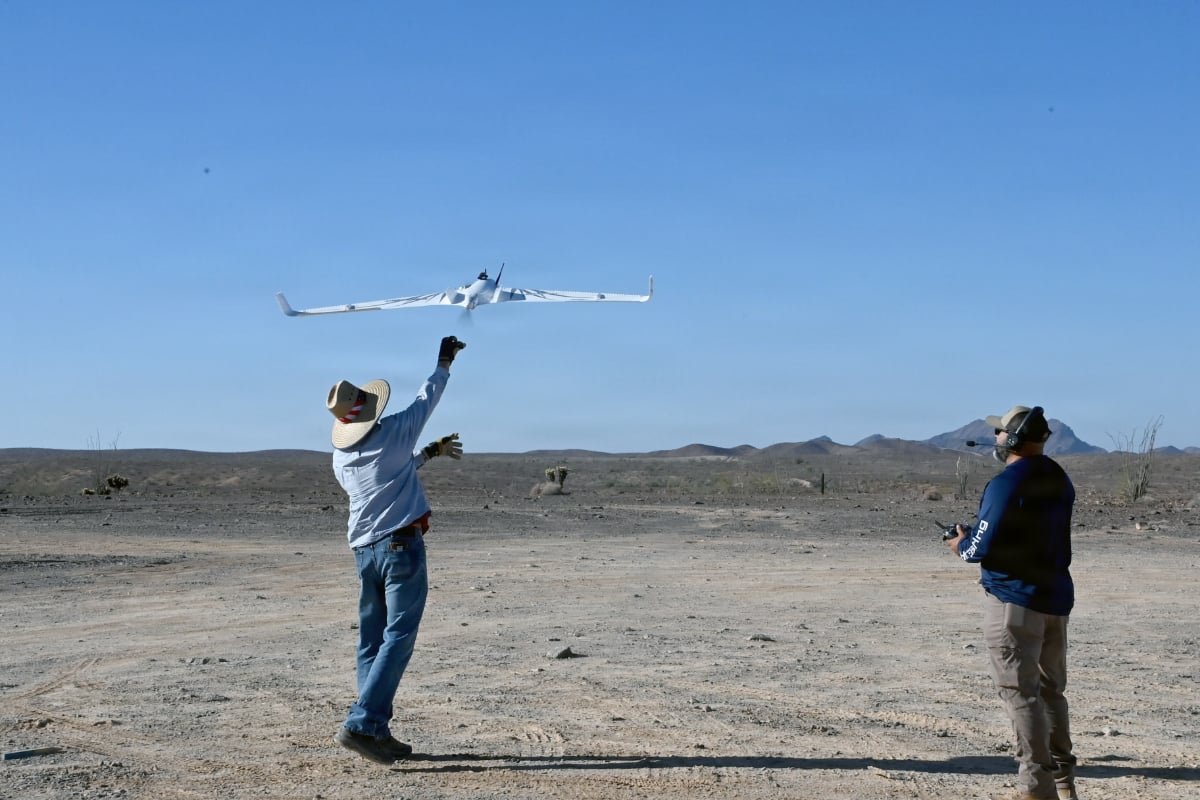
The U.S. Army has set up permanent test lanes for counter-drone weapons at Yuma Proving Ground in Arizona, where it spent most of September putting systems from multiple companies through scenarios modeled on drone incursions along the U.S. southern border.
The work was part of Falcon Peak 26.2, an operational experiment run by Joint Interagency Task Force 401, the Pentagon office set up in August 2025 to coordinate counter-drone efforts across the military and other agencies. The exercise supported U.S. Northern Command and Joint Task Force Southern Border, and was the first Falcon Peak event to simulate drone incursions in the desert conditions found along the border.
Yuma now has three permanent lanes, one each for sensors that detect drones, electronic systems that jam or take them over, and kinetic weapons that shoot them down. The Army says vendors ran their systems through multiple realistic scenarios in each, and that the lanes will stay in place for ongoing testing involving the Department of War, military units, industry and defense partners. The Army has not said which companies took part or how their systems performed, though Allen Control Systems’ Bullfrog robotic gun turret was photographed firing at drone targets during Falcon Peak on Sept. 9.
– ADVERTISEMENT – CONTINUE READING BELOW –
“The range is standardizing the spec sheet for each of these three lanes. The goal is to have set standards of measurement so we all have a baseline to start with,” said Hi-Sing Silen, the task force’s test integrator.
Falcon Peak 26.2 was also the first test event to use Lattice, Anduril’s autonomous command-and-control software, as the baseline for evaluating how well commercial counter-drone systems pass targets from sensors to weapons. In practice, that means vendors’ radars, cameras and weapons were measured on how well they plugged into a common software system that tracks drones and assigns them to the right weapon.
“YPG is the first deployment of Lattice for test and evaluation purposes. There are a lot of lessons learned, especially from a test and evaluation perspective,” said David Bates, a capability integrator in Yuma Proving Ground’s Air Combat Systems Directorate.
Since the task force was created, the Yuma Test Center has served as its primary dedicated range for testing and training against small drones. Bates said Yuma is meant as a model that could be copied at other Department of War test sites, with changes depending on each site’s capabilities and location.
Acting Secretary of the Army Adam Telle visited the range near the end of the exercise.
– ADVERTISEMENT – CONTINUE READING BELOW –
“We can’t assume that we are only going to face these threats overseas,” Telle said in a social media video recorded at Yuma’s Castle Dome Heliport.
The task force is in the middle of a large buying push. On Sept. 28, the U.S. Army awarded counter-drone contracts with a combined ceiling of $4.15 billion to 10 companies, including Allen Control Systems, to support Domestic Shield, its effort to protect U.S. bases and infrastructure from small drones.
“It really all comes down to fundamentals. We want simple, reliable systems that work every time,” said Brig. Gen. Matthew Ross, the task force’s director.
