


The strange case of a mysterious high frequency radio signal transmitted from the Arctic region may have finally been solved.
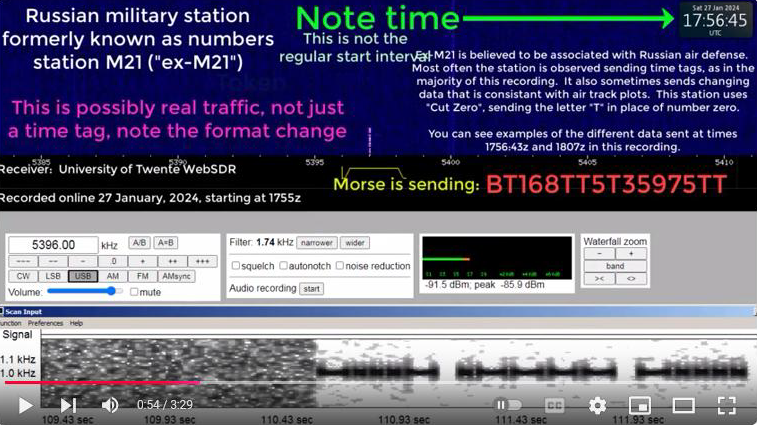
EW Analytics LLC has applied its Characterisation and Analysis of Shortwave Emissions (CASE) expertise to investigate the riddle of a mysterious High Frequency (HF: three megahertz/MHz to 30MHz) radio signal observed by using civilian software-defined radios primarily located in Scandinavia, notably in Finland and Sweden. The company shared with Armada that the CASE analysis revealed that the signal is alternatively transmitted on at least two frequencies; 5.355MHz or 5.887MHz. The signal is transmitted on a near-continuous basis and normally consists of a burst of repeated morse code approximately twelve seconds in duration followed by 48 seconds of ‘dead’ time. The morse code burst includes a time-of-day value which correlates to the Coordinated Universal Time plus three time zone. The meaning of the remainder of the morse code content is not self-evident but seems to involve an abundance of character repetition. Occasionally, the morse code bursts are notably longer and contain additional content. The intervals between bursts shorter can also be shorter.
The recording of a 14 second transmission burst thought to be from the HF radio equipping the Arctic Trefoil aviation guidance point. The more code in the signal can be clearly heard.
The Arctic Trefoil
Possibly related to the mystery are two unusual radio antenna arrays at Russia’s Arctic Trefoil base that EW Analytics LLC discovered using open-source intelligence methods. The Arctic Trefoil is an Aviation Guidance Point (AGP) operated by the Russian Aerospace Force (RASF) located at Nagurskoye airbase on Alexandra Land in the Arctic Ocean’s Franz Josef Land archipelago. Aviation Guidance Points form a key part of Russia’s strategic Integrated Air Defence System (IADS) and are like the Control and Reporting Centres routinely used by North Atlantic Treaty Organisation (NATO) and allied IADSs.
Aviation Guidance Points use organic ground-based air surveillance and fire control/ground-controlled interception radars to feed their Recognised Air Picture (RAP) into the larger, federated RAP produced by each Russian military district’s Air and Air Defence Forces Army (AFADA). The AFADA is the operational/strategic command for all air forces and air defence forces within that Military District (MD). As EW Analytics LLC has explained in the past, the AGP at Nagurskoye airbase would play a key role directing MiG-31 (NATO reporting name Foxhound) series combat aircraft against NATO warplanes in the event of a confrontation in the Arctic. The company’s analysis continues that the Nagurskoye AGP is responsible for the airspace and air approaches over the Franz Josef Land archipelago, the Barents Sea and North Pole.
The Kola Peninsula
The company’s analysis determined that the arrays at the Arctic Trefoil combine Russian-built RPDRUM-5/RPDRUM-1 HF radios with Vh-60/12 sloped V-shaped antennas. This configuration is designed to transmit in the 60-metre shortwave radio band which equates to HF signals at/around five megahertz and is optimised for high frequency radio communications across the Arctic. It seems likely, due to the southern orientation of the antennas, that they are used to direct signals towards other Russian strategic locations like the Kola Peninsula in the country’s northwest. It is possible that IADS Command and Control (C2) facilities are deployed in the peninsula. Such facilities would federate the RAPs from Military District (MD) AGPs like the Arctic Trefoil to provide a recognised air picture of the Leningrad MD’s airspace and air approaches. The Leningrad MD falls within the UTC+3 time zone, further suggesting that the five-megahertz morse code transmissions of interest support air defence activities in that district. This operational level RAP is also likely shared at the strategic level with the National Defence Management Centre in Moscow.
Given the tyranny of limited bandwidth inherent in high frequency communications, it seems unlikely that the HF radios at the Arctic Trefoil base are used as the primary method for disseminating the RAP and satellite communications links seems more likely. Nonetheless, the five megahertz HF signals observed by EW Analytics LLC carry morse code which could be used to transmit air track data generated by a Russian ground-based air surveillance radar at the Arctic Trefoil, or perhaps by a radar on the Kola peninsula. Interestingly, the company has observed surges in HF traffic on the above-mentioned frequencies when NATO aircraft were operating near Russian airspace off the coast of the Kola peninsula. This behaviour would seem to corroborate the HF traffic supporting air defence activity. The use of at least two frequencies on which air track data can be transmitted gives the Russians alternatives should one frequency be unavailable due to unfavourable propagation conditions; a perennial preoccupation for HF radio practitioners. Moreover, two radio channels always result in one more target for electronic warfare cadres to detect and jam.
The Arctic Trefoil facility, by virtue of its location and role, is doubtless one of the RASF’s most sensitive and closely guarded sites. The presence of the Vh-60/12 sloped v-shaped antennas at this air defence facility are probably part of an IADS Concept of Operations (CONOPs) to transmit air track data in the 60 metre shortwave radio band during Arctic area contingencies. Regardless of whether the two five megahertz morse code signals discovered by EW Analytics LLC originate from the Arctic Trefoil or the Kola peninsula; the signals are likely indicators of the CONOPS which can be found using open-source analysis. Thus, the IADS is unwittingly giving up some of its secrets and capabilities in the Arctic by broadcasting at HF. Delving into the riddle of the mysterious HF transmission provides yet more insight into the C2 arrangements of Russia’s operational and strategic level IADSs. By understanding the organisation, mission and systems of one RASF AGP it is possible to apply this methodology to other, similar installations. EW Analytics LLC has played an unrivalled role in demystifying what is arguably the world’s largest and most complex IADS. Those who want to learn more should visit the company’s website.
by Dr. Thomas Withington
