

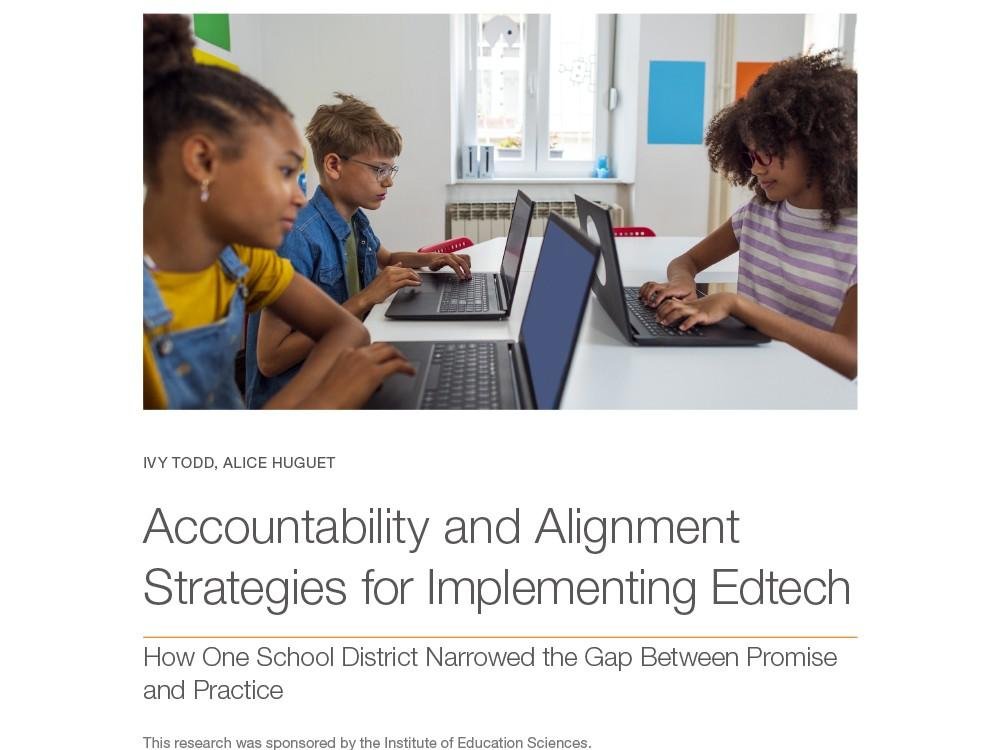
Educational technology (edtech) products are central in many school districts’ instructional strategies. However, prior research shows that school districts often struggle to move from adopting edtech products to ensuring that students use them consistently. Students’ and schools’ use of edtech products often fall below developer-recommended levels. But what if a district could meaningfully narrow the gap between recommended and actual use?
In this report, the authors describe the strategies that one district and its schools used during a two-year period in which usage of Zearn Math, a mathematics edtech platform, increased markedly. The authors draw on a randomized controlled trial in which 32 schools in a large, urban school district supplemented math instruction for grades three through five with Zearn Math. In the study’s first year, fewer than one in five students met the platform’s annual lesson goal. In the second year, about half did.
Zooming in on qualitative data from six case study treatment schools, the authors use two concepts from implementation research, accountability and alignment, to examine the district- and school-level strategies associated with this increased usage. They found that clear expectations, monitoring, and incentives helped prioritize Zearn Math’s usage. Such strategies as better alignment between the platform and primary curriculum, dedicated usage time, fewer competing tools, and expanded professional learning opportunities made using Zearn Math easier for teachers. The authors also discuss trade-offs, including that, while most participating teachers found these strategies to be helpful, others reported that they might have displaced other valuable learning activities.
This publication is part of the RAND research report series. Research reports present research findings and objective analysis that address the challenges facing the public and private sectors. All RAND research reports undergo rigorous peer review to ensure high standards for research quality and objectivity.
This document and trademark(s) contained herein are protected by law. This representation of RAND intellectual property is provided for noncommercial use only. Unauthorized posting of this publication online is prohibited; linking directly to this product page is encouraged. Permission is required from RAND to reproduce, or reuse in another form, any of its research documents for commercial purposes. For information on reprint and reuse permissions, please visit www.rand.org/pubs/permissions.
RAND is a nonprofit institution that helps improve policy and decisionmaking through research and analysis. RAND’s publications do not necessarily reflect the opinions of its research clients and sponsors.
