

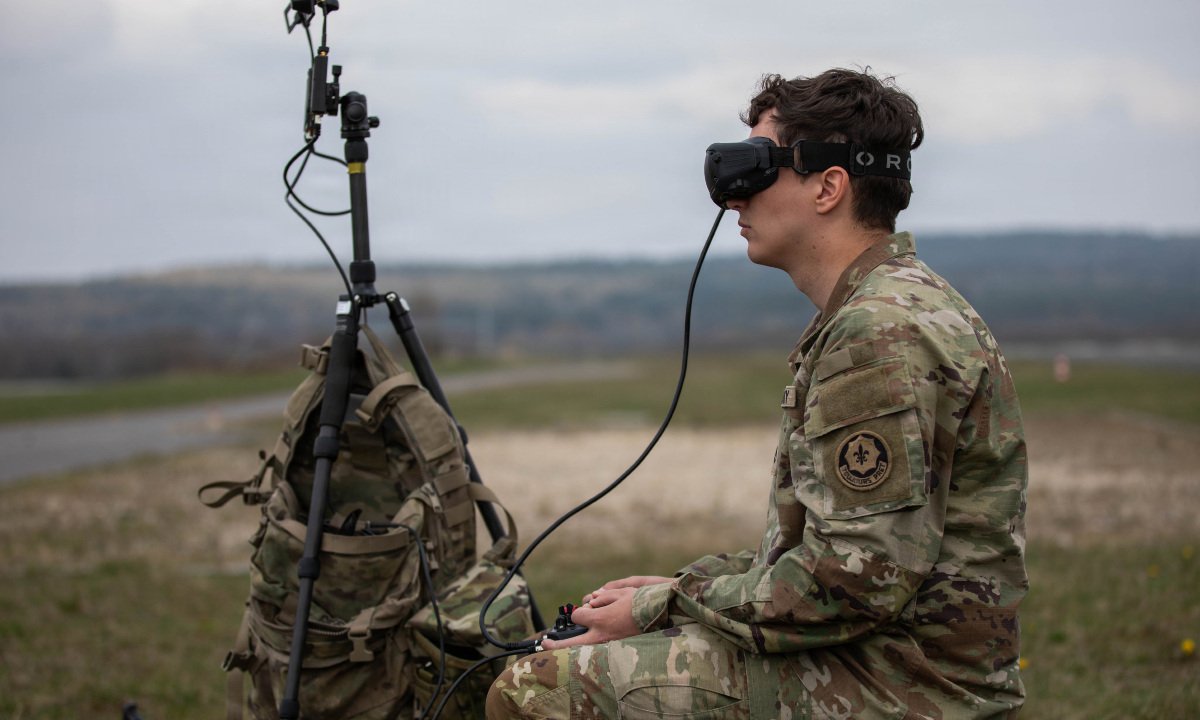
The modern battlefield is transparent. A soldier moving without understanding aerial observation, electronic signatures, and enemy sensing operates at a fatal disadvantage. Conversely, soldiers employing unmanned systems extend their reach, improve situational awareness, support maneuver, and reduce unnecessary exposure. But how can the Army prepare its formations for this reality when the character of warfare is changing faster than institutional training systems can adapt?
Small unmanned aircraft systems, counter–unmanned aircraft systems tools and technologies, and unmanned ground vehicles are no longer specialized capabilities isolated within specific formations. They define the basic environment where every soldier fights, survives, communicates, and leads. That means the Army cannot wait for these skills to slowly permeate throughout the force.
The Army has taken important steps in the right direction. Through the transformation in contact initiative, leaders are placing emerging technology directly into formations, allowing soldiers to develop the necessary employment techniques. The Army has also accelerated the fielding of modern small unmanned aircraft systems to operational formations to improve reconnaissance and lethality. But the pressing issue is training enough soldiers to operate effectively within this environment before the next large-scale combat operation. We cannot afford to learn these lessons after contact with the enemy begins.
Thankfully, there is an infrastructure already in place that the Army can take advantage of to address this issue. The Expert Infantryman Badge, Expert Soldier Badge, and Expert Field Medical Badge—collectively conducted in many organizations as E3B—provide the optimal framework to introduce and validate fundamental unmanned competencies. These are no longer niche technical skills; they are baseline soldier skills.
Leveraging the E3B Vehicle
Digital communications, GPS, and night-vision devices were once considered specialized capabilities. Today, competence with each is a baseline expectation. Unmanned systems are undergoing the same transition. Not every soldier requires master-level certification in drone piloting or robotics. The requirement is baseline tactical literacy. Soldiers must understand what friendly unmanned systems provide, recognize enemy unmanned platforms, and execute basic protective measures. They must safely operate designated soldier-level systems and integrate them into tactical tasks. As ground robotics mature, soldiers will encounter them across reconnaissance, logistics, and casualty support. Individual training standards must align with current all-arms maneuver doctrine.
The primary challenge in institutionalizing this requirement is finding the time, resources, ranges, and repetitions to train the force at scale. E3B solves this problem. The infrastructure, trainers, and dedicated unit time already exist. E3B evaluates the fundamental skills required to survive and operate in combat. Adding unmanned system fundamentals reinforces this foundation. An expert soldier must demonstrate mastery of the skills required for today’s battlefield, not the one from two decades ago.
The true value of E3B lies in the training leading up to the test. For every soldier who earns the badge, dozens participate in the train-up, rehearsing tasks and receiving instruction. By incorporating basic unmanned system skills into E3B preparation, the Army generates thousands of repetitions across the force. soldiers return to their squads and platoons with practical familiarity and teach others. This builds capability at scale without establishing a separate, costly training enterprise.
Establishing the Standard, Expanding the Scale
Of course, E3B must not become a specialized robotics course. The goal is a common baseline. For small unmanned aircraft systems, tasks must include safe handling, system preparation, observation, reporting, and tactical integration. For counter–unmanned aircraft systems, standards must cover threat recognition, reporting, protective actions, and familiarity with approved soldier-level countermeasures. For unmanned ground vehicles, requirements must include system familiarization, safe operation, and integration into simple tasks. Crucially, these standards must emphasize principles over specific platforms. Technology evolves too quickly to build training around a single piece of hardware. Teach soldiers the capability and the application, then allow units to apply those fundamentals to their organic equipment.
This standard must include the medical community. Expert Field Medical Badge execution cannot be separated from this effort. Medical soldiers operate on the same contested battlefield and face the same unmanned threats during casualty treatment and evacuation. They also stand to benefit from unmanned capabilities for route reconnaissance, supply delivery, and robotic casualty movement. Including these skills in Expert Field Medical Badge execution reinforces that unmanned warfare is a universal characteristic of the operating environment, not a branch-specific challenge.
The traditional Army response to a new requirement is a new course, a mobile training team, or a new certification. That approach fails here due to the required scale. We need hundreds of thousands of soldiers to develop unmanned systems literacy. We must integrate these skills into existing training events.
Implementation should start at installations with existing unmanned systems experience. Develop a pilot lane, certify evaluators, execute the training, and capture lessons. The Army uses this iterative approach in transformation in contact; it applies directly to E3B modernization. The initial standard must be safe, relevant, and executable. Delaying implementation to develop a flawless standard guarantees the resulting standard will be obsolete upon arrival.
The Expert Infantryman Badge, Expert Soldier Badge, and Expert Field Medical Badge represent technical and tactical competence. Adaptation does not lower that standard; it sustains it. Land navigation, weapons proficiency, medical skills, and physical fitness remain critical. However, a soldier navigating terrain without understanding aerial observation or a leader occupying a position without factoring in unmanned signatures is failing the modern tactical problem.
The Army has a narrow window to execute this change. Adversaries are actively developing unmanned and autonomous systems. Technology will continue to advance, which is the exact reason to accelerate training. Equipment alone does not create capability; trained soldiers do. If we acknowledge that these systems affect every squad, platoon, and formation in large-scale combat operations, we must stop treating familiarity with them as an optional skill. We must integrate them into our expert training, build the repetitions, and rapidly scale across the Army.
Command Sergeant Major Jesse J. Clark is the senior enlisted advisor of 2d Cavalry Regiment. He has held every noncommissioned officer leadership position from infantry team leader to regimental command sergeant major. He has deployed twite to Afghanistan in support of Operation Enduring Freedom, to Iraq in support of Operation Iraqi Freedom, to Poland in support of Operation Atlantic Resolve, to Kuwait in support of Operation Spartan Shield and Operation Inherent Resolve, and to Qatar in support of Operation Allies Refugee.
The views expressed are those of the author and do not reflect the official position of the United States Military Academy, Department of the Army, or Department of Defense.
Image credit: Sgt. Addison Shinn, US Army
