

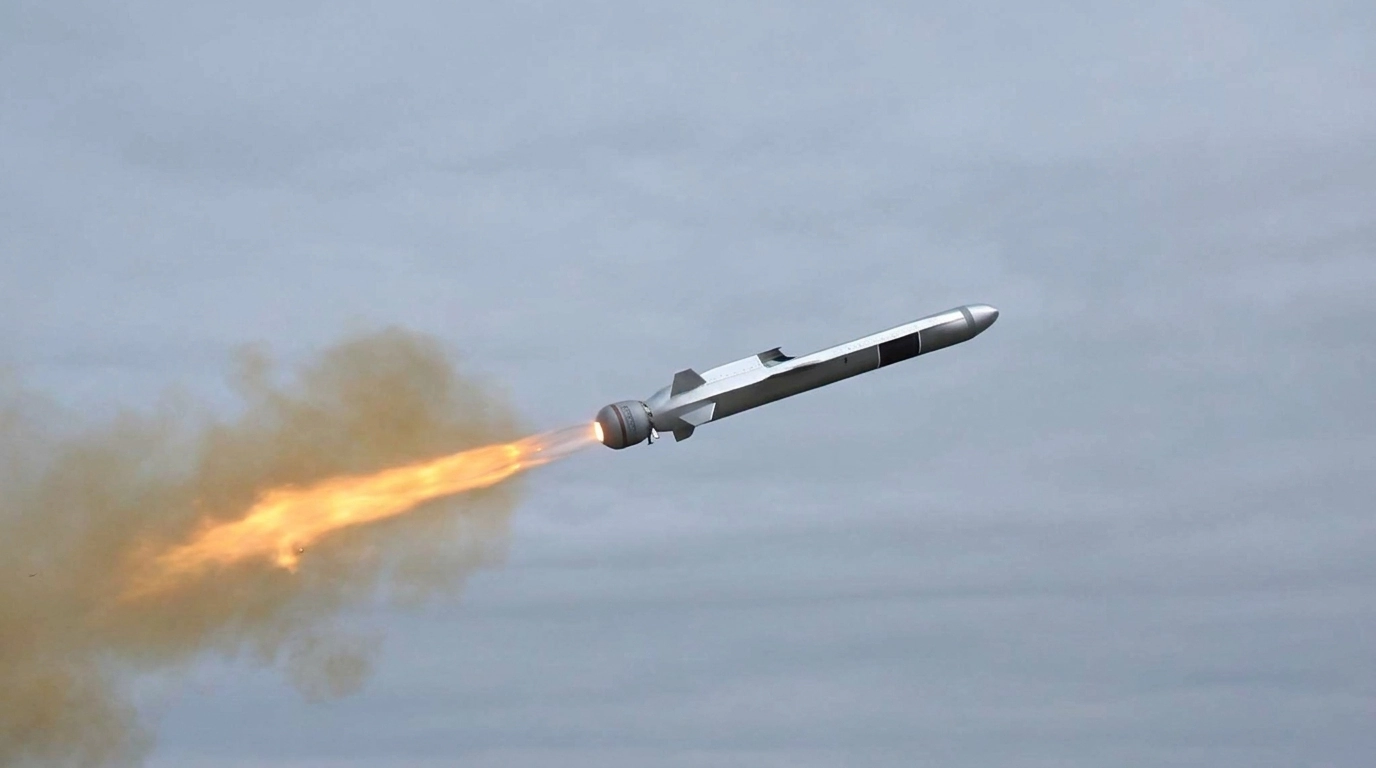
A missile doesn’t need to be the fastest weapon in the sky to be dangerous.
The Norwegian Naval Strike Missile (NSM) proves the point. It flies at high subsonic speed, carries a roughly 125 kg warhead, and does not rely on a big radar seeker shouting its position across the sea. Instead, it stays low, approaches quietly, and uses an imaging infrared seeker to find and recognize its target.
That combination is what makes the NSM interesting.
The textbook description is simple: Norway built a long-range anti-ship cruise missile. But that misses the real story. A warship has to detect an incoming missile, track it, identify it, and then shoot it down before impact. NSM is designed to make each of those steps harder.
Its sea-skimming flight matters because radar detection gets tougher when a missile stays close to the surface. Its passive seeker matters because the missile isn’t broadcasting radar energy during its attack. And near the target, the NSM can perform sharp terminal maneuvers instead of flying a straight path toward the ship.
That doesn’t make it invincible. No anti-ship missile is.
But it does explain why the NSM has attracted customers well beyond Norway, including the United States, Australia, and Poland.
Kongsberg’s current figures put the missile’s range at more than 300 kilometers, although published figures have varied by source and configuration. That discrepancy is worth examining rather than pretending there is one universal number.
So how powerful is the Naval Strike Missile?
The better question is what happens when range, low-level flight, passive sensing, target recognition, and a 125 kg warhead are packed into one missile. That’s where NSM gets serious.
What Is the Norway Naval Strike Missile?
The Naval Strike Missile was built around a simple problem: how do you hit a modern warship without giving its defenses an easy target?
Norway’s answer was NSM, a cruise missile developed by Kongsberg Defence & Aerospace. It grew out of the country’s experience with the earlier Penguin anti-ship missile, but the design took a different path. Instead of chasing extreme speed, NSM puts more weight on stealth, navigation, target recognition, and the final attack run.
That choice matters.

A typical anti-ship missile has to survive the last part of its flight, when the target’s defenses are fully engaged. NSM tries to make that phase as difficult as possible. It can fly just above the sea, use passive sensing, and alter its path during the terminal approach. The missile’s imaging infrared seeker then helps it distinguish the intended target from the surrounding scene.
The missile is also more flexible than its name suggests. NSM was designed for ships, but it can also attack land targets. That gives the same basic weapon a role in coastal defense and precision strike missions.
Norway fields the missile on its Fridtjof Nansen-class frigates and Skjold-class corvettes. The weapon has also moved into ground-based coastal defense, showing why NSM is better viewed as a strike system than simply a ship-killer.
There is another detail worth clearing up. NSM is not the same missile as the Joint Strike Missile (JSM). JSM is the air-launched member of the family, designed to be carried by aircraft such as the F-35.
That distinction gets blurred online. It shouldn’t.
The NSM’s core idea is straightforward: stay hard to detect, arrive from a useful direction, recognize the target, and hit where the missile was sent. Its power comes from that chain working together, not from one spectacular specification.
Naval Strike Missile Specifications: Range, Speed and Warhead
The numbers tell only half the story, but the NSM’s numbers are still worth knowing. Its design is compact for a weapon meant to strike ships hundreds of kilometers away, and that compact size helps explain how widely it can be deployed.
Here are the core figures readers will usually look for:
| Specification | Naval Strike Missile |
| Manufacturer | Kongsberg Defence & Aerospace |
| Country | Norway |
| Length | About 3.96 meters |
| Weight | About 407 to 410 kg |
| Speed | High subsonic |
| Warhead | About 125 kg |
| Guidance | INS/GPS with imaging infrared seeker |
| Flight profile | Sea-skimming, with terrain-following capability |
| Primary roles | Anti-ship and land attack |
| Published range | More than 300 km on Kongsberg’s current page |
The range figure needs a closer look.
Kongsberg’s current NSM product page gives a range of more than 300 kilometers. Norwegian reference material has listed 185 kilometers, while older Kongsberg material described the operational range as more than 100 nautical miles, roughly 185 kilometers. Those figures should not be mashed together into one fake precision number.
Why the gap?
Missile range depends on configuration, flight profile, launch conditions, and the performance standard being quoted. Public sources do not always describe those conditions in the same way. For an article like this, “more than 300 km” is the current manufacturer figure, while 185 km is a useful figure from earlier published references.
The warhead is easier to pin down. Norwegian reference material puts it at roughly 125 kg, a serious payload for a missile weighing only about 410 kg.

Speed is where NSM looks less dramatic. It is high subsonic, not supersonic or hypersonic. And that’s deliberate. The missile’s designers spent weight and design effort on staying low, sensing the target, and making the terminal attack harder to stop.
That tradeoff is the key to understanding the NSM. Its most useful specification isn’t a single number in a table. It’s how those numbers work together.
How Does the NSM’s Stealth and Guidance System Work?
The Naval Strike Missile’s real trick is not invisibility. It’s making the defender’s job harder at every stage of the attack.
Start with the flight path. NSM can skim close to the sea, keeping its altitude low as it approaches a target. That matters because radar systems do not get an unlimited view of the horizon. Earth’s curvature and surface clutter can hide a low-flying missile until it gets relatively close.
Think about the timing. A warship might have only a short window to detect a sea-skimming weapon, confirm that it is hostile, track it, and fire an interceptor. NSM is built to squeeze that window.
The missile also avoids the usual habit of broadcasting its presence. Its terminal seeker is an imaging infrared sensor, rather than an active radar seeker. In simple terms, it looks for the target’s heat and visual shape instead of sending radar pulses toward it.
That’s a major design choice.

NSM also uses inertial navigation, with satellite navigation support, to reach the target area. Once there, its seeker can help identify the intended target. Kongsberg calls this Autonomous Target Recognition, or ATR. The missile is designed to recognize relevant features of a ship rather than simply chase the biggest radar return.
That becomes useful in a messy coastal scene. Islands, merchant ships, small vessels, and shore features can all complicate an attack. A missile that can process what it sees has more options than one following a simple point-to-point route.
Then comes the terminal phase. NSM can maneuver sharply as it closes on the target, which matters because a predictable approach gives defensive systems an easier firing solution.
Here’s the common mistake: calling NSM a “stealth missile” and leaving it there. Stealth is not a magic cloak. Its advantage comes from the combination of low flight, low observable design, passive sensing, and unpredictable terminal movement.
Remove those pieces, and the headline becomes much less impressive.
How Powerful Is the NSM’s Warhead?
A 125 kg warhead sounds modest until you consider where it is supposed to explode.
The Naval Strike Missile does not need to carry the biggest explosive payload in its class. Its warhead is designed to damage a ship after the missile has already done the harder work of getting through the defenses and reaching the right part of the target.
Norwegian reference material puts the NSM warhead at about 125 kg. Kongsberg describes a titanium-alloy warhead casing and a programmable fuze, giving the missile more flexibility than a simple impact charge.
That fuze matters.
A ship is not just a floating box. Detonating a weapon at the wrong point can waste much of its destructive effect. NSM’s fuze can be set for different target conditions, allowing the weapon to control when the warhead detonates rather than treating every target exactly the same.

The missile also relies on penetration before delivering its main effect. That changes the equation. A roughly 410 kg missile carrying a 125 kg warhead is not trying to flatten an entire ship with blast alone. It is trying to put a large amount of destructive energy into a specific target area.
Consider a frigate. Damage to propulsion, power generation, sensors, weapons, or command spaces can matter far more than simply punching a large hole somewhere in the hull.
And this is where online comparisons often go wrong. People line up anti-ship missiles by warhead weight and assume the largest number wins. That’s a poor way to judge them. A warhead’s effect depends on its casing, fuze, impact conditions, penetration, and where it reaches the ship.
NSM’s warhead is therefore only one part of the weapon’s punch.
Its bigger advantage is the delivery system wrapped around it. If a missile can approach low, avoid active radar emissions, identify the intended target, and maneuver during the final attack, the warhead gets a chance to do its job.
A 125 kg payload delivered accurately is a very different problem from a 125 kg
How Does the Naval Strike Missile Attack Enemy Ships?
The NSM attack is best understood as a sequence, not a single dramatic dive toward a ship. The missile spends most of its flight getting into position, then saves its most demanding work for the final approach.
After launch, the Naval Strike Missile follows a programmed route using its navigation system. The path does not have to be a simple straight line between launcher and target. Waypoints can shape the approach, which matters when geography or the expected threat environment makes a direct route undesirable.
The missile can then fly at very low altitude over the sea. That sea-skimming profile is one of its most useful features because a low missile can remain hidden from a ship’s radar for longer than a higher-flying weapon.

But finding the target is only part of the problem.
Near the target area, NSM’s imaging infrared seeker takes over the job of identifying what is actually in front of it. Its Autonomous Target Recognition system is designed to help distinguish the intended ship from other objects.
That gives the missile a different character from a basic point-and-shoot weapon.
The final approach is where NSM becomes especially interesting. Rather than simply flying straight into the target, the missile can perform high-agility terminal maneuvers. Those movements can complicate the defender’s tracking and interception process.
The missile then uses its programmable fuze and warhead to deliver the attack.
A useful way to picture the sequence is:
Launch → programmed route → low-level cruise → target-area search → infrared recognition → terminal maneuver → impact and detonation
The exact mission profile is not public in the level of detail needed to reconstruct a real engagement, and claims about precise interception timelines should be treated carefully.
Still, the basic logic is clear. NSM does not try to win by arriving first. It tries to arrive undetected for as long as possible, identify the right target, and become hardest to stop at the very end.
That’s a much more sophisticated approach than the old image of an anti-ship missile simply flying toward a radar contact.
Which Ships and Countries Use the Naval Strike Missile?
The NSM has moved far beyond its original Norwegian role. Its growing use on ships, coastal batteries, and U.S. Marine Corps systems shows what makes the missile attractive: the same basic weapon can be placed on very different launch platforms.
Norway was the starting point. The Norwegian Armed Forces use NSM aboard the Fridtjof Nansen-class frigates and Skjold-class corvettes. That pairing makes sense. The frigates provide a larger naval platform, while the small, fast Skjold-class vessels give Norway a way to carry a long-range strike weapon on a much smaller combatant.

Poland took a different approach.
Its NSM batteries are land-based, giving the missile a role in coastal defense without putting a warship inside the threat area. That’s a major shift in how an anti-ship missile can be used. The launcher does not need to sail toward an opposing fleet to threaten it.
Australia has also adopted the weapon for its surface fleet. The Royal Australian Navy selected NSM to replace the Harpoon anti-ship missile carried by its major surface combatants. The choice places a newer missile on ships operating across a huge maritime region.
Then there’s the United States.
The U.S. Navy selected NSM for its Over-the-Horizon Weapon System, while the U.S. Marine Corps is using the missile as part of its NMESIS coastal strike system. Kongsberg announced a contract in 2024 worth up to NOK 12 billion for additional NSM deliveries to the U.S. Navy and Marine Corps.
That last point is particularly revealing.

The missile’s value isn’t tied to one ship design. A frigate can launch it. A small coastal unit can carry it. A truck-based launcher can put it somewhere an enemy fleet has to account for.
And NSM has an air-launched relative, the Joint Strike Missile, or JSM. JSM is designed for aircraft, including the F-35.
So when someone says “the Norwegian NSM,” don’t picture one launcher or one ship. Think of a missile family built around a common idea: put a relatively compact, difficult-to-detect anti-ship weapon where an opponent has to worry about it.
Why Is the NSM Considered a Powerful Anti-Ship Missile?
The Naval Strike Missile’s strength comes from how its parts fit together. None of its headline numbers is extraordinary by itself. Put them together, and the design starts to make sense.
Start with survivability. NSM can fly close to the sea, reducing the radar horizon available to a defending ship. Its low-observable design adds another layer, while passive sensing means the missile does not need to advertise itself with an active radar signal during its terminal search.
Then comes target recognition.
The imaging infrared seeker and Autonomous Target Recognition system give NSM a way to identify a target without simply chasing the strongest radar return. That’s useful in crowded waters, where a missile may have several ships or other objects in its target area.
Its range also gives commanders room to operate. Kongsberg currently lists the NSM at more than 300 kilometers, although older Norwegian and Kongsberg references have cited about 185 kilometers. Those figures should be treated as different published performance references, not as proof that one source must be wrong.
The warhead adds the final punch. At roughly 125 kg, it is large enough to cause serious damage when delivered into a vulnerable part of a ship. The programmable fuze gives the weapon another degree of control over how that warhead is used.
But here’s where I would push back against the usual “most powerful missile” framing.
NSM is not hypersonic. It doesn’t depend on brute speed. And a 125 kg warhead isn’t the largest anti-ship payload ever fielded. Calling it powerful because of one number misses why the missile was designed this way.
Its real strength is the attack chain: find the target, approach at low altitude, remain passive, recognize the ship, maneuver during the terminal phase, and then deliver the warhead.
That chain can break at many points. Good defenses, poor targeting data, electronic warfare, weather, or a failed seeker can change the result.
So the useful takeaway isn’t that NSM is unstoppable. It isn’t.
The useful takeaway is simpler: NSM was designed to make a modern warship solve several difficult problems at once.
If you’re judging the missile, start there. Don’t start with its speed.
