

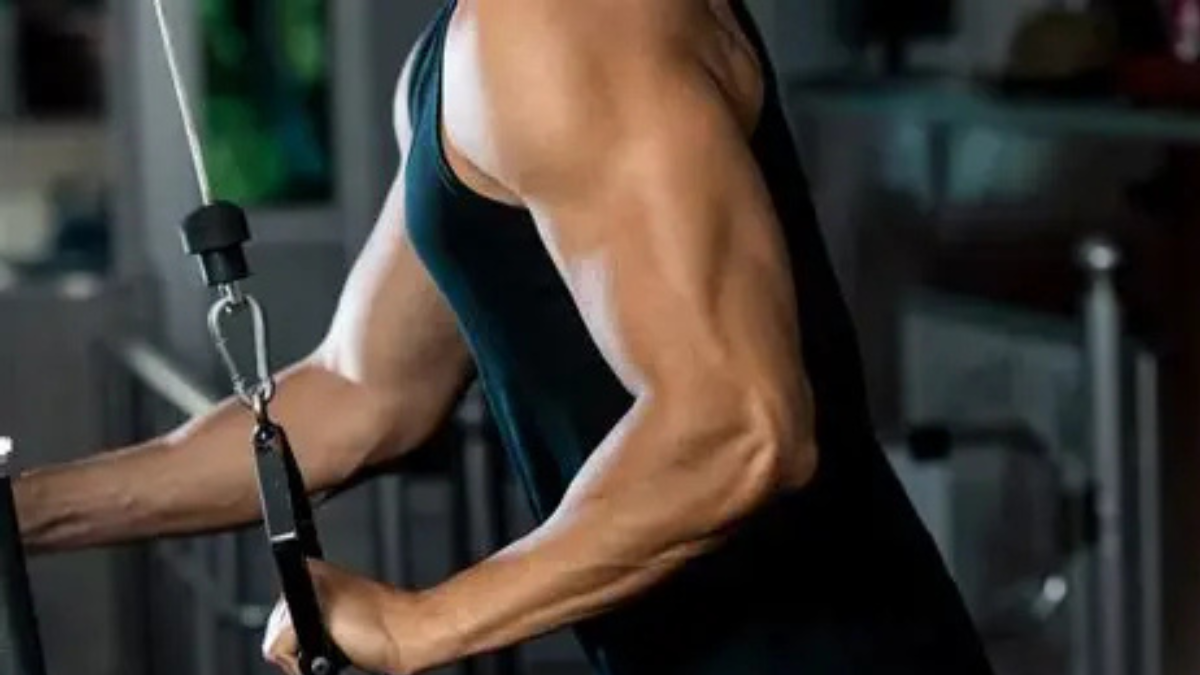
Big arms are not built by biceps training alone. Your triceps make up a large share of your upper arm muscle mass, so they have a major effect on how thick and muscular your arms look from every angle. They also matter for pressing strength, because they help straighten the elbow during push ups, bench presses, overhead presses, and many athletic movements.
For beginners, the best triceps exercises are not necessarily the most complicated. You need movements that are easy to learn, stable enough to load progressively, and effective across the three sections of the triceps. The long head runs along the back of the upper arm and crosses the shoulder joint, while the lateral and medial heads sit underneath and beside it. Training with more than one arm position can help you develop the muscle more completely.
The three exercises below give beginners an efficient foundation. Start conservatively, focus on clean repetitions, and aim to gradually add repetitions or resistance over time. Research consistently shows that progressive resistance training, sufficient training volume, and working reasonably close to muscular fatigue are key factors for muscle growth.
Why Triceps Training Matters for Muscle Mass
The triceps brachii is made up of three heads, and all three contribute to elbow extension. The long head also crosses the shoulder joint, which means its length changes when you raise your arm overhead. This matters because exercise position can affect the stimulus a muscle receives.
A larger triceps can make your arms look noticeably more muscular even when you are relaxed. It can also improve the final portion of pressing movements, where the elbow must straighten under load. For a beginner, direct triceps work is useful because compound pressing exercises do train the triceps, but they may not provide enough focused volume to maximize arm development.
Resistance training builds muscle by exposing the muscle to repeated mechanical tension. You do not need to use extremely heavy weights to make progress. Research shows that a wide range of loads can produce hypertrophy when sets are performed with enough effort. That makes dumbbells, cables, bodyweight exercises, and machines all useful tools for beginners.
3 Best Barbell Exercises for Ripped and Strong Lower Abs
Training volume also matters. More hard weekly sets generally produce more muscle growth up to the point where recovery becomes a problem. Beginners do not need huge amounts of work, but they do need consistency. A sensible starting point is to perform a few focused triceps sets two or three times per week, alongside your regular upper body training.
1. Close Grip Push Up
The close grip push up is one of the best places to start because it uses your bodyweight, teaches full body tension, and trains the chest, shoulders, and triceps at the same time. Moving your hands closer together usually increases the demand on elbow extension, making the triceps work harder than in a wider push up position.
This exercise is highly practical because it can be scaled to almost any beginner. If a full floor push up is currently too difficult, perform the movement with your hands on a bench, sturdy box, or Smith machine bar. As you become stronger, lower the incline until you can perform the exercise from the floor with controlled form.
How to Do It
Set your hands slightly inside shoulder width, rather than placing them directly together. Keep your body in a straight line from your head to your heels, brace your midsection, and lower your chest toward the floor. Keep your elbows relatively close to your body as you descend.
Press the floor away and straighten your elbows at the top without forcing them backward. Your shoulders should remain stable, and your hips should not sag toward the floor. Use a range of motion that allows you to control the exercise without shoulder discomfort.
Why It Builds Triceps
Push ups are a multi joint pressing exercise, so they allow beginners to train several upper body muscles at once. Electromyography research has found that hand position changes muscle activity during push ups, with narrower hand placements increasing triceps involvement compared with wider positions.
The close grip push up also gives you a simple way to apply progressive overload. You can add repetitions, use a lower incline, slow down the lowering phase, pause near the bottom, or eventually add external resistance. Each of these strategies can increase the challenge while keeping the movement pattern familiar.
For muscle growth, do not stop every set when it becomes mildly uncomfortable. Aim to finish with only a few good repetitions left in reserve while keeping your technique controlled. Beginners should prioritize smooth reps over chasing exhaustion.
How to Program It
Perform two or three sets of six to 15 repetitions. Choose an incline or floor variation that makes the final few repetitions challenging without causing your form to collapse. Rest for around two minutes before repeating the set.
Use this exercise early in your workout when you are fresh enough to maintain good positioning. It works especially well as part of an upper body session alongside rows, pulldowns, squats, and other foundational movements.
2. Cable Triceps Pushdown
The cable triceps pushdown is one of the most beginner friendly direct triceps exercises because the cable provides consistent resistance and the machine helps limit unnecessary body movement. It is easy to adjust the load in small increments, which makes steady progression more manageable.
A rope attachment is an excellent option because it allows your hands to move naturally. A straight bar or angled bar can also work well. The best attachment is usually the one that lets you train hard without irritating your wrists, elbows, or shoulders.
How to Do It
Set the pulley near the top of the cable machine. Stand tall with your feet planted firmly and hold the attachment with your elbows close to your sides. Begin with your elbows bent and your forearms roughly parallel to the floor.
Push the attachment down by straightening your elbows. Keep your upper arms still throughout the movement and avoid using a big forward lean or swinging your torso to move the weight. At the bottom, fully straighten your elbows with control, then slowly return to the starting position.
The return phase is important. Lowering the weight under control keeps tension on the triceps and prevents momentum from taking over. Use a load that lets you maintain the same body position from the first repetition to the last.
Why It Builds Triceps
The pushdown is an isolation exercise, which means the triceps are the primary muscles producing movement. This can make it useful after pressing exercises, when your chest and shoulders may already be fatigued but you still want to add focused arm volume.
Research on resistance training indicates that isolated and compound exercises can both contribute to hypertrophy. Compound movements are time efficient, while isolation work can add targeted volume for a muscle that you want to develop further. For someone who wants noticeably larger triceps, this combination is very effective.
The pushdown trains the triceps with the upper arm close to the torso. That makes it a useful complement to the overhead extension later in this article. Using both positions gives the triceps exposure to resistance under different joint angles.
How to Program It
Perform two or three sets of eight to 15 repetitions. Start with a weight that allows a brief pause at the bottom of each repetition. Once you can complete all your planned repetitions with excellent control, increase the load slightly.
Avoid turning the movement into a full body exercise. If you need to rock backward, lean far over the cable, or allow your elbows to drift forward, reduce the load. The triceps should do the work, not momentum.
3. Overhead Cable Triceps Extension
The overhead cable triceps extension is an outstanding exercise for building the long head of the triceps. Since the long head crosses both the shoulder and elbow joints, lifting the arms overhead places it in a more lengthened position before you even begin to extend the elbow.
This is especially valuable for people who already do plenty of presses and pushdowns but still want more fullness through the back and upper portion of the arm. It is not a magic exercise, but it is an efficient way to give the triceps a different and highly useful stimulus.
How to Do It
Set a cable pulley around chest height or slightly lower, then face away from the machine. Hold a rope attachment and take one or two small steps forward until the cable provides tension. Raise your hands beside or slightly behind your head while keeping your elbows pointed generally forward.
Straighten your elbows until your arms are extended overhead. Pause briefly, then lower the rope behind your head under control. Keep your ribs down and avoid turning the exercise into a lower back extension.
Use a comfortable range of motion. You should feel your triceps working and lengthening, but not sharp pain in your shoulders or elbows. If the standing version feels unstable, perform an overhead dumbbell extension while seated with back support.
Why It Builds Triceps
A controlled trial comparing overhead and neutral arm position cable extensions found that training in the overhead position produced greater triceps hypertrophy, including greater growth of the long head. Both variations were productive, but the overhead position offered a clear advantage in that study.
The likely explanation is the longer muscle length experienced by the long head in the overhead position. Research across resistance training has increasingly shown that exercises performed at longer muscle lengths can be very effective for hypertrophy, although no single exercise is essential for growth.
For beginners, the most important lesson is simple. Include one triceps movement with your arms overhead and one with your arms closer to your sides. This approach is easy to implement, gives you variety, and helps avoid relying on just one movement pattern.
How to Program It
Perform two or three sets of 10 to 15 repetitions after your main pressing work and pushdowns. Use a light enough load to control the stretch at the bottom, because rushing this position can irritate the elbows or shoulders.
If you train triceps twice weekly, use push ups and pushdowns in one session, then use overhead extensions in the other. If you train them in one weekly session, perform one or two sets of each movement and progress them steadily over several months.
How to Build Your Triceps Without Overcomplicating It
You do not need an advanced bodybuilding routine to grow your triceps. Start with the three exercises in this article, train consistently, and track your performance. If you can complete more repetitions than last week with the same clean technique, or use slightly more resistance for the same repetitions, you are moving in the right direction.
Give your triceps time to recover. They work hard during chest and shoulder training, so avoid adding excessive direct volume immediately. Begin with six to nine direct triceps sets per week, spread over two sessions if possible. Adjust upward only if you are recovering well and still progressing.
Protein intake and total food intake also influence muscle gain. Resistance training works best when it is supported by adequate dietary protein and sufficient energy intake. Sleep matters as well, since consistently poor sleep can interfere with training performance and recovery.
Massive triceps are built from months of patient training, not one brutal workout. Use exercises you can perform comfortably, push your sets with good effort, and make gradual progress. The close grip push up, cable pushdown, and overhead cable extension will give you a powerful, beginner friendly foundation.
References
- American College of Sports Medicine (2009) ‘American College of Sports Medicine position stand: Progression models in resistance training for healthy adults’, Medicine & Science in Sports & Exercise, 41(3), pp. 687–708.
- Grgic, J., Schoenfeld, B.J., Orazem, J. and Sabol, F. (2022) ‘Effects of resistance training performed to repetition failure or non failure on muscular strength and hypertrophy: A systematic review and meta analysis’, Journal of Sport and Health Science, 11(2), pp. 202–211.
- Maeo, S., Wu, Y., Huang, M., Sugiyama, T., Kanehisa, H. and Isaka, T. (2023) ‘Triceps brachii hypertrophy is substantially greater after elbow extension training performed in the overhead versus neutral arm position’, European Journal of Sport Science, 23(5), pp. 791–799.
- Morton, R.W., Murphy, K.T., McKellar, S.R., Schoch, R.D., Henselmans, M., Helms, E., Aragon, A.A., Devries, M.C., Banfield, L., Krieger, J.W. and Phillips, S.M. (2018) ‘A systematic review, meta analysis and meta regression of the effect of protein supplementation on resistance training induced gains in muscle mass and strength in healthy adults’, British Journal of Sports Medicine, 52(6), pp. 376–384.
- Saeterbakken, A.H., Mo, D.A. and Scott, S. (2017) ‘The effects of bench press variations in competitive athletes on muscle activity and performance’, Journal of Human Kinetics, 57, pp. 61–71.
- Schoenfeld, B.J., Ogborn, D. and Krieger, J.W. (2017) ‘Dose response relationship between weekly resistance training volume and increases in muscle mass: A systematic review and meta analysis’, Journal of Sports Sciences, 35(11), pp. 1073–1082.
- Schoenfeld, B.J., Grgic, J., Ogborn, D. and Krieger, J.W. (2017) ‘Strength and hypertrophy adaptations between low versus high load resistance training: A systematic review and meta analysis’, Journal of Strength and Conditioning Research, 31(12), pp. 3508–3523.
- Silva, F.H.O., Arantes, F.J., Gregorio, C.D., da Silva, M.C., Bentes, C.M., Miranda, H. and Willardson, J.M. (2019) ‘The effect of hand position on the electromyographical activity of upper body muscles during push ups’, Journal of Physical Education and Sport, 19(3), pp. 1457–1462.
- Stokes, T., Hector, A.J., Morton, R.W., McGlory, C. and Phillips, S.M. (2018) ‘Recent perspectives regarding the role of dietary protein for the promotion of muscle hypertrophy with resistance exercise training’, Nutrients, 10(2), 180.
Key takeaways
| Exercise | Main role | Beginner target |
|---|---|---|
| Close grip push up | Builds pressing strength while heavily involving the triceps | Two or three sets of six to 15 controlled repetitions |
| Cable triceps pushdown | Adds stable, direct triceps volume with simple progression | Two or three sets of eight to 15 repetitions |
| Overhead cable triceps extension | Trains the triceps in an overhead position and strongly challenges the long head | Two or three sets of 10 to 15 controlled repetitions |
| Weekly plan | Supports steady growth without excessive fatigue | Start with six to nine direct triceps sets per week |
