

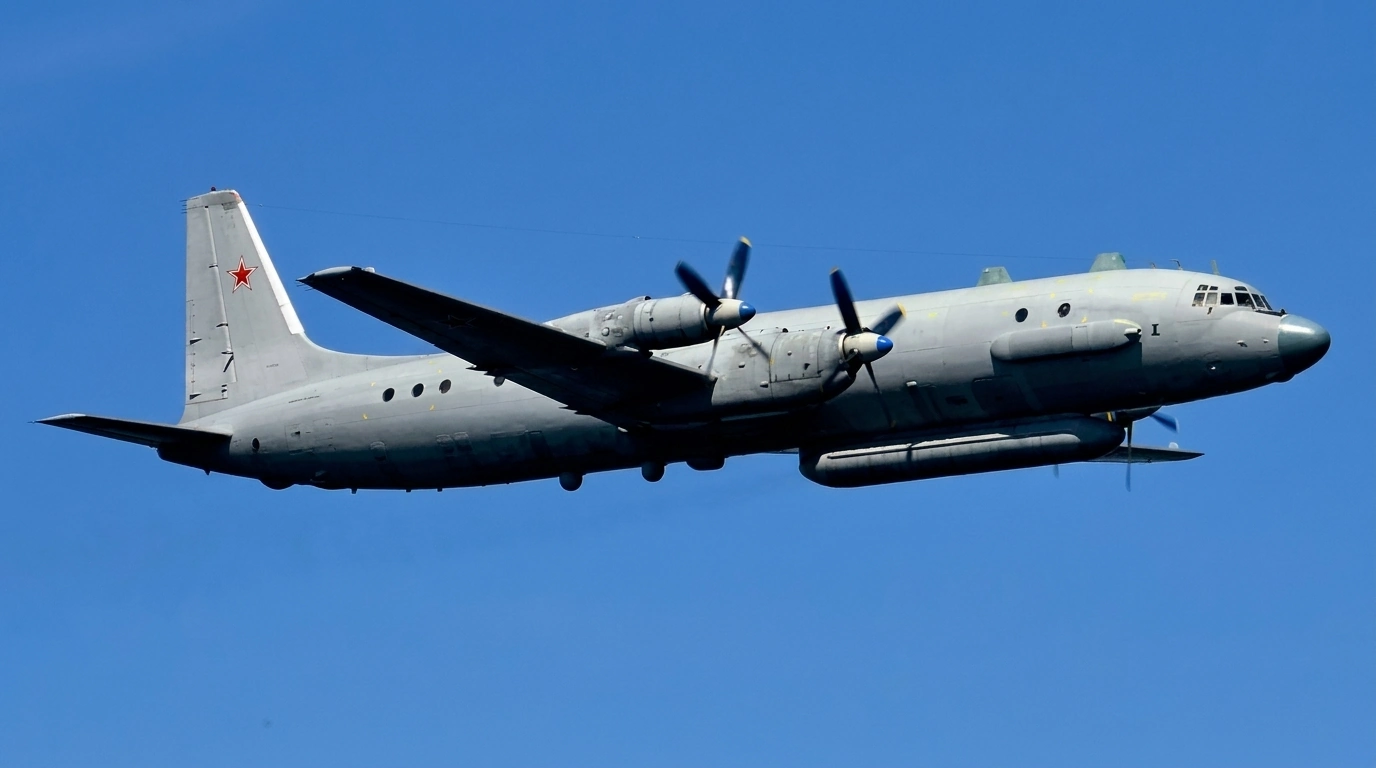
A Soviet-era turboprop still has a job in Russia’s intelligence fleet.
The Ilyushin Il-20 first appeared decades ago, yet NATO fighters were still being sent to identify the aircraft in 2026. In March, Norwegian F-35s shadowed an Il-20M flying in international airspace off Finnmark during the Cold Response exercise. The aircraft’s transponder was off, but Norwegian sensors detected it and the fighters identified it visually.
The same pattern showed up around the Baltic.
Lithuanian defense officials reported NATO fighters identifying Il-20 and Il-20M aircraft on several occasions during 2026.
On July 30, an Il-20 flying from mainland Russia toward Kaliningrad was identified and escorted in international airspace. Its transponder was off and no flight plan had been filed, although the crew maintained radio contact.
That sounds dramatic.
The reality is more interesting.
The Ilyushin Il-20 is not a fighter looking for a fight. It is a reconnaissance and surveillance aircraft, built to collect information rather than carry a large weapons load. Its value comes from sensors, operators and endurance.
That also explains why the aircraft has survived for so long.
A fighter becomes outdated quickly when its speed, radar or weapons fall behind. An intelligence aircraft follows a different rule. If the airframe can carry useful sensors and stay airborne long enough to collect information, age becomes less important.
The Il-20M, known by NATO as Coot-A, was developed from the Il-18 turboprop airliner. Its large fuselage gave Soviet designers plenty of room for reconnaissance equipment and mission crew.
And that’s the real question.
Why does Russia still find an old four-engine turboprop useful when modern surveillance technology has changed so much?
The answer starts with what the aircraft is actually looking for.
What Is the Ilyushin Il-20?
The Ilyushin Il-20 makes more sense when you stop thinking of it as an old military aircraft and start thinking about the job it was built to do.
It was designed as a flying intelligence station.
The Soviet Union developed the Ilyushin Il-20 in the late 1960s from the Ilyushin Il-18, a four-engine turboprop airliner. That choice gave engineers something fighters could not easily provide: a large cabin with room for mission operators, electronics, antennas and other reconnaissance equipment.
Speed was never the main goal.
The Il-20M, the main version discussed in modern military reports, could carry its equipment over long distances while giving its crew enough space to manage several intelligence tasks. NATO assigned the aircraft the reporting name Coot-A.
That large airliner heritage is easy to miss when you see the aircraft in a military context.
The Il-18 was already a proven long-range turboprop design. Turning that airframe into an intelligence platform meant Russia could focus on the sensors and mission systems rather than creating an entirely new aircraft from scratch.
The result was a machine built around collection.
The Il-20M is associated with ELINT and COMINT, which means collecting electronic signals and communications. It has also been linked to radar and optical reconnaissance equipment. These systems give the aircraft a different purpose from a conventional patrol aircraft or fighter.
And the distinction matters.
An Ilyushin Il-20 doesn’t need to rush toward a target. It needs to get close enough for its sensors to collect useful information while remaining outside restricted airspace when operating in international airspace.
That’s why its relatively modest performance isn’t a deal breaker.
A modern fighter may be far faster, but speed isn’t much use if the mission requires hours of sensor work and multiple operators.
The Ilyushin Il-20’s large cabin, endurance and sensor space are the reason this Cold War aircraft still has a place in Russia’s intelligence fleet.
Ilyushin Il-20 Specifications and Performance
The Ilyushin Il-20 specifications reveal an aircraft built around endurance, cabin space and sensor capacity rather than speed.
The aircraft first flew on March 21, 1968 and entered service in 1969. It was developed from the Il-18D airliner, keeping its four-engine turboprop layout while adding a completely different mission role.
Here are the commonly reported specifications for the Ilyushin Il-20M:
| Specification | Ilyushin Il-20M |
| Aircraft type | Reconnaissance and intelligence aircraft |
| NATO reporting name | Coot-A |
| Powerplant | 4 × Ivchenko AI-20M turboprop engines |
| Maximum speed | Approximately 675 km/h |
| Cruise speed | Approximately 620 km/h |
| Range | Approximately 6,200 km |
| Service ceiling | Approximately 10,000 m |
| Length | Approximately 35.9 m |
| Wingspan | Approximately 37.4 m |
| Maximum takeoff weight | Approximately 64,000 kg |
| Primary missions | Electronic intelligence, communications intelligence and reconnaissance |
These numbers are not spectacular by modern combat-aircraft standards.
But speed was never the main requirement.
The Ilyushin Il-20M was designed to carry equipment that turns a conventional flight into an intelligence-gathering mission. Its large airliner-derived fuselage provides room for mission operators, electronics and supporting systems.
That creates an important advantage.

A fighter has to balance fuel, weapons, radar and maneuverability within a relatively compact airframe. The Ilyushin Il-20 can dedicate much more internal space to people and equipment. Its four turboprops also give it the endurance needed for longer reconnaissance missions.
Its external appearance reflects that mission. Various sensor housings and antenna systems are mounted around the fuselage, allowing the aircraft to collect different types of information without relying on conventional fighter radar alone.
The figures also explain why the Ilyushin Il-20 can still be useful decades after its introduction.
It does not need to outrun a fighter. It needs enough range, altitude and endurance to reach an operating area, collect information and return to base.
In that sense, the Ilyushin Il-20’s age is less important than what Russia can keep inside it.
The airframe is old. The mission systems are where much of the aircraft’s modern value lies.
What Does the Ilyushin Il-20 Actually Do?
The Ilyushin Il-20 is essentially a flying intelligence collection platform. Its job is to gather information about military activity from the air, using several types of sensors rather than weapons.
One of its best-known roles is electronic intelligence, or ELINT. The aircraft can detect and study electromagnetic emissions from systems such as radars and communications equipment.
Older U.S. Air Force reporting described the Ilyushin Il-20 as an electronic intelligence and reconnaissance aircraft designed to help locate communications centers, radars and other electronic activity.
The aircraft also carries equipment for other forms of reconnaissance.
A large fairing beneath the fuselage has been associated with the Igla side-looking airborne radar, while additional housings and antennas support electronic collection and other intelligence tasks. Later Ilyushin Il-20 variants have received updated computers, ELINT equipment and defensive systems.
That combination gives the aircraft several useful ways to build a picture of an area.

For example, radar can provide information about objects and terrain, while electronic sensors can help identify where particular signals are coming from. Optical equipment can add another layer when conditions allow.
The important part is that these systems work together.
An Ilyushin Il-20 flying near a military exercise does not simply take photographs. It can collect signals, observe activity and help Russia understand what forces are doing in the area.
This explains why the aircraft often appears near NATO activity.
In 2026, Norwegian F-35s identified an Ilyushin Il-20M during the Cold Response exercise in international airspace off Finnmark. Norwegian officials said the aircraft was detected by national sensors and assessed that its likely purpose was to gather situational awareness of allied activity.
The Ilyushin Il-20’s mission is therefore less about direct action and more about information.
For an intelligence aircraft, knowing what another military force is doing can be just as valuable as knowing where its aircraft and ships are.
Why Does NATO Keep Intercepting Russian Il-20 Aircraft?
The Ilyushin Il-20 NATO encounters in 2026 are mostly about identification, monitoring and air-policing procedures, not an attempt to push Russian aircraft out of NATO territory.
That distinction matters.
In March 2026, Norwegian F-35s identified and shadowed an Ilyushin Il-20M operating in international airspace off Finnmark during the Cold Response exercise. Norwegian Armed Forces described these flights as routine and expected, while noting that the Russian aircraft was likely gathering situational awareness of Allied activity around the exercise.
The Baltic region has seen a similar pattern.
On March 19, NATO fighters identified and escorted an Ilyushin Il-20M flying from Kaliningrad and back through international airspace. The aircraft’s transponder was off, it had no flight plan and it was not maintaining radio contact with regional air traffic control. A second Ilyushin Il-20M was identified the following day while flying between Kaliningrad and mainland Russia.
The same type of mission continued later in the year.

Lithuanian officials reported NATO fighters identifying and escorting an Ilyushin Il-20 flying from mainland Russia toward Kaliningrad on July 30. The aircraft was in international airspace, its transponder was switched off and no flight plan had been filed, although radio contact was maintained.
So why send fighters?
Because identification is part of maintaining awareness around NATO airspace. A fighter can visually confirm an aircraft’s identity and monitor its behavior instead of relying only on ground-based sensors.
Norway’s 2026 example shows the logic clearly. Two F-35s were launched from Evenes, identified the Il-20M and shadowed it before the Russian aircraft returned toward the Kola Peninsula. Norwegian officials said such Quick Reaction Alert missions help maintain an overview of aircraft activity and flight patterns.
For the Ilyushin Il-20, that means its presence can trigger a predictable response without necessarily crossing a territorial boundary.
The aircraft collects information. NATO collects information about the aircraft.
What Sensors and Intelligence Systems Does the Il-20 Carry?
The Ilyushin Il-20 sensors are what turn this old turboprop into a useful intelligence aircraft. Its airframe may date from the Cold War, but the mission depends on the equipment carried inside and around the fuselage.
The best-documented system is the Igla side-looking airborne radar, or SLAR. Air Force Magazine identified the radar as the primary sensor on the Ilyushin Il-20, housed in a long fairing beneath the fuselage. The system allows the aircraft to observe areas to the side of its flight path rather than relying only on sensors pointing directly ahead.
The aircraft also carries equipment associated with electronic intelligence, or ELINT.
That means detecting and analyzing electromagnetic emissions. In practical terms, this can include radar and other electronic signals. Air Force reporting on the Ilyushin Il-20 has described its role as locating and studying communications centers, radars and other electronic activity.
Its external shape gives away part of the story.
The Ilyushin Il-20 has multiple antennas, blisters and sensor housings around the fuselage. Older assessments also identified containers containing cameras or other intelligence sensors.

Later modernization has added another layer.
Air Force Magazine reported that the Ilyushin Il-20MS upgrade retained the Igla SLAR while adding a newer computer, updated ELINT equipment and a modernized self-protection suite. Other modified aircraft have appeared with different antenna arrangements and electro-optical equipment, showing that the fleet has not remained frozen in its original Cold War configuration.
This is where the Il-20 becomes more interesting than its age suggests.
Russia does not need the aircraft to be technologically new. It needs the platform to collect useful information.
And because the exact equipment fitted to individual aircraft can change, public sources cannot reliably reveal every sensor currently carried by every Russian Il-20M.
What is clear is the basic formula: radar reconnaissance plus electronic intelligence, supported by a large aircraft able to carry operators and mission equipment for extended flights.
Why Is Russia Still Using the Ilyushin Il-20 in 2026?
The Ilyushin Il-20 is still flying in 2026 because its basic design remains well suited to intelligence work. Russia does not need this aircraft to win a speed contest. It needs a stable platform that can carry sensors, operators and communications equipment over long distances.
The airframe’s age is obvious. Its usefulness is less obvious.
The Ilyushin Il-20 came from the Il-18 airliner family, giving it a large fuselage and four-engine layout. That creates plenty of room for mission equipment without forcing the aircraft into the tight compromises found on smaller military platforms.
Russia has also modernized parts of the fleet.
Janes reported that an upgraded Il-20M delivered for state trials in 2018 received the Il-20MS designation. The modernization included two new digital long-range oblique photography cameras, replacing older wet-film cameras. The upgrade also formed part of a broader effort to refresh the aircraft’s reconnaissance capability.
This is the key to understanding the aircraft’s survival.

The Il-20 does not have to remain technologically identical to the aircraft that entered Soviet service. The airframe provides the platform, while cameras, computers, electronic intelligence equipment and other mission systems can be replaced or improved.
There is also a practical reason to keep using an existing platform.
Building a completely new special-mission aircraft takes time, money and industrial capacity. Modifying an established aircraft can preserve a capability while newer platforms are developed.
And Russia still clearly sees value in that capability.
Norwegian F-35s identified an Il-20M off northern Norway during Cold Response 2026, while NATO air-policing forces continued to encounter Il-20 aircraft around the Baltic region.
The Ilyushin Il-20 survives because its mission has not disappeared.
Military forces still need to know what other forces are doing, what signals they are emitting and how their activity changes over time. As long as the aircraft can collect useful information, its Cold War origins alone do not make it irrelevant.
What Does the Ilyushin Il-20 Tell Us About Modern Intelligence Warfare?
The Ilyushin Il-20 shows that intelligence aircraft do not become obsolete simply because their airframes are old. What matters is whether they can still collect useful information and operate within the limits of the mission.
That lesson is visible in Russia’s continued use of the aircraft in 2026.
Norwegian F-35s identified Il-20M aircraft operating in international airspace off Finnmark during Cold Response. Norwegian officials said the flights were expected and were likely intended to build situational awareness of Allied activity around the exercise.
The Baltic region provides another example.
Lithuanian authorities reported NATO fighters identifying Il-20 aircraft on multiple occasions during 2026. On August 31 and September 5, Il-20s flew between mainland Russia and Kaliningrad through international airspace, with their transponders switched off and no filed flight plan. NATO fighters were sent to identify them.
This creates an interesting intelligence cycle.
Russia uses the Ilyushin Il-20 to observe military activity. NATO detects and identifies the aircraft, then monitors its flight pattern. The presence of the Il-20 also gives NATO another opportunity to practice and demonstrate its air-policing response.
The aircraft is therefore both a collector and a detectable object.

That does not make the Ilyushin Il-20 useless. Quite the opposite. Its repeated appearance shows that Russia still considers manned airborne intelligence collection valuable.
At the same time, the Ilyushin Il-20 is not operating in isolation.
NATO is also using newer ISR platforms. In May 2026, the Alliance’s RQ-4D Phoenix unmanned aircraft operated from Norway for the first time, expanding NATO’s ability to conduct intelligence, surveillance and reconnaissance from a different type of platform.
That contrast tells the bigger story.
Modern intelligence warfare is not simply about replacing old aircraft with new ones. It is about combining different sensors, aircraft, data links and surveillance methods.
The Ilyushin Il-20 remains part of that equation because its basic job still matters.
The aircraft may look like a relic. The information it is built to collect is not.
