

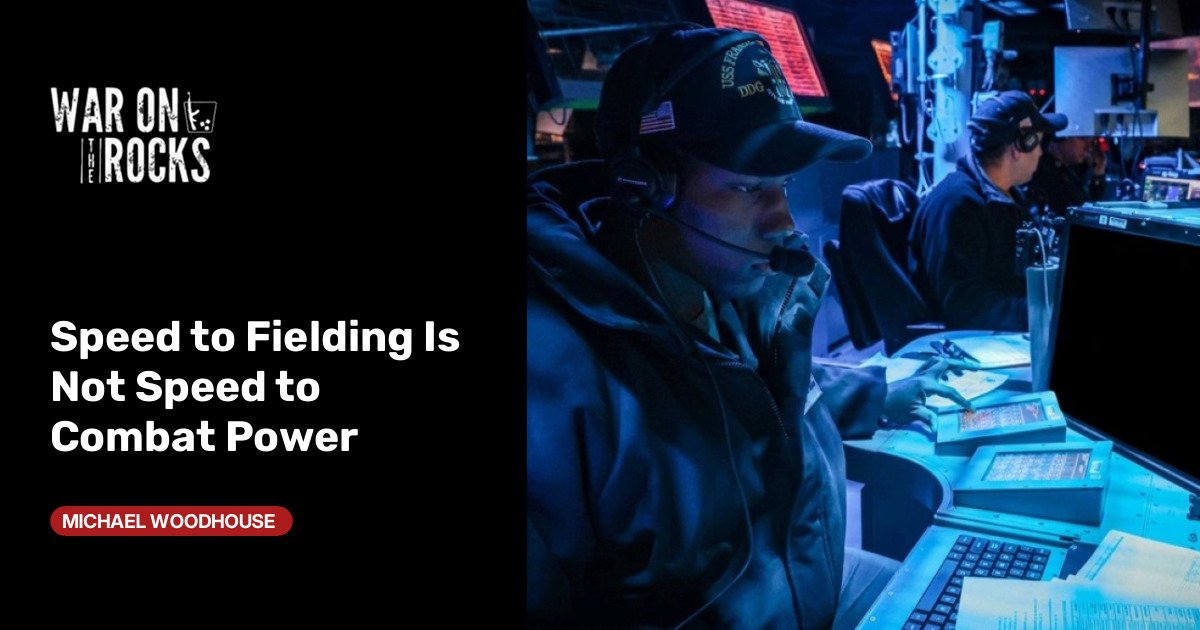
I spent more than 20 years in U.S. Army air defense, much of it in cramped control stations where the difference between a successful engagement and a catastrophic loss came down to the soldier at the console. The radar did its job. The fire control system did its job. But the responsibility, the weight, and the trust sat on one person making a call in seconds, sometimes less.
Now I sit on the other side of the fence, as vice president of space, air, and missile defense for business development at Leonardo DRS. I work for a defense contractor with a commercial stake in the very market this article addresses, including in how the U.S. government writes performance requirements, and readers should weigh my argument with that interest in mind. From that seat, I listen to people in Washington and industry discuss the same problem: more interceptors, faster fielding, and lower cost. Those conversations matter, but in those rooms, the operator is absent.
Let me state the argument plainly. The United States will not win the next fight simply because it owns the best technology. It will win it if it does two things better than its opponents: decide which decisions still require human judgment and make those humans dangerous faster. The second is a design problem. Time to proficiency, measured in the days it takes an operator to use a system effectively under realistic conditions, should become a formal requirement. Programs should have to meet it, just as they meet requirements for range, reliability, and lethality.
The autonomy debate makes that requirement more urgent, not less. The war in Ukraine shows software moving deeper into detection, identification, tracking, and targeting. Meanwhile, both sides search for ways to shorten the path from seeing a target to acting on it. War on the Rocks has documented both the growing use of machine assistance and the limits of claims that drones have transformed war on their own. As machines take on more of the sorting and terminal guidance, people do not disappear. Their work moves up the chain to supervision, orchestration, attribution, and the decisions that carry moral and strategic weight. The question is not whether a person sits inside every decision loop. Rather, it is which decisions still need one. And last but not least, whether that person is ready when the moment comes.
To be sure, Washington is trying to move faster. The April 2025 executive order on defense acquisition, a bipartisan House bill to streamline procurement, and the Defense Department’s November 2025 acquisition memorandums all push towards speed, flexibility, and delivery. I have watched reform efforts come and go. This one has real momentum because the wars in Eastern Europe, in the Middle East, and pressures in the Pacific have made delay impossible to ignore. But procurement is accelerating faster than the institutions that prepare people to use what arrives.
I can hear the objection, because the reform community will raise it immediately, and they will be right to raise it. The point of this reform push is to strip requirements away, not add them, and here I am proposing another gate for programs to clear before they can field. That looks exactly like the drag this effort exists to eliminate.
My answer is that a fast contract and a fast delivery are the wrong finish lines.
A system delivered in record time that then sits underused while its unit struggles to employ it has not been fielded fast. The delay has simply been moved off the program schedule, where it is measured and briefed, and onto the gaining unit, where nobody counts it. A time-to-proficiency requirement does not slow delivery. It counts the part of delivery the current clock ignores. If reform means anything, it means speed to combat power, and that clock stops only when the operator is dangerous.
When the military identifies a capability gap, it is supposed to consider more than hardware. Doctrine, training, organizations, personnel, education, facilities, and policy are supposed to change or at least be considered along with the equipment. The requirements process even has a name for this analysis: Doctrine, Organization, Training, Materiel, Leadership and Education, Personnel, Facilities, and Policy. In practice, hardware has program offices, budget lines, schedules, and clear congressional attention. The rest often get a working group and a slide deck if they’re lucky. A counter-drone system can reach a battalion while its courseware is stale or nonexistent, its personnel model is unchanged, and its tactics were written for a different threat. At that point, the military has not fielded a capability: It has essentially fielded a box. Boxes don’t save lives.
I saw the difference at White Sands Missile Range, where I commanded the Army detachment that helped conduct early soldier-led flight tests of the Integrated Battle Command System. The dramatic moment was the intercept, but the more revealing moments came before it. Crews had to turn a new interface, new data, and a new relationship among sensors and weapons into decisions they trusted. A system can perform exactly as designed while the crew is still borrowing confidence from an engineer or trainer standing nearby. That is the gap between a successful demonstration and an operational capability, and it is also why qualification is a poor substitute for proficiency.
The people are not the problem. Recruiting proves as much: The Army signed contracts with more than 61,000 recruits in Fiscal Year 2025 and met its goal four months early. The pipeline that turns those recruits into confident operators is the problem, and it is documented. A 2024 Government Accountability Office review of Army modernization found the Army fielded all six of its recent priority equipment efforts before completing at least one of the required planning elements — training among them — and fielded most with three or more elements incomplete. The schoolhouses feel the same lag: The Army’s own Signal School leadership has acknowledged that modernization fields new equipment faster than the centralized courses can absorb it and is redesigning instruction into modules pushed to home station in response. Instructors work hard, but the system can leave them teaching yesterday’s software to tomorrow’s operator. Recent changes to enlisted professional military education recognize the pressure, but shortening or rearranging courses does not solve the larger problem. Training should move at the pace of the system and the threat.
That pace is only increasing. Weapons now receive software and hardware changes during an operator’s tour, and a focus on modular open systems architecture makes continuing upgrades a feature rather than an exception. Another Government Accountability Office review from 2025 found that the Department of Defense still struggles to plan for the benefits of modular open designs across programs. That review examined cost, schedule, and engineering planning, but the retraining bill each update hands to an operating crew sat outside its scope entirely. That is the point. Even our most rigorous oversight of continuous upgrades treats the operator as out of frame. Every refresh changes what a crew must notice, understand, and act upon. The standard for how fast a crew must absorb each change should come from the test range, not the app store. At White Sands, the difference that mattered was whether a crew could act without an engineer at its shoulder, and the honest question for every software drop is how many days a crew needs to fight its way back to the point. I want soldiers to be dangerous within days, not weeks or months.
Time to proficiency should not mean the day an operator completes a course or passes a written test. It should mean the time required for a representative operator to perform the mission, under realistic pressure, without a trainer prompting the next move. The clock should start when the operator first touches the system, and it should only stop when the operator can recognize a problem, choose a sound response, recover from an error, and explain the decision afterward.
Once the military measures that time, design choices become visible. A confusing menu is no longer a minor usability complaint: It is added training time. An alert that forces a crew to search three screens is no longer an inconvenience: It is delayed action that could cause irreversible results. A software update that changes familiar workflows creates a measurable bill that somebody must pay in retraining. Industry would have to compete not only on what a system can do but on how quickly ordinary soldiers can make it useful.
Two objections deserve answers before anyone writes this into a requirements document. The first is that time to proficiency is tough to measure cleanly and easy to manipulate. A vendor willing to saturate the test audience with training will beat the score of a competitor that simply built an easier system. Reasonable people will fight over who counts as a representative operator: drawn from which units, at what experience level, selected by whom. These are real problems I have witnessed firsthand, and they are the same problems the operational test community already manages for every other performance requirement. The fixes are familiar. The government, not the vendor, defines and controls the test population. Vendors get no more access to those soldiers than they will have to the crews who fight the system. The population itself is specified in the requirements document, the same way threat conditions and target sets already are. Reliability numbers can be gamed too: The military’s answer was independent testing under realistic conditions, not giving up on the measurement.
The second objection is harder, and advocates of usability rarely own it: A system optimized for fast proficiency can be a less capable system. Sometimes the interface is complex because the mission is complex, and stripping it down trades away options the operator will want on the worst night of combat. I would not personally resolve that tension with a rule. I would resolve it in the way the Department of Defense resolves every other tension between requirements: put time to proficiency beside range, reliability, and lethality as a competing parameter and let the program decide — deliberately and on the record — which matters more for that mission. That trade is already being made today. It is just made by default, invisibly, and almost always against the operator.
AI belongs inside this prescription: Let the machine sort, filter, and prioritize the sensor picture. Let it stack threats, suggest options, and show likely second- and third-order effects. Leave the consequential judgment and responsibility with the person designed to carry it. The goal is not to remove thought from combat: It is to remove avoidable cognitive clutter so the operator can spend limited yet focused attention on the decision that matters.
The Department of Defense has the policy language to do this. Its human systems integration instruction directs programs to account for human performance, training, manpower, personnel, safety, and habitability throughout design and testing. The discipline exists, however, too often it has become a compliance activity instead of a combat performance requirement. Measuring time to proficiency would give it some teeth.
A time-to-proficiency requirement would change acquisition from the beginning. Program managers would define the operator population and mission conditions before vendors demonstrate a polished prototype. Testers would put representative soldiers on the system, introducing fatigue, degraded communications, software changes, ambiguous tracks, and other selective conditions, and measure how fast their performance becomes reliable. A contractor could no longer claim that a system is intuitive because its own engineers know how to use it.
It would also force training and fielding onto one clock. Courseware would ship with the system and update with the software. Units would receive practice environments that match the current build, not screenshots from two versions ago. Instructors could rotate through operational units and test events often enough to stay current. Commanders would see proficiency data alongside readiness reports. This data would also include how long it takes a replacement to join a crew and become useful. In my experience as a Patriot battery commander, the time to build crew efficiency and individual soldier readiness in an exquisite and complex system was unnecessarily long.
Finally, this measure would expose false economy. A cheaper system that demands months of extra schooling, more instructors, or persistent expert support may not be cheaper at all. A system that costs more but cuts the path to confident performance from months to days may deliver more combat power for the dollar. Time to proficiency turns the operator from a sentence in a requirements document into part of the value calculation.
Ukraine offers a warning against treating technology as the whole answer. Drones have changed tactical behavior, but training, leadership, adaptation, and supporting institutions still determine how much value weapons create. Magazine depth, production, and cost all matter, but a warehouse full of weapons operated through confusing interfaces, backed by stale training and old doctrine, is inventory, not combat power.
Acquisition reform is necessary, but speed to contract and speed to fielding are not enough. The useful finish line is speed to proficiency. The next fight will be decided in the space between the operator’s ears and the interface in front of them. The nation that designs for that space, tests it honestly, and measures how quickly people master it will turn technology into advantage faster than its opponent. We have the people. We are buying the tools. Now we need to measure the time it takes to make the two dangerous together.
Michael “Woody” Woodhouse is a retired U.S. Army air defense officer. He is vice president of space, air, and missile defense business development at Leonardo DRS and the author of SEAM: The Adaptive Strategy Framework for Leaders. The views expressed in this article are the author’s own and do not represent the official position of Leonardo DRS, the U.S. Army, the Department of Defense, or any other organization with which the author is affiliated.
Image: Christian Kibler via DVIDS
