

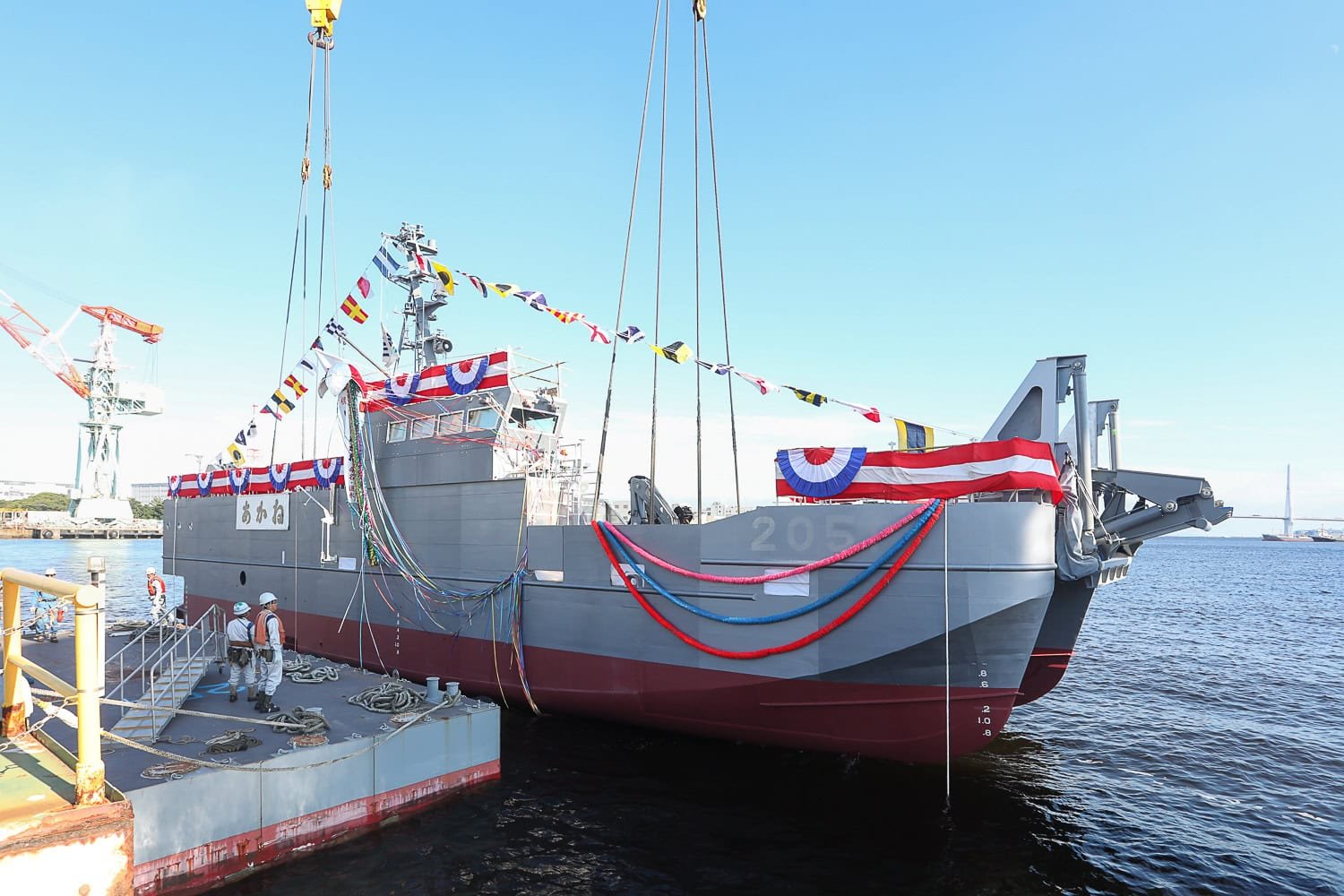
Japan has launched and named its first high-speed landing craft, as the country expands its ability to conduct rapid ship-to-shore operations across its southwestern islands.
Christened Akane, the aluminium-hulled vessel was unveiled at Japan Marine United’s (JMU) shipyard in Yokohama on 17 September 2026.
The 35m-long and 8m-wide vessel displaces approximately 150 tonnes, and it is based on the British BMT Caimen tri-bow landing craft design. The vessel features vehicle ramps at both the bow and stern, allowing it to embark and disembark vehicles and personnel from either end.
Japan’s Acquisition, Technology & Logistics Agency (ATLA) contracted BMT and JMU in December 2025 to design and build the vessel.
Graeme Nayler, BMT’s Managing Director Asia-Pacific, commented, “The programme is also significant in representing a rare instance of an overseas vessel design being adopted for a Japanese defence programme. We see this launch not as an end point, but as a milestone in a long-term commitment to Japan’s maritime sector.”
Nayler added, “It strengthens the defence industrial relationship between the United Kingdom and Japan, and it deepens BMT’s presence and partnerships across the Asia-Pacific region where so much of the future of maritime capability is being shaped.”
Three additional Akane-class vessels, also referred to as the Maneuver Support Vessel (MSV), are scheduled for delivery to the Japan Self-Defense Force’s Maritime Transport Group in FY2027. The vessels will eventually be based on Amami Oshima, between Kyushu and Okinawa.
Japan is constructing a new military port at Kojinaya on Amami Oshima, which is scheduled for completion in 2032. The facility is expected to support the Maritime Transport Group – which was stood up in March 2025 – and to improve Japan’s ability to move personnel, vehicles and equipment between its southwestern islands.
The Akane class forms part of a broader Japanese effort to strengthen ship-to-shore logistics and maritime mobility. In November 2024, Japan launched the 3,500-tonne Yoko-class landing support vessel (LSV) and the 2,400-tonne Nihonbare-class landing craft utility (LCU).

Together, these vessels are intended to provide the Japanese military with greater capacity to rapidly transport forces and heavy equipment to remote islands, supporting Japan’s growing emphasis on mobility and reinforcement across the Nansei Island chain.
Tokyo also confirmed in July 2026 that it is in discussions with Vietnam on the joint development and production of high-speed landing craft, although details of this potential cooperation remain scant.
A Caimen-90-derived design is also in service with the US Army, where it is known as the Maneuver Support Vessel (Light).
by Chen Chuanren
