

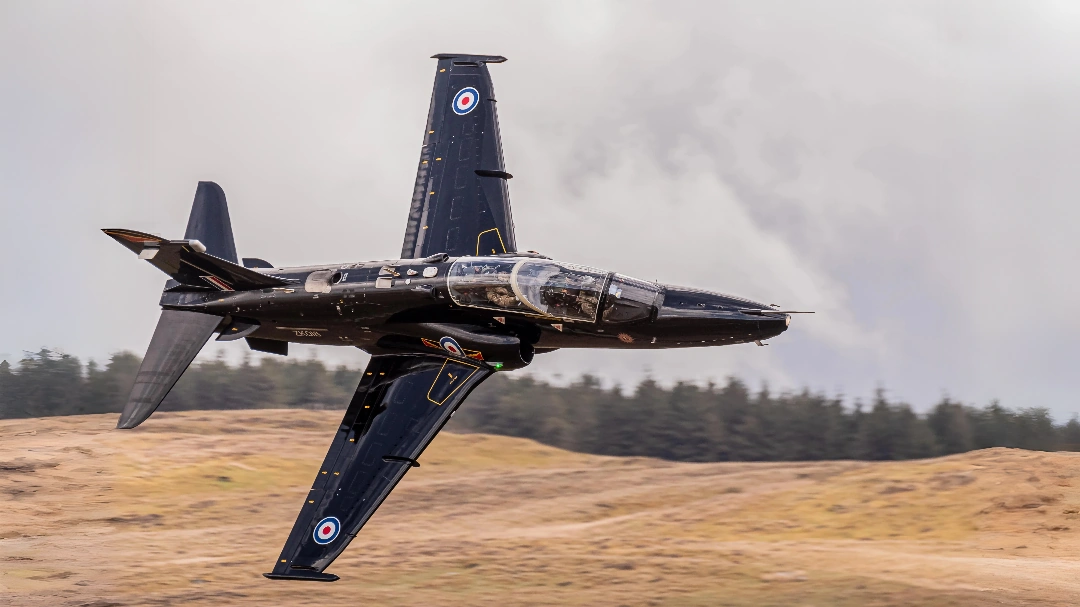
The BAE Systems Hawk T2 doesn’t need to be a fighter to teach fighter skills.
That’s the point.
At RAF Valley in Wales, student pilots use the Hawk T2 to learn how to manage radar contacts, electronic threats, weapons simulations, high-speed flight, and the workload of a modern combat cockpit. The aircraft gives them a taste of the job before they move into front-line jets such as the Eurofighter Typhoon.
The trick is what happens inside the cockpit.
The Hawk T2, also known as the Hawk 128, is a two-seat advanced jet trainer powered by a Rolls-Royce/Turbomeca Adour Mk 951 engine. The engine produces about 6,500 pounds of thrust, giving the aircraft enough performance for demanding fast-jet training without turning it into an expensive fighter substitute.
That distinction matters.
People often describe the Hawk T2 as a smaller version of a modern fighter. That misses the clever part. Its value comes less from raw speed or weapons and more from the systems wrapped around the pilot.
The cockpit uses a glass display layout, a head-up display, mission computers, and hands-on-throttle-and-stick controls. Students can also work with simulated radar and electronic warfare threats. They aren’t just learning how to fly the aircraft. They’re learning how to process information while flying it.
That’s a much harder problem.
Imagine a student trying to maintain formation while watching a simulated radar picture and responding to a threat. The instructor sitting behind them can build that scenario without needing a real enemy aircraft or live weapon.
I’ve always found that more interesting than the Hawk’s top-speed figure. A trainer that teaches the right decisions under pressure can be more useful than one that simply flies faster.
Read also: Top 5 Best Military Trainer Aircraft and What Makes Them Effective
The Hawk T2 was built around that idea.
It bridges the gap between basic flight training and the demands of a modern fighter cockpit, giving RAF pilots a place to make mistakes before those mistakes become expensive.
Hawk T2 Specifications: Speed, Engine, and Performance
The Hawk T2’s performance is built for one job: preparing pilots to handle fast jets without the cost and complexity of putting them straight into a fighter.
Its engine, size, and flight envelope give instructors room to teach advanced skills, while the aircraft’s training systems bring the real challenge into the cockpit. A large top-speed number makes a good headline. It doesn’t tell you how useful the aircraft is.
The BAE Systems Hawk T2 uses the Adour Mk 951 turbofan, which produces approximately 6,500 pounds of thrust. That power supports the aircraft’s transonic performance and gives students a platform for practising high-speed flight, aerobatics, and tactical manoeuvres.
Here are the commonly published Hawk T2 figures:
| Specification | Hawk T2 |
| Manufacturer | BAE Systems |
| Engine | Adour Mk 951 |
| Engine thrust | Approximately 6,500 lbf |
| Length | 12.43 m |
| Wingspan | 9.94 m |
| Maximum speed | Approximately Mach 0.84 |
| Maximum altitude | 42,000 ft |
| Crew | Two |
The aircraft measures about 12.43 metres long, with a wingspan just under 10 metres. Those dimensions help explain why the Hawk feels closer to a compact fighter than a basic trainer, yet remains manageable for instruction.
Its transonic capability is useful, but there’s a common mistake in how people read that figure. The Hawk T2 isn’t designed to match a Typhoon in speed or combat power. It’s designed to let pilots practise the skills needed before they operate one.
That means energy management, formation work, instrument flying, and tactical manoeuvres matter as much as the number on the speed gauge.
The two-seat layout is another practical advantage. The instructor can monitor a student’s decisions and intervene during demanding exercises. Training isn’t simply about sending a pilot into the air and hoping the flight goes well.
Read also: Boeing T-7A Red Hawk: How It Prepares Pilots for 5th-Gen Warfare
And the aircraft’s performance has limits. The Hawk T2 doesn’t provide the same thrust, sensor suite, or combat capability as a frontline fighter. Its value comes from the balance between flight performance, operating costs, and training systems.
That’s why judging the aircraft by speed alone misses the point.
For readers comparing trainers, the useful question is not whether the Hawk T2 is the fastest aircraft in its class. It’s whether the aircraft gives students enough performance to practise advanced skills while keeping training practical and repeatable.
The key takeaway: The Hawk T2’s specifications make sense when you view them as tools for pilot development, not as a fighter’s performance checklist.
Inside the Hawk T2 Cockpit and Advanced Avionics
The Hawk T2 cockpit is where the aircraft stops looking like a conventional trainer and starts behaving like a fighter school.
Its glass cockpit was designed around the workload of modern fast jets. Instead of forcing a student to scan a large collection of traditional gauges, the aircraft presents key flight and mission information through multifunction displays, a head-up display, and digital flight systems.
That changes how students learn.
A pilot isn’t simply watching airspeed and altitude anymore. They must manage navigation, tactical information, communications, and simulated threats while keeping control of the aircraft. That workload is closer to what they’ll face later in a Typhoon than the cockpit of an older training aircraft.

The Hawk T2 also uses hands-on-throttle-and-stick, or HOTAS, controls. The idea is simple: keep important functions close to the pilot’s hands so they don’t have to keep looking down at the instruments.
That sounds like a small detail. It isn’t.
During a demanding manoeuvre, even a short glance away from the outside view can matter. HOTAS lets pilots control key functions while keeping their attention where it belongs.
The head-up display, or HUD, pushes another layer of information into the pilot’s forward view. Flight and mission data can be presented without requiring the student to constantly look down at the cockpit displays.
Read also: T-45C Goshawk: The U.S. Navy’s Proven Carrier-Capable Jet Trainer
The Hawk T2 also uses mission computers to manage training functions and tactical information. This gives instructors a way to create scenarios that test decision-making rather than basic aircraft handling.
And there’s a useful distinction here. The Hawk T2 doesn’t need to carry every sensor found on a front-line fighter. Its systems can simulate capabilities such as radar while still giving students the experience of interpreting tactical information.
That is the clever part.
A student can learn how to manage a busy combat-style cockpit before stepping into a far more powerful aircraft.
How the Hawk T2 Simulates Radar, Weapons, and Electronic Warfare
The Hawk T2’s most useful combat systems are often the ones that aren’t physically there.
That sounds odd for a military aircraft. But it makes perfect sense for a trainer. The aircraft can create a simulated tactical environment inside the cockpit, letting students practise radar work, weapons employment, and electronic warfare without turning every training sortie into a live weapons exercise.
The synthetic radar is a good example. Instead of relying on a dedicated fighter radar to generate every contact, the Hawk T2 can present simulated radar information to the student. The pilot then has to interpret that picture, manage contacts, and make tactical decisions.
That tests the brain, not just the airframe.
The system can also introduce simulated threats into training missions. Surface-to-air missile systems, hostile aircraft, weapons effects, and other entities can be represented within the training environment. Students can therefore practise reacting to threats that would be costly or impractical to reproduce with real aircraft.

Electronic warfare adds another layer.
A pilot may have to recognize a simulated threat, decide what it means, and respond while still flying the aircraft. That combination is far harder than learning each task separately in a classroom.
Read also: Leonardo M-346 Master: Why This Jet Is Gaining Attention
The Hawk T2 also supports data links and mission planning functions, allowing training scenarios to involve more than one aircraft and create a shared tactical picture. After the flight, instructors can review what happened and use the results during debriefing.
This is where the Hawk T2 earns its keep.
A common mistake is to treat synthetic training as a cheaper replacement for flying. It isn’t. A simulator can’t reproduce every physical sensation of an aircraft in flight. But the reverse is also true: a real aircraft sortie doesn’t need to recreate every threat with live assets.
The Hawk T2 sits between those two extremes.
A student can fly a real jet, experience real acceleration and workload, then fight a simulated tactical battle at the same time. That’s a powerful combination, especially when the goal is to prepare for the information-heavy cockpit of a modern fighter.
The Hawk T2’s Role in RAF Pilot Training at RAF Valley
At RAF Valley, the Hawk T2 is where flying skill starts turning into fighter-pilot skill.
Students arrive with substantial flight training behind them. The job now changes. They have to fly accurately while learning how to fight, manage sensors, work with other aircraft, and make decisions under pressure.
That is why the Hawk T2 sits in the Royal Air Force’s advanced fast-jet training pipeline rather than basic flight instruction.
RAF Valley, on the island of Anglesey in North Wales, is home to the RAF’s fast-jet training operation. Student pilots use the Hawk T2 for advanced training before moving on to an operational conversion unit for their chosen fast-jet path.

The aircraft gives instructors a useful middle ground. It has enough performance for high-speed manoeuvres and tactical flying, but its two-seat arrangement allows an instructor to remain in the cockpit during demanding lessons.
That second seat matters more than it sounds.
A student can make a poor tactical decision and learn from it while the aircraft is still safely under instructor supervision. The instructor can also introduce a more difficult scenario as the student’s workload improves.
Training covers much more than simply learning to fly a Hawk.
Students work through formation flying, instrument flying, aerobatics, low-level navigation, and tactical exercises. The Hawk T2’s simulated systems add another layer, allowing pilots to practise weapons and sensor management without requiring every threat to exist physically in the sky.
The training environment also includes ground-based simulation. This matters because not every lesson needs an airborne sortie. A student can rehearse procedures and mission tasks on the ground before using valuable flight time to test them in the aircraft.
But the Hawk isn’t the final destination.
After advanced training, pilots who continue into the fast-jet stream move toward operational conversion on aircraft such as the Eurofighter Typhoon. The Hawk T2 therefore has a very specific purpose: make the jump to a front-line cockpit less abrupt.
And that’s probably the best way to judge it. Not by asking whether the Hawk can fight like a Typhoon, but whether it can teach a future Typhoon pilot to think like one.
Hawk T2 vs. Hawk T1: What Has Changed?
The easiest way to understand the Hawk T2 is to stop thinking of it as simply a newer Hawk T1.
The airframes share the same basic Hawk family heritage, but the cockpits and training systems serve very different eras of pilot training. The T2 was built to expose students to the kind of workload they would encounter in modern combat aircraft.
The Hawk T1 entered RAF service in the late 1970s and became one of Britain’s best-known trainers. It has also had a second life with the Red Arrows, where its flying qualities make it well suited to demanding display work.
The T2 arrived decades later with a very different training problem to solve.
| Feature | Hawk T1 | Hawk T2 |
| Generation | Earlier Hawk variant | Newer advanced trainer |
| Cockpit | Conventional instrument layout | Glass cockpit |
| Training focus | Basic and advanced flight training roles | Advanced fast-jet training |
| Mission systems | Older-generation architecture | Digital mission and training systems |
| Radar training | Limited compared with T2 | Synthetic radar capability |
| Electronic warfare training | More limited | Simulated EW environment |
| RAF role | Training and Red Arrows | Advanced fast-jet training |
The biggest change isn’t the shape of the aircraft. It’s the information presented to the pilot.
The T2’s multifunction displays, HUD, HOTAS controls, mission computer, and synthetic training systems create a cockpit that better reflects modern combat aviation. A student can practise managing tactical information rather than spending most of the lesson learning how to operate older analogue instruments.
That distinction matters when the next aircraft may be a Typhoon.

There’s also a common misconception that the T2 replaced every role performed by the T1. It didn’t. The two variants have occupied different roles within RAF aviation, and the T1 remains strongly associated with the Red Arrows.
So why not simply upgrade every T1?
Because modern pilot training isn’t just about adding a few new screens. The training architecture, mission computers, simulation systems, and cockpit philosophy have to work together.
The T2 was designed around that idea from the start.
That makes the difference less about old Hawk versus new Hawk and more about old training philosophy versus modern tactical preparation.
Why the Hawk T2 Remains Important for Future Combat Air Training
The Hawk T2’s real value is that it teaches pilots to manage complexity before they face the full cost of a front-line fighter.
A modern pilot can spend a large part of a mission dealing with information. Radar contacts, navigation, communications, threats, friendly aircraft, weapons data, and flight controls all compete for attention. The Hawk T2 gives students a place to build those habits early.
That makes synthetic training especially useful.
A real sortie has limits. Aircraft availability, weather, airspace, fuel, range, and safety all shape what instructors can do. A synthetic training system can introduce scenarios that would be difficult to reproduce with live aircraft.

The RAF has also been moving toward more immersive training at RAF Valley. In 2026, the service announced mixed-reality upgrades for training devices used by Hawk T2 and Texan student pilots. The aim is to let students rehearse tasks such as circuits, formation flying, and low-level navigation in a virtual environment before putting those skills to work in the aircraft.
That’s not a replacement for flying.
It works best as preparation for flying.
A student can make the basic mistakes on the ground, then spend airborne training time dealing with the harder parts of the lesson. That can make each flight more focused.
The same principle applies to tactical training. Creating a simulated radar contact or electronic threat costs far less than putting another real aircraft into the sky solely to provide a training target.
But there’s a limit.
No screen can perfectly reproduce the physical forces, vibration, sound, acceleration, and workload of a real jet. The Hawk T2 therefore remains valuable precisely because it combines both sides: real flight with synthetic tactical scenarios.
That’s also why the aircraft shouldn’t be judged by whether it looks dated next to a Typhoon or F-35. A trainer doesn’t need to dominate the aircraft it prepares pilots to fly.
It needs to teach the right habits.
And the Hawk T2’s strongest habit is learning to keep flying the aircraft while making decisions inside a crowded tactical picture. For an aspiring fighter pilot, that’s the skill worth carrying into the next cockpit.
