

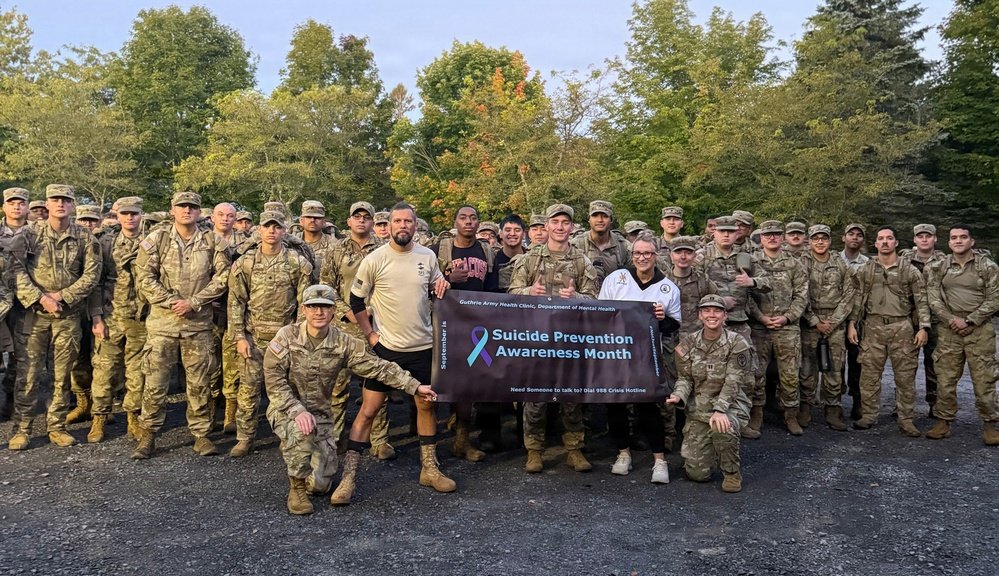
While ruck marches help Soldiers hone combat readiness and mental toughness, this one had a distinct mission: promoting open dialogue for Suicide Prevention Month.
Bill Van Orman, Fort Drum Suicide Prevention Program coordinator, said the “No One Climbs Alone” ruck march served to foster connection and communication among service members. Like the Get a Grip competition last week, the event used a physical challenge as a bridge to build bonds.
Van Orman said that having trusting relationships is one of the most effective safeguards against isolation.
“We’re all tribal creatures, so you need to find your tribe,” he said. “Those relationships build resilience and they’re a huge protective factor. If I’m struggling and I start to isolate, I need those people who will be like, ‘Hey, I haven’t seen you in a bit, what’s going on? What can I help you with?’”
To reinforce that message, Van Orman teamed up with Ready and Resilient (R2) professionals who work with Soldiers on performance optimization through mental skills and resilience training.
“R2 is all about cognitive training,” said Victoria Blakeslee, R2 master resilience trainer. “Everything that we do is rooted in ‘control the controllables.’ With suicide prevention, oftentimes in those moments it feels like a total loss of control. And that is where mental skills training can, hopefully, be inserted proactively.”
Blakeslee said that partnering with the Suicide Prevention Program on different occasions helps illustrate practical ways Soldiers can cope with adversity and navigate stress.
“But one of the biggest myths of resilience is that resilient people handle everything on their own,” she said. “Research shows time and time again that the most resilient people not only know how and when to reach out to others for support, but they also know who they can reach out to for support.”
Blakeslee said that Army life can feel isolating at times, but she assured Soldiers that they are surrounded by support.
“I promise you that if you look for the connections, they are there,” she said. “There are so many people here who want to support you … who want to be your battle buddy.”
Stationed along the trail, representatives from R2 and the Family Advocacy Program presented discussion prompts addressing healthy relationships, conflict resolution, and active listening.
Among the participants was Capt. Montgomery Potter, with 2nd Battalion, 10th Aviation Regiment, 10th Combat Aviation Brigade, rucked alongside his co-pilot Spc. Bryan Fuentes. He said that clear communication is as much an operational requirement in the cockpit as it is an everyday life skill.
“We have a concept called positive communication,” Potter said. “Most people hear that and they think that means being a good mood. But in air crew coordination, it means that what is transmitted must be received. If I’m initiating my approach to a landing zone, I will communicate that to my co-pilot, and he will respond back that the message was received. So, open communication is great in our line of work, but it extends to personal relationships as well.”
