

by Tatum Delaney
The countdown ticks forward, each second marching the Arctic ice closer to its liquid form. Some see opportunity in what will be left behind: new sea lanes, access to resources, and expanded commercial activity. Others see danger in a region where governance structures and territorial claims are outpaced by national ambitions. Is the United States prepared for the risks of a rapidly changing Arctic?
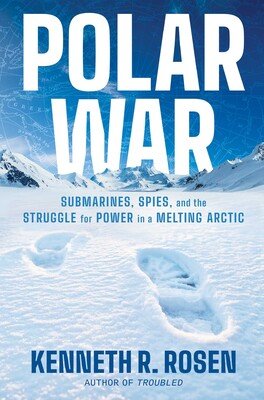
Author Kenneth R. Rosen confronts this question through more than two years of investigative reporting with military units, scientific stations, and remote communities in Polar War: Submarines, Spies, and the Struggle for Power in a Melting Arctic. Rosen argues that the United States has fallen behind evolving threats along its northern flank, hampered by decades of inadequate investments. Although his reporting spans multiple Arctic Council states, Rosen’s greatest contribution lies in his pointed vignettes of U.S. preparedness. Through poorly suited infrastructure, broken equipment, inexperienced crews, and isolated service members, Polar War makes the consequences of neglect tangible.
Despite the high stakes, Rosen’s depictions of deficient infrastructure can be unexpectedly comedic. He recounts his experience aboard the USCGC Healy, one of the United States’ few icebreakers, as its crew struggles with a small boat transfer alongside a Norwegian vessel:
They find “the marine off-load release—the device connecting the American small boat to a crane and winch—is stuck, frozen stiff, caked in a thin layer of ice.
“Looks like you need a mallet,” I say.
“I am a mallet,” comes the petty officer’s response as he hacks away at the device with a piece of flotsam.”
The contrast becomes sharper when Rosen describes the Norwegian vessel’s design. Its covered launch wells cradle the small boats, keeping them ice-free and ready for immediate deployment. Polar War is at its strongest in moments like these, using small failures to expose larger institutional problems.
The Healy’s recurring equipment failures and the crew’s improvised solutions create the impression of a vessel struggling with reliability, even under routine conditions. The consequences become more serious when a Russian vessel approaches the Healy and launches a helicopter overhead. Although the Healy is outfitted with aircraft hangars, budget constraints have left them empty. Icy wings delay the arrival of a P-8 Poseidon, allowing the Russian ship to depart before the United States could respond with any meaningful display of airpower. For Rosen, the encounter demonstrates how distance, weather, and limited capabilities can constrain U.S. strategy.

The shortcomings extend well beyond any single vessel. Throughout the book, Rosen documents how budget shortfalls and inadequate winterization affect U.S. military infrastructure across the Arctic. Runways and barracks in Alaska and Greenland suffer from structural problems. Units lack equipment suited to Arctic conditions. The Polar Security Cutter Program faces persistent delays, while Alaska continues to have insufficient deep-water port infrastructure supported by storage and container facilities. Even the basic systems that sustain personnel in the field can be inadequate. Among Rosen’s most striking accounts are nurses resorting to sous vide machines in hardware store buckets to maintain medication temperatures, despite the availability of heated medical chests. Again, Rosen captures how deficient investment leaves personnel improvising when purpose-built solutions already exist.
Rosen situates these failures within a broader pattern of deferred decision-making. The same logic that slowed U.S. investment in climate adaptation, he argues, has long shaped its approach to the Arctic. For decades, the region was treated as an expensive future problem and sidelined in favor of more immediate theaters of conflict. Even with that progress, the consequences of delay may be difficult to overcome quickly. Rosen warns that this lag could yield strategic advantages to an adversary like Russia, which has actively worked to cultivate its Arctic presence.
Still, not every gap Rosen identifies necessarily represents simple neglect. Maintaining infrastructure and specialized capabilities in one of the world’s most remote and expensive operating environments requires difficult resource tradeoffs, and the United States has faced competing priorities elsewhere. Readers may reasonably question whether some shortcomings reflect strategic prioritization rather than institutional indifference. Nevertheless, Rosen convincingly argues that the cumulative effect of these choices has left the United States with a force operating in the Arctic without the infrastructure, equipment, or experience necessary to do so effectively.
“We are an Arctic nation that doesn’t know how to be an Arctic nation,” observes Captain Krautler of the USCGC Stratton. Rosen recalls Krautler’s concern for his crew as they conduct wintertime inspections in the Bering Sea for the first time. The boardings go poorly, with Lieutenant Mike He later describing one as “embarrassing.” As these accounts accumulate, Polar War generates a sense of unease, not because personnel lack commitment or professionalism, but because they are asked to operate in an environment with limited domain-specific preparation.
These challenges are compounded by the constant rotation of personnel through Arctic assignments. At an Army readiness exercise in Alaska, a drone operator suggests that Arctic units should be all-volunteer. “Most people are only here for three years,” he explains. “By the time someone figures out their job, they are gone.” Institutional knowledge drains away just as hard-earned experience begins to accumulate. Rosen contends that addressing this churn requires more than increased recruitment; it demands an institutional culture better suited to Arctic conditions.
The human costs of failing to adapt are perhaps the book’s most sobering dimension. Rosen speaks with Delilah, a mortician in Anchorage, who has become familiar with receiving the bodies of service members from the 11th Airborne Division following suicide. Unlike rotational units that merely train in Alaska, the so-called Arctic Angels live—and sometimes die—there. Rosen’s reporting here shifts Polar War from questions of infrastructure and operational capability toward the sustainability of maintaining a military presence in such an unforgiving environment. Isolation, extreme weather, and the demands of Arctic service can become more than obstacles to readiness; they can fundamentally affect the lives of those asked to endure them.
Some tentative progress emerges through grant-funded initiatives with the Center for Alaska Native Health Research. They draw inspiration from the Qungasvik approach to reducing suicide among Alaska Native youth. The program offers avenues for improving mental health and resilience within Arctic units by fostering community connection, particularly among mid-level enlisted leadership. Targeting interventions at these leaders is intended to instill a sense of unity with and among the combat soldiers they interact with and train on a daily basis. Critically, rather than simply asking personnel to endure Arctic conditions, such efforts attempt to adapt systems of support to the realities of living and operating there.

Taken as a whole, Rosen’s reporting suggests that Russia’s advantage in the Arctic stems not only from technological superiority, but from decades of sustained presence, domain specialization, and familiarity with the region. In contrast, the United States has historically approached the Arctic more episodically, deferring infrastructure investments and rotating personnel through an environment where experience is particularly difficult to acquire and retain.
Yet the value of sustained presence should not be understood as entirely fixed. Rosen gives relatively little attention to how warming temperatures may also complicate the maintenance of Arctic infrastructure built for a different climate. As permafrost thaws, destabilized ground can damage foundations, walls, and floors, potentially turning long-established infrastructure into an increasingly expensive liability. The United States faces these challenges as well, but future investments may offer an opportunity to build with a changing Arctic in mind rather than adapting infrastructure designed for conditions that no longer exist.
Readers seeking a systematic assessment of Arctic force balances or a comprehensive academic treatment of the region’s security environment may find Rosen’s episodic approach less satisfying. The vignette-driven structure can leave readers wondering how representative individual failures are of the broader U.S. posture. For readers who are solution-oriented, the book ends with recommendations for how the United States might move forward. But its greatest strength lies more in diagnosis than prescription. Rosen excels at making strategic problems feel immediate. Taken together, his anecdotes reveal how grand strategy is experienced by the people responsible for carrying it out. In doing so, Rosen connects broad debates about Arctic competition to the realities of operating in the region. Polar War offers readers an accessible and unsettling account of what happens when a nation begins preparing for a theater only after its importance has become clear.
Climate change is wearing away the ice buffer that once insulated the United States from greater northern risks. As sea ice recedes, the margin for error may recede with it. The Arctic is no longer a distant frontier, but an operating environment whose strategic importance is increasingly difficult to defer. Rosen ultimately asks whether the United States will develop the capacity to meet that challenge or arrive too late to act.
Tatum Delaney is a Ph.D. researcher in the Ashley School of Global Development and the Environment at Cornell University. She is a National Defense Science and Engineering Graduate Fellow with the U.S. Air Force Research Laboratory in Political, Economic, and Sociocultural Sciences. Her current work primarily focuses on fisheries enforcement and management challenges in Alaska, including Coast Guard operations.
Featured image: U.S. Coast Guard Cutter Healy (WAGB 20) crew and researchers install equipment on a floe of multi-year ice in the Beaufort Sea, Aug. 9, 2023. (U.S. Coast Guard photo by Petty Officer 3rd Class Briana Carter)
Discover more from Center for International Maritime Security
Subscribe to get the latest posts sent to your email.
