

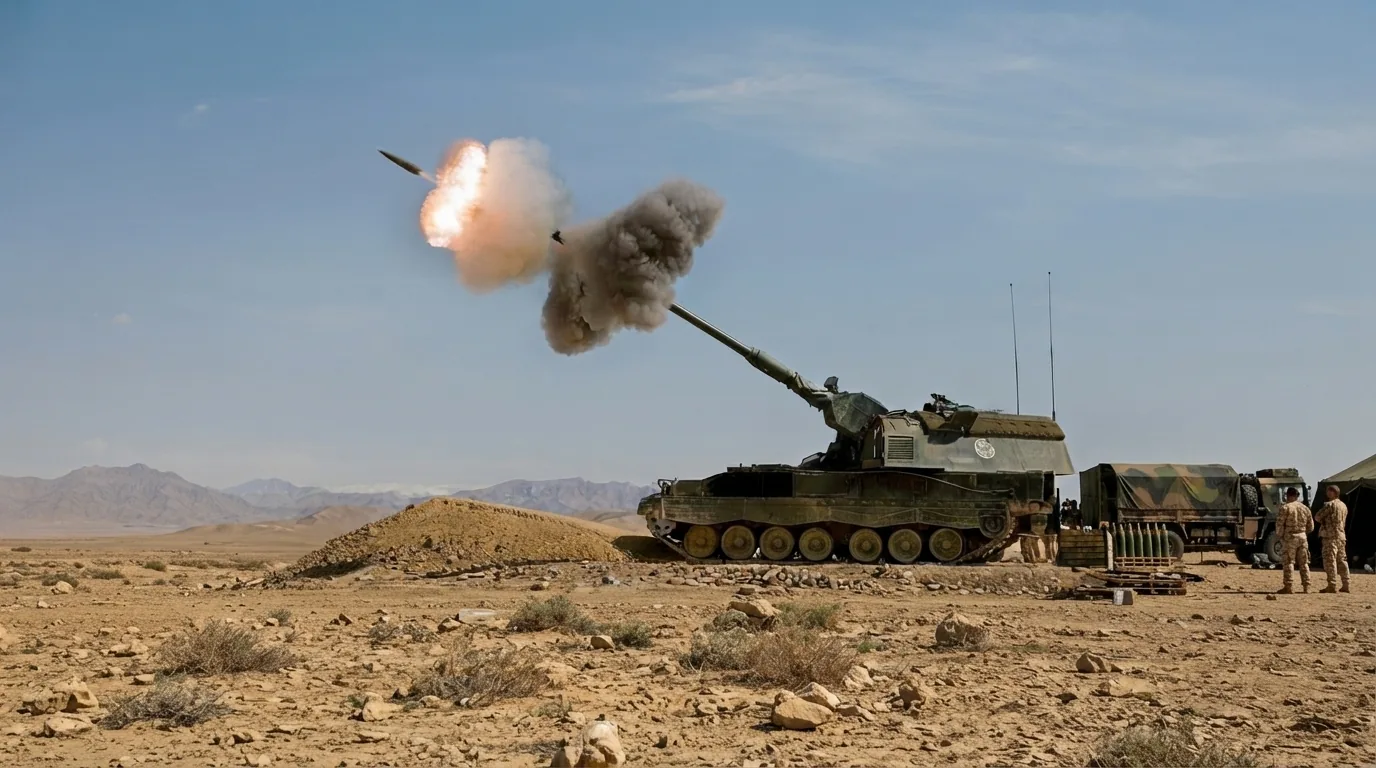
A howitzer can throw a shell farther than its rival and still be the less useful weapon.
That sounds backward, but artillery isn’t a drag race. A crew needs to receive a target, get into position, fire, survive the enemy’s response, and move before counter-battery fire arrives. The best self-propelled howitzers compress that whole cycle.
That’s why the usual answer to “what is the most powerful self-propelled howitzer?” can be misleading. People often grab the biggest range figure and stop there.
A PzH 2000, for example, can reach about 54 km with suitable extended-range ammunition, while the Archer is advertised at more than 50 km depending on ammunition. But those numbers don’t tell you how quickly each system can fire, relocate, reload, or protect its crew.
For this list, I’m treating power as a combination of firepower, range, rate of fire, mobility, automation, ammunition capacity, and battlefield survivability. That gives us a much better way to compare modern 155 mm systems with the Russian 152 mm Koalitsiya-SV.
There’s another wrinkle. Manufacturer figures aren’t always directly comparable. A quoted maximum range may depend on a special projectile, while a standard high-explosive round reaches much less.
So don’t read this as five machines sorted by one giant number.
Think of it as five different answers to the same artillery problem: how do you put a lot of explosive on target, then avoid becoming a target yourself?
And that is where the real differences start.
1. PzH 2000, Germany’s Heavyweight Artillery Benchmark
If you want one machine that shows why modern artillery is about more than range, start with the PzH 2000.
Its core advantage is simple: the system puts a powerful 155 mm/L52 gun on a heavily protected tracked chassis, then surrounds it with enough automation to fire rapidly without turning the crew into ammunition handlers. KNDS lists a combat weight of 57 tonnes, a road speed above 60 km/h, and a crew of three plus two reserve positions.
Here are the numbers that matter:
| Specification | PzH 2000 |
| Main gun | 155 mm/L52 |
| Combat weight | 57 tonnes |
| Road speed | More than 60 km/h |
| Ammunition | 60 projectiles |
| Modular charges | 288 |
| Burst rate | 3 rounds in 10 seconds |
| Maximum listed rate | Up to 10 rounds/min |
| Range | About 40 km with base-bleed, up to 54 km with V-LAP |
| Crew | 3 + 2 reserve |
The range figures need some context. A common mistake is to write “54 km range” as if every shell can travel that far. It can’t. KNDS gives about 40 km with base-bleed ammunition and up to 54 km with V-LAP, while other ammunition can produce different results.
The bigger story is the loading system.
The PzH 2000 carries 60 primed projectiles and uses an automated loading system to feed them into the gun. Its documented burst rate is three rounds in 10 seconds, with a stated maximum rate of up to 10 rounds per minute.
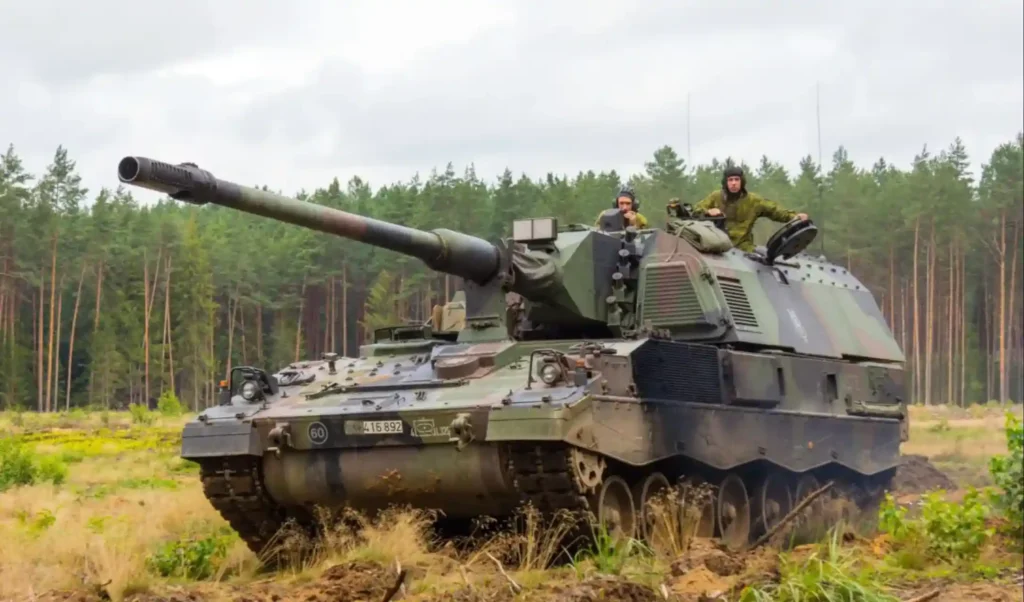
That changes how the vehicle fights. It can deliver a short, violent burst without sitting still for minutes while the crew manually handles every round.
KNDS also describes a rapid “shoot and scoot” cycle, with the system able to come into action in about 25 seconds and leave its firing position shortly afterward.
That’s why I wouldn’t judge the PzH 2000 by its 54 km figure alone. Its real strength is the combination of heavy firepower, deep onboard ammunition, automation, protection, and rapid movement after firing.
For a tracked artillery system, that’s a hard package to beat.
2. K9 Thunder, South Korea’s Mobile Artillery Powerhouse
The K9 Thunder takes a different route to artillery power. It doesn’t try to be the heaviest machine in the field. Instead, it combines a 155 mm/L52 gun with speed, automation, and enough protection to keep pace with armored units.
That balance is a big reason the K9 has become one of the most widely adopted modern self-propelled howitzers.
The baseline K9 uses a tracked chassis and a 155 mm/L52 weapon. Hanwha Aerospace lists a maximum road speed of 67 km/h, while the vehicle carries 48 rounds. Its standard maximum firing range is around 30 km, rising to roughly 40 km with rocket-assisted ammunition.
| Specification | K9 Thunder |
| Main gun | 155 mm/L52 |
| Combat weight | About 47 tonnes |
| Road speed | 67 km/h |
| Ammunition | 48 rounds |
| Standard range | About 30 km |
| Extended range | About 40 km |
| Crew | 5 |
| Engine | 1,000 hp |
The numbers explain the design philosophy. With a 1,000 hp engine pushing a vehicle of roughly 47 tonnes, the K9 has a strong power-to-weight ratio for a tracked artillery platform. That matters when artillery units have to reposition repeatedly rather than sit behind the front line.
Its automatic loading system also reduces the physical work required from the crew. The K9 can fire three rounds within 15 seconds during a burst, then continue firing at a lower sustained rate.

And here’s where the K9 gets more interesting: the platform has become a family rather than a single vehicle.
South Korea developed the K9A1 and K9A2 upgrades, while export customers have introduced local variants such as Poland’s K9PL. The K9A2 moves toward greater automation, reducing crew workload and aiming to raise the system’s firing performance.
I’ve always found the K9 more interesting than raw range charts suggest. A 40 km maximum tells only part of the story. A gun that can relocate quickly, carry 48 rounds, and operate with a mature logistics network has value that doesn’t show up beside a range number.
That combination is what makes the K9 Thunder one of the most powerful self-propelled howitzers in service today.
3. RCH 155, Germany’s Next-Generation Wheeled Howitzer
The RCH 155 is where self-propelled artillery starts looking less like a traditional gun vehicle and more like a remotely operated weapons system on wheels.
Its key feature isn’t simply the 155 mm gun. It’s the automated artillery module mounted on a Boxer 8×8 chassis, which allows the crew to operate from the protected hull rather than sitting inside the gun turret during firing. That separation gives the design a very different approach to crew safety and mobility.
The RCH 155 uses a 155 mm/L52 weapon and carries 30 rounds with their associated charges. KNDS gives the system a maximum range of up to 40 km with conventional ammunition and up to 54 km with V-LAP ammunition. Its combat weight is about 39 tonnes, considerably less than a PzH 2000.
| Specification | RCH 155 |
| Main gun | 155 mm/L52 |
| Chassis | Boxer 8×8 |
| Combat weight | About 39 tonnes |
| Ammunition | 30 rounds |
| Conventional range | Up to 40 km |
| V-LAP range | Up to 54 km |
| Maximum road speed | About 100 km/h |
| Crew | 2 |
That weight difference matters. A wheeled vehicle weighing around 39 tonnes can be moved by road with fewer constraints than a 57-tonne tracked PzH 2000. The Boxer chassis also gives the RCH 155 a road speed of about 100 km/h.
But its most talked-about feature is the ability to fire while moving.
KNDS has demonstrated this capability with the RCH 155, using the gun system while the Boxer vehicle is in motion. It sounds like a gimmick until you consider the counter-battery problem. If the vehicle doesn’t need to stop before firing, the window in which an enemy can target it becomes much harder to exploit.
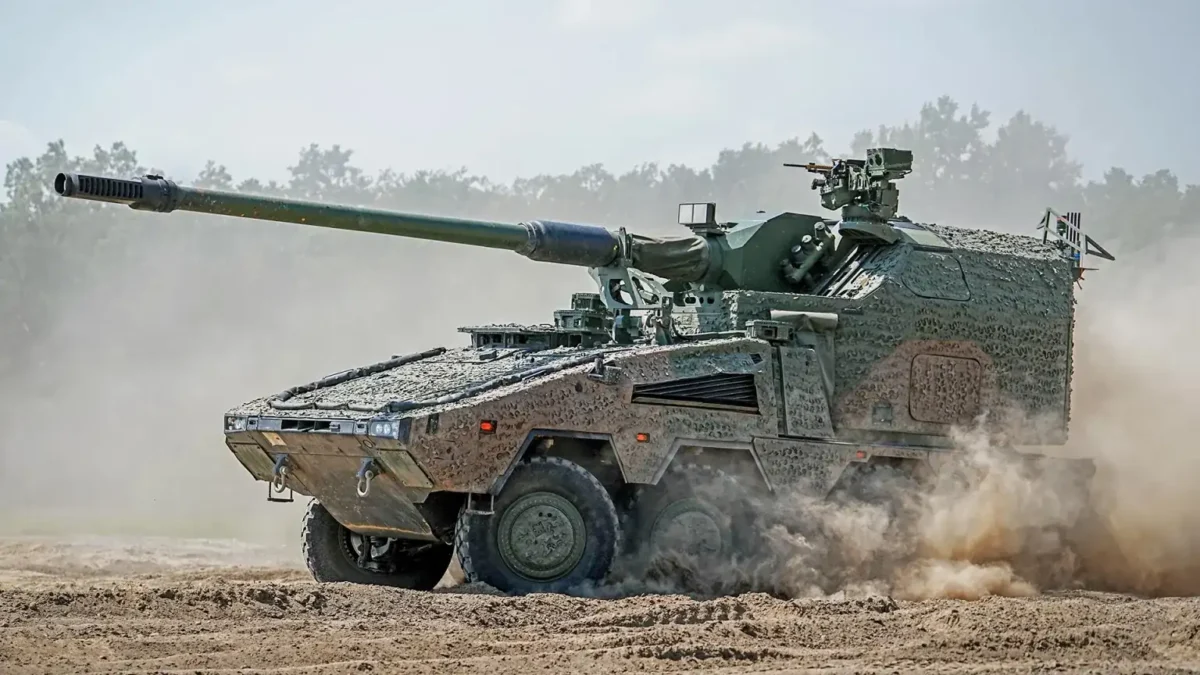
The catch is that “firing on the move” shouldn’t be confused with firing at peak accuracy under every condition. Terrain, vehicle movement, fire-control data, ammunition, and target distance all affect practical performance.
The RCH 155 also isn’t designed to carry the same ammunition depth as the PzH 2000. Its 30-round capacity is half that of the heavier German system.
So why put it among the most powerful self-propelled howitzers?
Because survivability increasingly depends on how little time an artillery crew spends exposed at one firing point. The RCH 155 pushes that idea further than most conventional howitzers, and that’s what makes it worth watching.
4. Archer Artillery System, Sweden’s Fast-Shooting Specialist
The Archer doesn’t need a tracked chassis to hit hard. Its whole design is built around getting into position, firing quickly, and disappearing before the enemy can react.
That makes it one of the most interesting wheeled self-propelled howitzers in service.
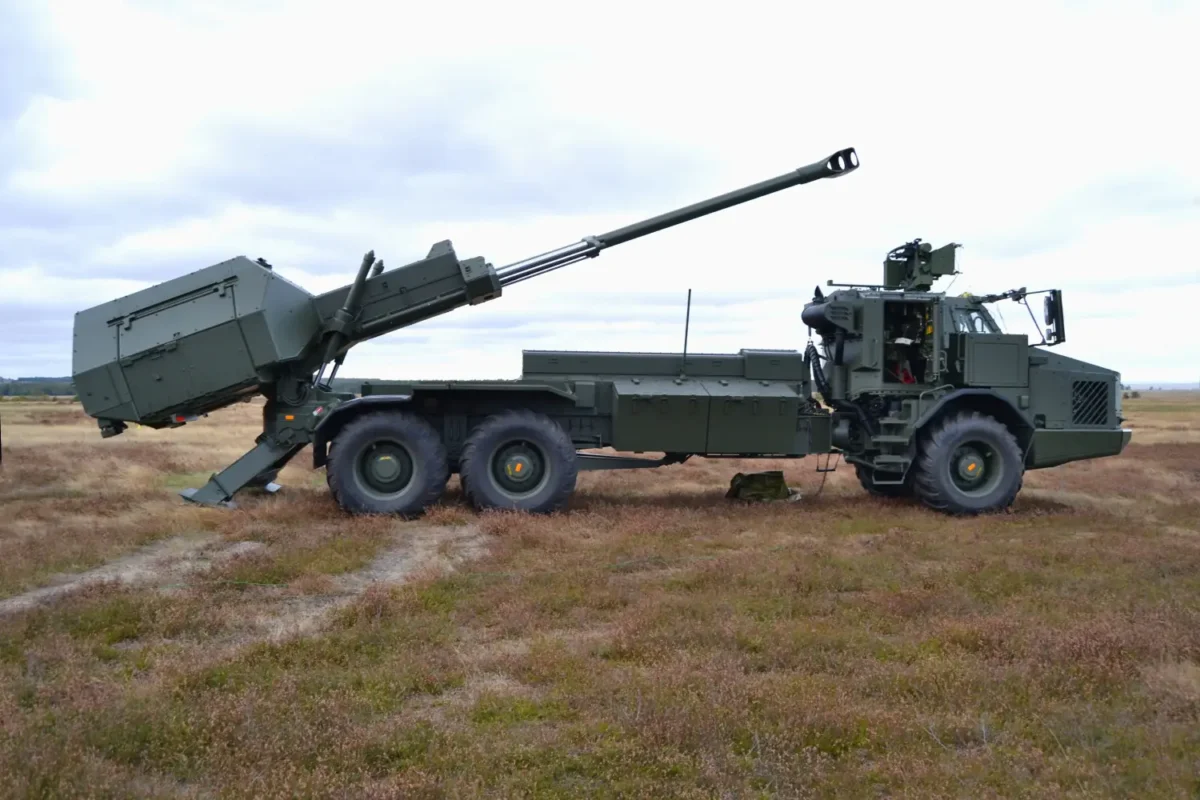
Developed by BAE Systems Bofors for Sweden, Archer uses a 155 mm/L52 gun mounted on a 6×6 articulated truck. The vehicle carries 21 rounds and can reach a road speed of roughly 90 km/h. Its automated loading system allows the crew to remain inside the protected cab while the gun is prepared and fired.
| Specification | Archer |
| Main gun | 155 mm/L52 |
| Chassis | 6×6 wheeled |
| Combat weight | About 33 tonnes |
| Ammunition | 21 rounds |
| Maximum range | Up to 50 km+ |
| Road speed | About 90 km/h |
| Crew | 3 |
| Deployment time | About 30 seconds |
The firing sequence is what separates Archer from ordinary truck-mounted artillery.
BAE Systems says the system can fire three rounds in 15 seconds and leave its position in roughly 30 seconds. The entire firing process is heavily automated, so the crew doesn’t have to climb around the rear of the vehicle feeding individual shells into the breech.
That matters because artillery survivability increasingly comes down to time.
A gun that takes several minutes to prepare and then remains exposed while its crew reloads gives counter-battery systems a much easier target. Archer attacks that problem from the other direction. It can arrive, fire a rapid salvo, and move before the firing position becomes predictable.
But there’s a price.
Its 21-round ammunition capacity is much lower than the PzH 2000’s 60 rounds. Archer also doesn’t have the same cross-country mobility as a heavy tracked system when terrain gets truly ugly.
That’s the trade I find most revealing. Archer isn’t trying to replace a tank-like artillery vehicle. It’s optimized for road mobility, rapid deployment, automation, and short exposure times.
Its maximum range can exceed 50 km with suitable ammunition, but that figure shouldn’t overshadow the more useful question: how quickly can the system complete the entire fire mission?
For modern artillery, that clock may matter more than another few kilometers of range.
5. 2S35 Koalitsiya-SV, Russia’s Long-Range Artillery Gamble
The 2S35 Koalitsiya-SV is built around a simple idea: push the range and rate of fire of self-propelled artillery much farther.
Unlike the 155 mm systems above, the Koalitsiya-SV uses a 152 mm gun. Its unmanned turret and automated ammunition handling are meant to reduce crew exposure while allowing the vehicle to maintain a high firing tempo.
The published figures are impressive, but this is also where readers need to separate specifications from battlefield proof. Russian sources have reported ranges approaching 70 km with specialized ammunition and firing rates of around 15 rounds per minute. Those figures are not directly comparable with every Western system’s standard ammunition data.
| Specification | 2S35 Koalitsiya-SV |
| Main gun | 152 mm |
| Chassis | Tracked |
| Crew | About 3 |
| Reported maximum range | Up to about 70 km |
| Reported rate of fire | Up to about 15 rounds/min |
| Turret | Unmanned |
| Loading system | Automated |
The unmanned turret is the part worth watching. The crew sits inside the hull while mechanical systems handle the ammunition and gun operations. That changes the internal layout and removes people from the turret, which can improve crew protection if the turret is damaged.
But automation creates its own demands. Ammunition handling has to work reliably under dust, vibration, heat, and repeated firing. A paper specification doesn’t tell you how well that machinery performs after hours of sustained combat.
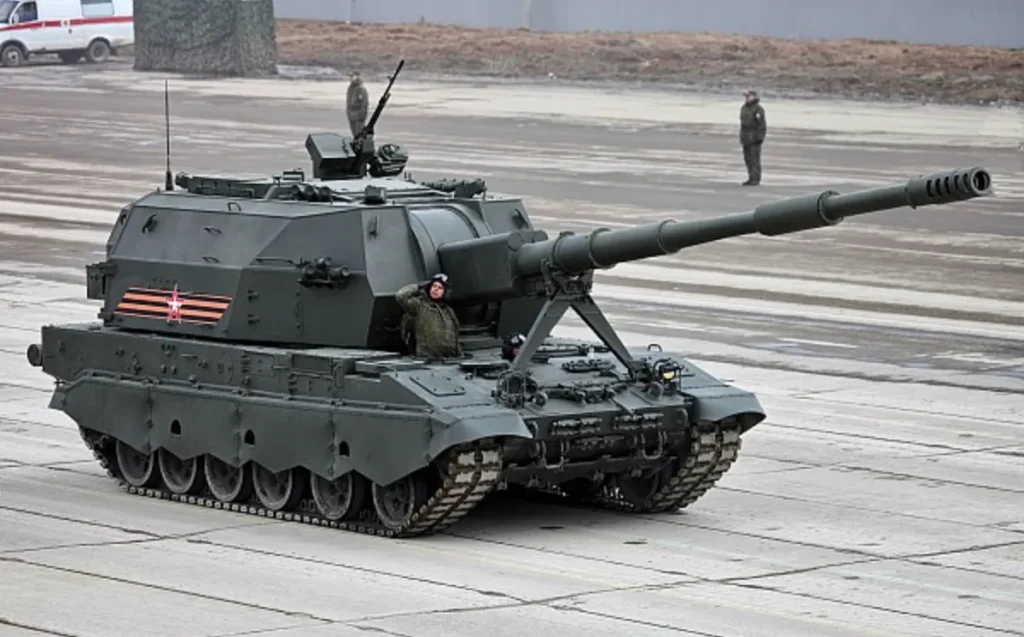
The Koalitsiya-SV also arrived much later than Russia’s familiar 2S19 Msta-S, and production and deployment have been far more limited. Public information about its real combat performance is still thinner than the marketing figures suggest.
That distinction matters.
I’ve seen artillery comparisons treat the 70 km figure as settled fact and then rank the Koalitsiya-SV above everything else. That’s too simple. A maximum range achieved with a specialized projectile isn’t equivalent to the everyday range of a gun firing conventional ammunition.
Still, the design deserves attention. Its 152 mm weapon, automated turret, high claimed firing rate, and long-range ammunition show where Russian artillery development has been heading.
The Koalitsiya-SV may have the most eye-catching numbers on this list. The harder question is how consistently those numbers translate into sustained battlefield performance.
Which Self-Propelled Howitzer Is the Most Powerful?
There isn’t a single specification that settles this.
If “most powerful” means the biggest published range figure, the 2S35 Koalitsiya-SV gets attention with Russian claims of roughly 70 km using specialized ammunition. If it means a mature combination of firepower, ammunition capacity, protection, automation, and mobility, the PzH 2000 presents a very different case.
That’s the problem with simple artillery rankings. They turn a system designed for a complete fire mission into a spreadsheet of numbers.
Look at the PzH 2000. Its 60-round ammunition load is three times Archer’s 20-plus rounds, while its automated loading system supports very high short-term firing rates. The K9 Thunder offers a similar 155 mm/L52 concept in a lighter package, with 48 rounds onboard and a 1,000 hp engine.
The wheeled systems make another trade. Archer and RCH 155 sacrifice ammunition capacity for road speed and rapid movement. The RCH 155 can reach about 100 km/h on roads, while Archer is around 90 km/h. Those figures matter when an artillery unit has to shift positions repeatedly.
Then there’s the question of evidence.
The Koalitsiya-SV is an impressive design on paper, but public information about its sustained combat performance remains much thinner than the data available for systems such as the PzH 2000 and K9. A claimed 70 km maximum shouldn’t automatically outrank a thoroughly fielded system with a lower published figure.
The textbook answer is often “longer range equals more powerful.”
It doesn’t.
A 50 km shot means little if the ammunition isn’t available, the fire-control network can’t generate a reliable solution, or the gun has to remain exposed after firing. Artillery works as a system, not as a cannon sitting alone on a specification sheet.
For readers comparing the most powerful self-propelled howitzers, the useful question is therefore narrower: which system best combines range, firing speed, ammunition capacity, mobility, crew protection, and the ability to survive after firing?
Use that checklist when comparing future artillery systems. It will tell you far more than the largest number in a brochure.
