

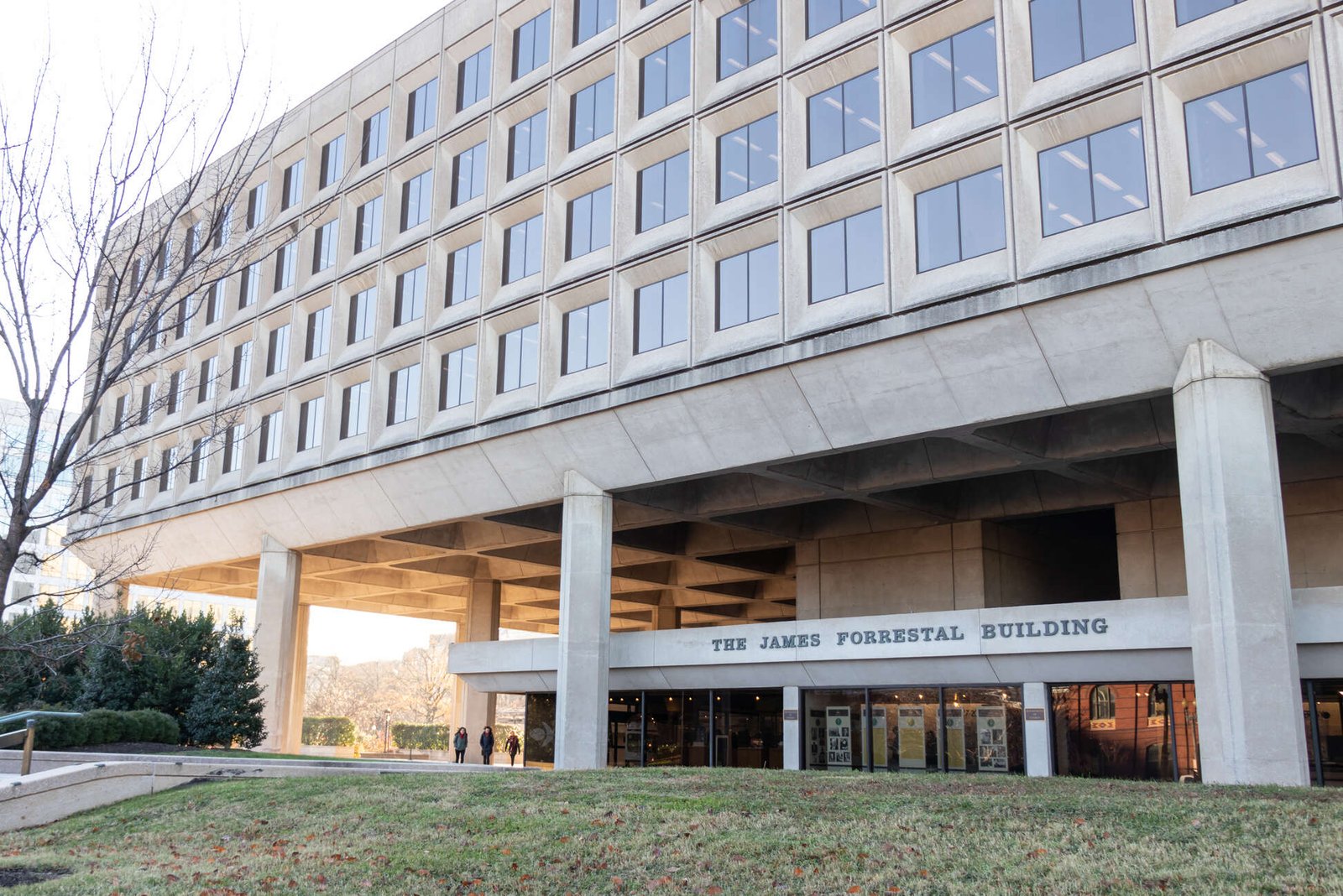
Terry Gerton David, let me start with you. A lot of our listeners may never have even heard of the Forrestal building or they might drive by it every day and not know that that’s what it is. Why has this federal office complex become such an important test case for the future of federal real estate?
David Winstead Terry, I think the Public Building Reform Board was created by the FASTA Act in Congress back in 2019. So it was created quite a while ago, and it was a bipartisan effort. Our board is consisted of six people that have been appointed by the White House, basically. And we have been underway and looking at the target of examining the federal buildings. We’re an independent federal agency. But because of COVID and because of telework policy, as you know, across the board, people are not in the office buildings as much as they used to be pre-COVID. So our board has been looking now for five years or six years at GSA’s federal inventory, working with them very closely, communicating. We actually have an office, the GSA building near the disposal division, near the portfolio division of GSA public building service. So we have been working closely taking independent look at these buildings. And the Forrestal Building kind of stood out because it’s a million and a half square foot building at the headquarter of the Department of Energy. But what was discovered three years ago, four years ago on initial analysis was the utilization of the Forrestal building was extremely low, you know, probably around in those years following COVID. So we took a look at that and realized that as a part of our recommendations to OMB, GSA and Congress, that the Forrestal Building, you know, should be on that list. 40% of the GSA’s real estate nationwide is in the Washington metropolitan area. When you have a bill, you know costs basically $41 million a year to operate and you have utilization of 20 and range of 20 to 28 percent. You know, that is an asset, a federal asset, that needs to be looked at in terms of the economic rationale for maintaining it. So the Forrestal building was a part of our round two recommendations that came out a year and a half ago, and it candidly, as Diane will say, it has major benefits. The only last, in terms redeveloping the site, it’s not worth, keep paying $40 million a year. Which puts the cost per federal employee over $100,000 a year when office space in the District of Columbia is in the range of $10,000 to $15,000 per person. So it economically didn’t make any sense. And my last comment, I’d love to talk more about why it’s a great opportunity, but is that Ed Forst, who’s the administrator at GSA, is very aggressively taking the lead on this. He is working with MCPC, as Dan will tell you, he’s bringing in the community of interest planners, district department of planning, district department economic development. And as recently as two weeks ago, he was at a public forum saying, you know, the Forrestal is a great opportunity because we’re working with DOE, we have better housing solutions for them, and they’re great benefits to looking at the four parcels that make up the Forrestal site in terms of potential redevelopment for lots of uses, including potentially museums, near the mall, on the mall. And so that’s really why we focused on Forrestal and it was listed in our round two recommendations a year and a half ago.
Terry Gerton Diane, David’s just made a great case for why it’s not economically feasible to continue to occupy the Forrestal building, but you and the National Capital Planning Commission have looked at lots of different ways to redevelop that site, including cultural space and housing and retail. So what public benefit would redevelopment create that the current site does not?
Diane Sullivan Thanks, Terry. Well, you know what? I want to take a step back for one second and just talk about where the Forrestal building is located on Independence Avenue, right across the street from the Smithsonian Castle. It is also surrounded by a whole host of other federal buildings. The USDA South building, which is two million square feet. And then the Forrestal building itself, as David mentioned, would allow if you took that down, it would allow for five new blocks of city development across the street from the National Mall. This is unprecedented in the history of Washington, D.C., where for the first time in decades, we are going to have a mixed neighborhood across from the National Mall, which would be so exciting. The rest of the National Mall has federal office space that’s going to remain. You have the Federal Triangle, Department of State. But here in southwest where you have so much exciting activity happening at the wharf and on the waterfront, which is only a quarter of a mile down L’Enfant Promenade from the Smithsonian Castle, right now it is such a terrible place to walk. It’s all concrete, it’s all office space, underutilized office space. The Forrestal Building in particular blocks the view of the Smithsonian Castle as you’re heading from the wharf back to the National Mall. So the opportunities are endless and the amount of square footage is immense and it’s going to take decades but the new uses and the new neighborhood that will come in here will be very similar to what we’ve seen happen at the yards over near Nationals Park and the wharf itself.
Terry Gerton David Winstead is an attorney and member of the Public Buildings Reform Board. Diane Sullivan is director of the current planning division of the National Capital Planning Commission. David, let me come back to you because federal real estate decisions usually focus on the condition of the building, and you talked earlier about the condition of the Forrestal Building, but this report asks whether the government should also consider the value of the land underneath those buildings. We’re talking here specifically about the District of Columbia, but how should agencies really across the country think about that judgment, about where they get the most value out of these properties?
David Winstead I think, Terry, the law that established our board is called the FASTA law, and it gives the administrator of GSA even more powers in terms of negotiating how to dispose of it. Our board has nothing to do with the disposal of these assets, negotiating with potential reuse, negotiating the District of Columbia in terms use of a parcel. So basically, we’re very committed to evaluating the cost, but then the negotiation I’m using it. I’m moving it. I’m closing it. How you proceed, is really left up to GSA. And they have appraisers they hire, they have a division, the disposal division, which looks at these assets and determines, okay, how much does it cost to move them to sale? How much time would it take? How do we engage on that? One of the recommendations that our board made several times in recent, in reports, previous reports, is that we felt very strongly for assets like the far stall building, which is very complicated. Lots of engagement with the district, with the federal government, with Congress, with museums, that using a real estate broker to augment the capacity of the in-house team at GSA is very important. And to our delight, we saw that Ed Forrest has grabbed that idea and is now utilizing brokers to look at these buildings and determine how is the best way to take them to market, what are the highest and best use. So this practice has really been, you know, BORED looks at all the properties around the country, not just Washington, D.C., but fortunately because of the USIC Act that was passed in January 2025 by Congress, all federal agencies now annually have to report to OMB how much they’re utilizing their space, what is the cost of maintaining that space, both GSA-owned buildings and leased property, and is there basis to consolidate to save money for the federal taxpayer. So that burden of approach and analysis is relevant to all of the federal asset managers around the country.
Terry Gerton And Diane, this prize winning development strategy for the Forrestal Building really is a long term economic look for the District of Columbia. Do you think the Forrestal building is a unique case or are there other federal properties around the country that could force government to ask similar questions about value and stewardship and long term benefit?
Diane Sullivan Well, I think one thing I wanted to add to what David was saying in the value of land, if you look at the Forrestal cite. The cafeteria itself is almost the size of a city block and it’s one story it is not this is not the kind of development that we should be having in our downtown of Washington D.C. it’s not very efficient at all and I’d say the rest of the building as well doesn’t maximize its potential. So when you look at the amount of square footage that can go in there if we were to take the Forrestal Building down it’s like you know it’s a significant increase over what is there now. And then in terms of looking at other sort of examples, I think, you know, I briefly just mentioned the yards, but GSA really did a great job working with the city on redeveloping the area around National Park. There was, it was federally owned land and. GSA really took the lead in master planning that and they have done that in a couple other areas across the country and they are looking very seriously at doing that for this site as well. So we are so excited. We are closer than ever to actually making this happen and so we’re just you know moving forward on all cylinders trying to sort of replicate that model because it was successful at the yards.
David Winstead One comment, if you look at the site, we recently, NCPC, ULI, and others got an award about a TAP, technical advisory panel. And through that process, I saw as a member of the board back going three years ago, as we looked at these GSA DC based properties post-COVID and utilization, we realized that we really had to. Take a look at what the economic development impacts would be as well and in the case of the forest hall building that Dan has been talking about, that TAP report that ULI did and distributed about a year ago would result in almost 2 million square feet of new development. Not necessarily office because office, as you know, occupancy in Washington is very low, but it would also result in $150 million in their assessment. Of new tax base for the District of Columbia you know you’re talking about the mixed-use benefits of Diane but you’re also talking about taking federal property that is grossly underutilized and redeveloping it and also develop you know creating a hundred fifty million dollars worth of property tax revenue to the district
Copyright
© 2026 Federal News Network. All rights reserved. This website is not intended for users located within the European Economic Area.
