

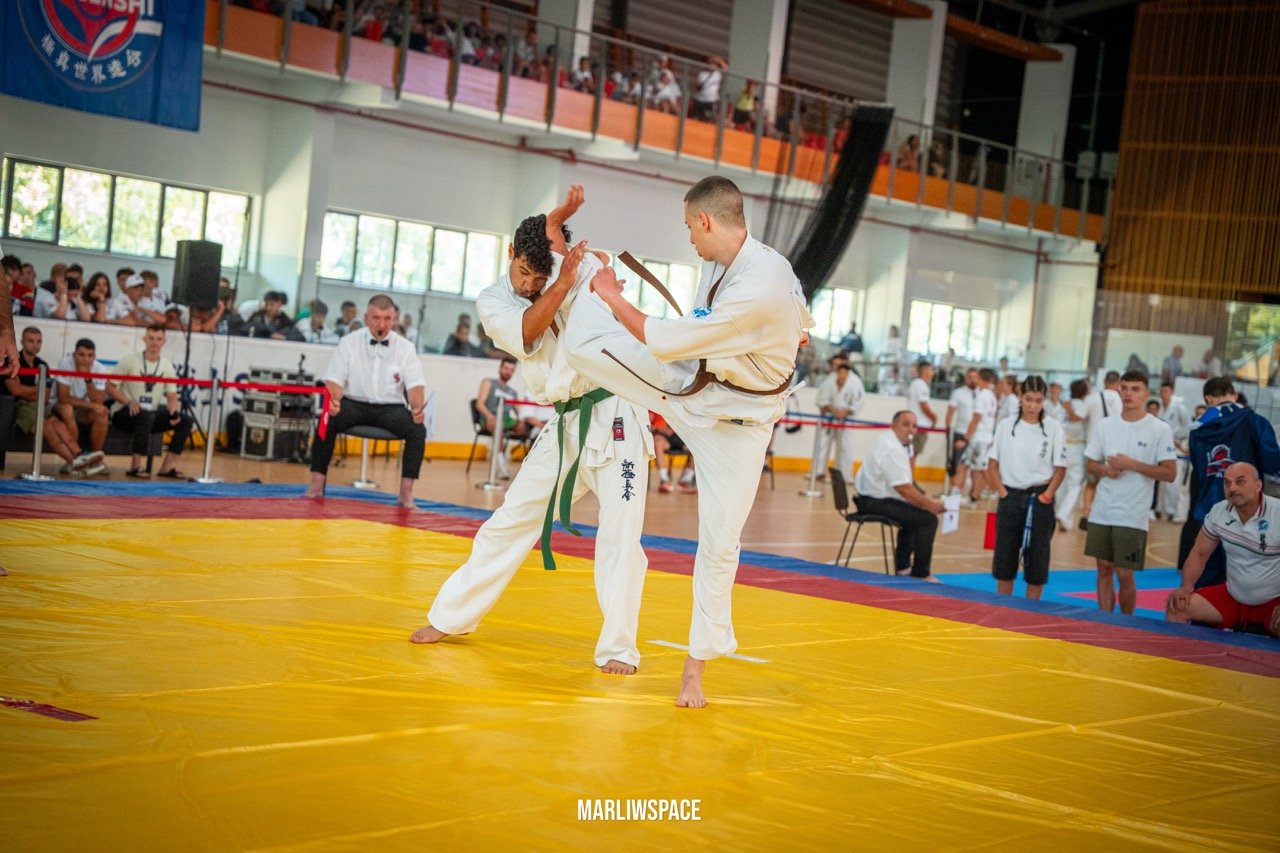
It is one of the first things people notice when watching a Kyokushin tournament.
The fighters compete full contact. They punch the body with bare fists, attack the legs with powerful low kicks, use knees and can kick to the head — yet punches to the face are prohibited.
For someone unfamiliar with Kyokushin, the obvious question is: Why?
The answer starts with an important distinction.
Kyokushin and Knockdown Kumite Are Not the Same Thing
Saying that “Kyokushin does not punch to the face” is not entirely correct.
Punches to the head and face exist within karate technique and training. What prohibits them is the traditional knockdown kumite competition format.
Knockdown kumite is a ruleset designed for full-contact competition. It allows fighters to strike with significant power while traditionally competing with very little protective equipment.
Under these rules, punches and other hand strikes are directed to the body, while kicks can attack the legs, body and head.
So the restriction is not a statement that the face is somehow irrelevant in Kyokushin. It is part of the way competitive knockdown fighting has developed.
Bare Knuckles Change the Equation
One of the defining characteristics of traditional Kyokushin competition is bare-knuckle fighting.
Allowing repeated full-power bare-knuckle punches to the face would dramatically change both the nature and the risk profile of a tournament.
Cuts, facial injuries and hand injuries could quickly become major factors in deciding matches. Introducing boxing-style gloves would reduce some of those risks, but it would also fundamentally change the traditional format.
Knockdown rules therefore developed around an unusual compromise:
full-contact fighting without gloves, but no punches to the face.
There is no single universally documented explanation from the early history of Kyokushin that settles every detail of why the rule developed exactly this way. Various historical accounts point to safety, injuries and the desire to preserve bare-knuckle competition as important factors.
What is clear is the result: a very distinctive fighting system.
The Head Is Still a Target
This is where another common misconception appears.
Punching the head may be prohibited, but attacking the head is not.
High kicks are one of the most dangerous weapons in Kyokushin competition.
Jodan mawashi geri, ushiro mawashi geri, mae geri, hiza geri and other kicking techniques can end a fight immediately when they land effectively.
That creates an unusual tactical situation.
A fighter does not have to defend against a boxing combination to the face, but lowering the attention too much can result in a head kick arriving without warning.
Experienced competitors constantly balance two threats:
protecting the body and legs from relentless close-range attacks while remaining ready for a sudden kick to the head.
How the Rule Shapes Kyokushin Fighting
Remove punches to the face and the entire structure of a fight changes.
Kyokushin competitors can operate at distances that would be extremely dangerous under boxing or kickboxing rules.
They can stand close to each other and exchange powerful punches to the ribs, solar plexus and liver while simultaneously attacking the thighs with low kicks.
This has helped create several characteristics strongly associated with Kyokushin fighters:
- powerful body punching
- devastating low kicks
- exceptional physical conditioning
- close-range pressure
- strong body resistance
- the ability to continue attacking while taking heavy contact
- explosive high kicks from surprisingly short distances
The rules do not make the fight easier.
They make it different.
Instead of repeatedly searching for the opponent’s chin with the fists, competitors must break the opponent down through the body, legs, pressure, timing and kicking techniques.
Why Not Simply Add Gloves?
That would create another combat sport.
Gloves fundamentally change punching combinations, defensive positions, distance management and the way fighters protect the head.
Kyokushin’s traditional knockdown format developed its own identity precisely because competitors fight bare-knuckle and without the conventional boxing guard created by constant punches to the face.
This is also why a Kyokushin fighter moving into kickboxing must make adjustments.
The strong conditioning, low kicks, body attacks and kicking ability transfer extremely well, but the fighter must adapt to defending punches to the head, using different guards and managing a different fighting distance.
Many elite Kyokushin karateka have successfully made that transition, which has helped demonstrate how influential full-contact karate has been on modern stand-up fighting.
A Ruleset, Not a Limitation of Karate
Perhaps the most important point is this:
Competition rules should not be confused with the complete martial art.
Every combat sport limits techniques.
Boxing does not allow kicks.
Taekwondo competition restricts certain attacks.
Judo limits many striking techniques.
Kickboxing has its own restrictions depending on the ruleset.
Kyokushin knockdown kumite is no different.
Its prohibition on punches to the face is one rule within a specific competitive format — a format built around bare-knuckle, full-contact fighting.
And that single rule has had an enormous influence on how Kyokushin fighters move, attack, defend and condition themselves.
It has helped create one of the most recognizable fighting styles in karate.
No punches to the face does not mean no full contact.
Anyone who has stood across from an experienced Kyokushin fighter in knockdown kumite understands the difference.
