

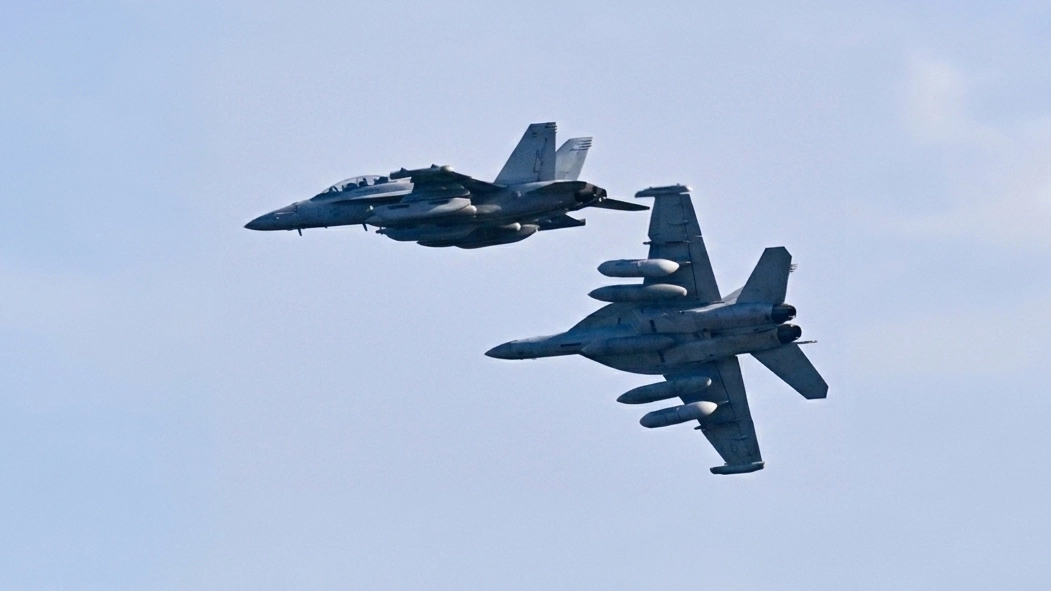
Imagine trying to fight an air battle when your radar suddenly fills with false targets, communications become unreliable, and the signals you trusted a few seconds ago no longer make sense. No missile has to be launched. No fighter has to cross the border. The battle can begin simply by controlling what the enemy can, and cannot, see, hear, and understand.
That is the strange power of electronic warfare.
The best electronic warfare aircraft are not judged only by speed, payload, or how many missiles they can carry. Their real weapon is the electromagnetic spectrum. These aircraft can detect hostile emissions, interfere with radar and communications, support suppression of enemy air defenses, and help friendly forces operate inside heavily contested airspace.
The EA-18G Growler is a useful example. Derived from the F/A-18F Super Hornet, it was purpose-built for airborne electronic attack and combines systems such as the ALQ-218 receiver, ALQ-99 jamming pods, and newer Next Generation Jammer technology. The U.S. Navy also records its first combat deployment in Libya during Operation Odyssey Dawn in 2011.
But the Growler is only part of the story.
Modern electronic warfare aircraft now range from fighter-sized tactical jammers to specialized business-jet platforms designed for long-range electromagnetic intelligence and stand-off attack. Some operate close to the action; others can influence the fight from much farther away.
So, which aircraft stand out?
In this post, we’ll examine five of the most capable electronic warfare aircraft in the world, looking beyond glossy specifications to the systems, missions, and design choices that make each platform significant in the electromagnetic battlespace.
How We Ranked the Best Electronic Warfare Aircraft
Ranking the best electronic warfare aircraft is trickier than ranking fighters by speed or bombers by payload. Much of an aircraft’s most important EW performance is classified, so a simple numbers game can create a very misleading list.
Instead, this comparison looks at what can reasonably be established from public information: the sophistication of an aircraft’s electronic warfare suite, its ability to detect and respond to threats, mission range and endurance, survivability, networking, operational maturity, and how effectively it can support other forces.
One factor receives particular attention: what the aircraft actually does in the electromagnetic battlespace.
A fast fighter with an impressive self-protection system is not automatically comparable with a purpose-built electronic-attack aircraft. Likewise, an intelligence-gathering platform may be extremely valuable without having the same mission as a tactical jammer. Keeping those categories separate makes the comparison more useful.
Key Ranking Factors
| Factor | Importance |
| Electronic attack and jamming | High |
| Sensors and EW systems | High |
| Survivability | Medium-High |
| Mission versatility | Medium-High |
| Operational maturity | Medium |
| Combat experience | Medium |
| Upgrade potential | Medium |
The electronic attack and jamming capability carries the greatest weight because actively disrupting hostile systems is central to the role of dedicated EW aircraft. Sensors matter almost as much, since an aircraft cannot effectively counter a threat it cannot detect or identify.
Survivability also deserves attention. An EW aircraft can be a particularly valuable target because it may help an entire formation operate in contested airspace. Speed, altitude, stand-off distance, escorts, networking, and situational awareness can therefore matter just as much as raw defensive equipment.
Finally, technology must be viewed in context. An aircraft entering service with a modern digital architecture may have considerable room for future upgrades, while an older platform with decades of operational experience can still offer lessons that newer designs haven’t accumulated.
So the list below isn’t an official military ranking. It is an open-source comparison of notable electronic warfare platforms, based on their documented missions, systems, operational roles, and publicly available capabilities.
1. Boeing EA-18G Growler: The Specialist That Hunts the Radar
If an air-defense network is the goalkeeper protecting the sky, the EA-18G Growler is the player whose job is to make that goalkeeper lose sight of the ball.
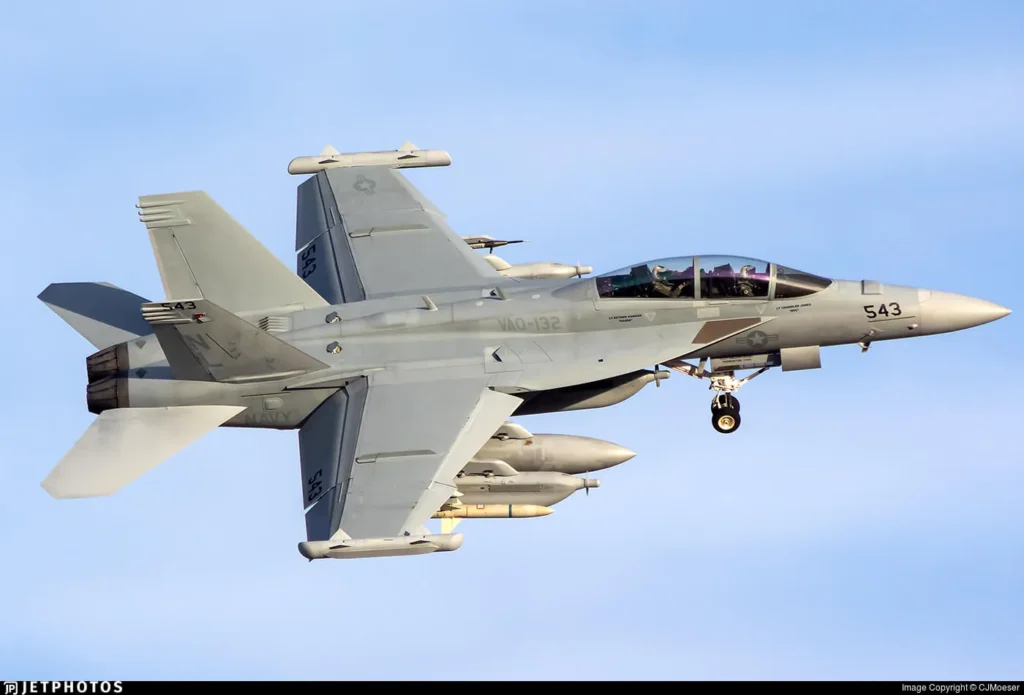
The Growler is built around the F/A-18F Super Hornet, but its purpose is very different. Instead of concentrating primarily on conventional air-to-air or strike missions, it carries a sophisticated airborne electronic-attack suite designed to detect, identify, and disrupt hostile radar and communications systems. The U.S. Navy describes it as an Airborne Electronic Attack aircraft and the successor to the EA-6B Prowler.
Why the Growler Stands Out
The interesting part isn’t one magic box. It’s the way several systems work together.
The aircraft incorporates the ALQ-218 receiver, which provides electronic sensing and situational awareness, alongside the ALQ-99 Tactical Jamming System and communications countermeasures.
The ALQ-99 can target radar and communications systems and was specifically developed to support the suppression of integrated air defenses.
And then there’s the aircraft’s offensive side. A published Navy fact sheet lists a combat range of more than 850 nautical miles in a representative configuration and identifies the AGM-88 HARM among its weapons. That combination matters because the Growler isn’t merely sitting outside the fight making noise; it can participate in missions designed to suppress hostile air-defense systems.
| Feature | EA-18G Growler |
| Primary role | Airborne electronic attack |
| Crew | 2 |
| Engines | 2 × F414 |
| Ceiling | 50,000 ft |
| Combat range | 850+ nautical miles* |
| EW systems | ALQ-218, ALQ-99, NGJ |
| Notable weapons | AGM-88 HARM, AIM-120 |
Perhaps the most important reason the Growler remains relevant is that it is evolving rather than standing still. The Next Generation Jammer uses digital and electronically scanned-array technologies and is intended to replace the legacy ALQ-99 over time.
That gives the EA-18G an unusual advantage: it isn’t simply an electronic warfare aircraft from the previous generation with newer paint. Its underlying platform is being continually upgraded to keep pace with increasingly sophisticated air defenses.
And in electronic warfare, that ability to adapt may be just as important as raw jamming power. The electromagnetic battlefield changes quickly. The aircraft that survives is often the one that can learn faster.
2. EA-37B Compass Call: The New Stand-Off Electronic Attacker
At first glance, the EA-37B Compass Call doesn’t look like a weapon. It looks more like the sort of Gulfstream business jet you might see parked outside an executive terminal. That’s exactly what makes it interesting.
Underneath that relatively ordinary silhouette is a purpose-built electronic-attack system designed to interfere with an adversary’s communications, radar, navigation, and command networks.

The U.S. Air Force classifies the EA-37B as a wide-area airborne electromagnetic attack platform, replacing the much older EC-130H Compass Call.
Why the EA-37B Is Different
The aircraft is based on the Gulfstream G550, giving it a combination of speed, altitude, and range that its C-130 predecessor could not match. Publicly available figures put its maximum speed at roughly 629 mph, with a ceiling of about 45,000 feet and a range of approximately 4,410 miles.
| Feature | EA-37B Compass Call |
| Primary role | Electronic attack |
| Airframe | Gulfstream G550 |
| Maximum speed | Approx. 629 mph |
| Service ceiling | Approx. 45,000 ft |
| Range | Approx. 4,410 miles |
| Operator | U.S. Air Force |
| Main mission | Wide-area stand-off EW |
The real technological shift, however, is inside the aircraft. Its newer Baseline 3 mission equipment uses software-defined radios and an open architecture, reducing dependence on the proprietary systems used by the legacy platform. That matters because electronic warfare is a moving target: an adversary can change frequencies, waveforms, and tactics much faster than a traditional hardware upgrade cycle can respond.
The transition is already underway. The Air Force completed initial operational testing and evaluation in July 2025, while the aircraft made its first European theater appearance at Ramstein Air Base in January 2026.
By 2026, the EA-37B had also moved beyond demonstrations. Two aircraft were reported participating in real-world operations during Operation Epic Fury, marking a significant step for the new platform.
That gives the EA-37B a fascinating place among the best electronic warfare aircraft: it isn’t designed to dogfight. Its job is subtler, stand farther away, reach across a wide area, and make an opponent’s electronic nervous system considerably less reliable.
3. Shenyang J-16D: China’s Dedicated Electronic-Warfare Fighter
Electronic warfare is often described as an invisible contest, but the Shenyang J-16D gives that contest a very visible shape. With large electronic-warfare pods mounted around its airframe, this Chinese aircraft looks less like a conventional fighter and more like a flying collection of antennas and receivers.
The J-16D is an EW-focused derivative of China’s J-16 multirole fighter. It was publicly unveiled at the 2021 Zhuhai Airshow, although the prototype reportedly flew several years earlier.

Jane’s reported that the two-seat aircraft was designed primarily for suppression of enemy air defenses, with prominent electronic-support equipment on its wingtips and multiple large jamming pods beneath the aircraft.
That configuration tells you something important about its intended job. The J-16D is not simply a J-16 carrying an extra electronic countermeasures pod. Several changes were made to transform the aircraft into a specialist EW platform.
Publicly observed differences include the removal of the conventional J-16’s infrared search-and-track equipment and internal cannon, creating room for additional mission equipment.
A Fighter Built Around the Electromagnetic Spectrum
The J-16D retains the underlying advantages of a large twin-engine fighter: speed, altitude, range, and the ability to operate with combat aircraft rather than functioning like a slow support platform.
China’s Ministry of National Defense describes the J-16D as an electronic warfare aircraft derived from the J-16, with reconnaissance, offensive, and defensive capabilities.
| Feature | J-16D |
| Country | China |
| Primary role | Electronic warfare / SEAD |
| Crew | 2 |
| Airframe | J-16 derivative |
| Engines | 2 × WS-10 series |
| EW equipment | Wingtip and external EW systems |
| Status | In PLAAF service |
Its operational significance has also become clearer. Chinese state media has shown J-16Ds conducting combat-oriented training, with the aircraft described as providing EW support to other combat aircraft, including the J-20.
There is, however, a major caveat: China does not publicly disclose the detailed performance of the J-16D’s electronic warfare systems. That makes precise comparisons of jamming power or effectiveness impossible from open sources.
And that uncertainty is part of what makes the J-16D so intriguing. Its hardware clearly signals a serious electronic-attack mission; exactly how effective that hardware is remains behind China’s information curtain.
4. Dassault Falcon 8X ARCHANGE: France’s Long-Range Electromagnetic Listener
Not every electronic warfare aircraft needs to fill the sky with interference. Sometimes, the more valuable mission is simply to listen extremely well.
That is where France’s Dassault Falcon 8X ARCHANGE becomes interesting. Developed under France’s ARCHANGE strategic intelligence program, the aircraft transforms a business jet into a specialized platform for electromagnetic intelligence. Three Falcon 8X aircraft have been ordered, with a mission system developed by Thales and designed to detect and analyze radar and communications signals.

The first ARCHANGE aircraft completed its maiden flight in July 2025, marking a major milestone for the program. France’s Directorate General of Armament says the aircraft is intended to strengthen the country’s ability to collect and analyze strategic intelligence from the electromagnetic environment.
Turning a Business Jet Into an EW Platform
The Falcon 8X is an unusual foundation for a military intelligence aircraft, but that is part of its appeal.
The trijet offers long-range performance and high-altitude operation without the enormous footprint of a transport aircraft.
France’s defense ministry says ARCHANGE is designed to intercept, characterize, and analyze radio and radar emissions. Its CUGE, or Universal Electronic Warfare Capability, incorporates advanced antennas and automated processing technologies, including artificial intelligence to assist signal processing.
| Feature | Falcon 8X ARCHANGE |
| Country | France |
| Platform | Dassault Falcon 8X |
| Primary role | Strategic electromagnetic intelligence |
| EW system | Thales CUGE |
| Aircraft ordered | 3 |
| Maiden flight | July 2025 |
| Key targets | Radar and communications emissions |
This also highlights an important distinction when discussing the best electronic warfare aircraft. ARCHANGE is not simply a French equivalent of the EA-18G Growler. The Growler is optimized for tactical electronic attack, while ARCHANGE is primarily concerned with collecting and exploiting electromagnetic intelligence.
Think of the difference as jamming the radio versus mapping the entire radio network.
That intelligence can help commanders understand an opponent’s sensors, communications architecture, and electronic order of battle before and during operations. In modern warfare, knowing where an enemy’s electromagnetic “ears” are located can be nearly as valuable as having a weapon pointed at them.
And ARCHANGE shows where EW is heading: sometimes the most powerful aircraft in the spectrum isn’t the one making the most noise. It’s the one quietly figuring out what everyone else is saying.
5. MC-55A Peregrine: The G550 Turned Into an EW Workhorse
A business jet isn’t usually the first thing that comes to mind when you picture an electronic warfare aircraft. Yet the Gulfstream G550 has become one of the most adaptable foundations for airborne intelligence and electronic warfare missions.
Australia’s MC-55A Peregrine is a particularly interesting example. Developed from the G550, the aircraft is designed to provide intelligence, surveillance, reconnaissance, and electronic warfare capabilities.
Its mission is less about charging into contested airspace and more about collecting electromagnetic information, supporting friendly forces, and helping commanders understand what is happening across the battlespace.

Why the G550 Makes Sense for EW
The G550’s appeal is straightforward: it offers the endurance, altitude, and cabin space needed for sophisticated mission equipment without the footprint of a much larger military transport.
That basic formula has attracted several air forces. Australia selected modified G550s for an airborne ISREW capability, while Italy has developed its own family of G550-based special-mission aircraft. Italy’s G550 fleet includes CAEW aircraft carrying the EL/W-2085 radar alongside COMINT, ELINT, ESM, IFF, and radar-warning systems.
| Feature | G550-based EW platforms |
| Base aircraft | Gulfstream G550 |
| Typical missions | ISR, SIGINT/ELINT, EW |
| Major advantage | Range and endurance |
| Operating concept | Stand-off sensing/support |
| Operators | Australia, Italy, Israel and others |
| Primary strength | Persistent electromagnetic awareness |
There is an important catch, though. G550-based aircraft are not all the same. Some are primarily airborne early-warning platforms, others specialize in signals intelligence, and newer configurations can incorporate electronic-attack capabilities. Treating every G550 special-mission aircraft as a dedicated jammer would blur some important distinctions.
That distinction is becoming even more relevant as the platform evolves. In 2025, L3Harris announced a $300 million contract with Italy for two G550 aircraft provisioned for modern electromagnetic warfare, including airborne jamming intended to disrupt communications, radar, and navigation systems from extended range.
So why include the G550 family among the best electronic warfare aircraft? Because it demonstrates a powerful trend: EW no longer has to mean a heavily modified transport or fighter. A relatively compact business jet can become a high-end electromagnetic sensor, or, with the right mission architecture, a serious electronic-attack platform.
Electronic Warfare Aircraft Comparison
Putting these aircraft side by side reveals something that is easy to miss when reading a simple top-five list: electronic warfare is not one mission. The aircraft in this group approach the electromagnetic battlefield from very different directions.
The EA-18G Growler is a tactical electronic-attack aircraft designed to operate alongside combat formations. Its combination of electronic support, jamming, networking, and suppression-of-enemy-air-defense capabilities makes it particularly suited to contested air operations.
The U.S. Navy lists a combat range of more than 850 nautical miles in a representative configuration and a service ceiling of 50,000 feet.
The EA-37B Compass Call takes a different route. Based on the Gulfstream G550, it is designed for wide-area electronic attack against communications, information-processing systems, navigation, radar, and other electromagnetic targets. Its published performance includes a range of about 4,410 miles and a ceiling of 45,000 feet.
The J-16D occupies the fighter-derived end of the spectrum, while the Falcon 8X ARCHANGE and G550-based platforms emphasize long-range sensing, intelligence, and stand-off operations. That makes direct “which is more powerful?” comparisons difficult, and sometimes misleading.
| Aircraft | Primary Role | Platform Type | Key Advantage |
| EA-18G Growler | Tactical electronic attack | Fighter | Tactical flexibility |
| EA-37B Compass Call | Wide-area electronic attack | Business jet | Stand-off reach |
| J-16D | Tactical EW / SEAD | Fighter | Fighter-like performance |
| Falcon 8X ARCHANGE | Strategic electromagnetic intelligence | Business jet | Long-range collection |
| G550-based EW | ISR / electronic warfare | Business jet | Endurance and adaptability |
One especially revealing detail is that the U.S. Air Force has already demonstrated the EA-37B operating alongside EA-18G Growlers.
In September 2025, the two aircraft types trained together at Kadena Air Base, showing how different EW platforms can complement rather than replace one another.
That’s perhaps the best way to understand the best electronic warfare aircraft: they aren’t necessarily competing for the same job. One may disrupt the network, another may hunt its emissions, and a third may keep the whole formation aware of what is happening.
In electronic warfare, teamwork can be more important than a single spectacular specification.
