

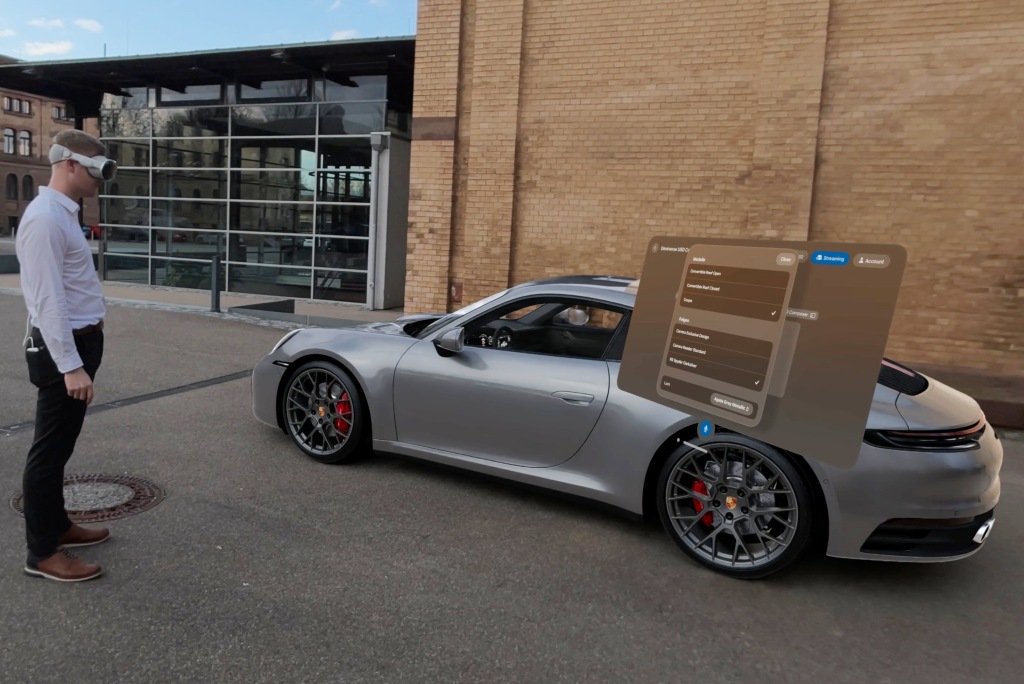
What if the real competitive advantage in a defence programme no longer lay solely in the power of a sensor, the range of a missile or the mobility of a vehicle, but in the ability to use the same trusted technical data from design through to in-service support? MHP, a Porsche company, offers an answer built around digital continuity, automotive industrial experience, and a new generation of military configurators
Why this subject caught my attention
I was particularly drawn to this subject because it is both modern and genuinely innovative. It highlights a deep, though still insufficiently visible, transformation within the defence industry. Behind the platforms, equipment and major programmes, another form of superiority is now emerging: the ability to depend on reliable, shared, and reusable data. It was this evolution – at the intersection of engineering, digital technology, production, and operational dialogue – that prompted me to write this article.
Europe’s defence industry is entering a period in which the challenge is no longer simply to devise new systems. It must also manufacture faster, increase production rates, maintain quality, and ensure the availability of platforms which complexity continues to grow. Land vehicles, aircraft, naval systems, sensors, effectors, and command-and-control architectures are becoming more modular, more connected and increasingly software-defined. As a result, the speed at which an operational requirement can be turned into a deliverable capability is becoming a decisive factor.
In this race for production capacity and resilience, the automotive sector offers a particularly relevant source of lessons. Over several decades, it has learned to manage product ranges containing multiple versions, powertrains, equipment options, market requirements and regulatory constraints, whilst connecting design, suppliers, manufacturing, sales, and digital customer experiences. For MHP, the issue is not to apply an automotive formula mechanically to the military world. Rather, it is about transferring robust methods for managing complexity, integrating data, and digitalising industrial processes, whilst respecting the specific requirements of defence: sovereignty, security, confidentiality, traceability and certification.
The digital thread
At the centre of this approach lies the concept of the digital thread. Its principle is simple in theory, though ambitious in practice: product data must remain consistent, governed, and usable throughout the entire lifecycle. From the first engineering studies to manufacturing, from customer configuration to training, and from maintenance to in-service upgrades, every function should be able to draw upon the same reliable technical foundation. The advantage therefore does not come from an isolated software tool, however capable it may be, but from the connection between engineering tools, industrial processes, enterprise systems, supply-chain management, and customer-collaboration interfaces.
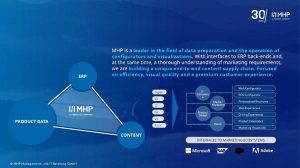
The concept’s most tangible application is MHP’s military configurator. Far from being merely an attractive presentation tool, comparable to the systems used to customise a car, it is designed as a genuine digital capability room. It would enable programme teams, engineers, and customers to examine possible variants, mission kits, sensors, interfaces and mission-specific equipment directly on a digital model.
The implications are significant. A requirement that might otherwise be expressed abstractly can be visualised immediately on an engineering-grade digital representation. Stakeholders can compare architectures, identify integration constraints, assess available space and discuss the interactions between different sub-systems. The conversation is therefore transformed: rather than focusing exclusively on a list of options or a succession of technical documents, it centres on a shared, contextualised, and visualised capability.
MHP’s proposed platform would connect configuration rules, product data and technical interfaces to corporate information systems. It could therefore interface with ERP (Enterprise Resource Planning) environments, supplier data and other management systems, preventing the configurator from becoming a simple visual showcase disconnected from industrial reality. The architecture incorporates a rules engine, a services and integration layer, interfaces with ERP and supplier systems, and a visualisation core able to generate 2D and 3D representations, augmented-reality outputs, and virtual-reality experiences.
Build once, use everywhere
This immersive dimension is another important element. The same digital asset could be used to demonstrate a product to a customer, prepare a programme review, create training material, support a maintenance procedure, or produce a virtual-reality experience. Selected configurations could also be turned into physical 3D-printed models, supporting workshops, presentations and validation meetings. The promise is clear: instead of recreating the same content repeatedly for different purposes, organisations can rely on a single, controlled and reusable digital source.
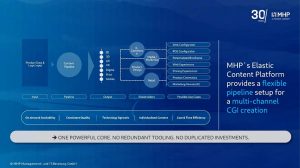
This philosophy, summarised by MHP as “build once, experience everywhere,” responds directly to the needs of a defence industry under sustained pressure. It can shorten development and industrialisation cycles, support higher production rates, improve consistency between departments and facilitate exchanges with customers. It can also reduce the gap between a system’s technical definition, its virtual representation, its support documentation and its use in training environments.
The ambition remains demanding. Defence cannot simply replicate civilian digital models: data must be protected, access rights strictly controlled and configuration rules fully traceable. Yet it is precisely in this adaptation that the concept becomes compelling. The military configurator is the visible element of a much broader shift, one in which engineering, production, supply chain, support and customer engagement are no longer treated as separate silos.
In the years ahead, industrial players that succeed in building this digital continuity will gain a substantial advantage. Not only will they be better equipped to develop complex systems; they will also be able to deliver, evolve and sustain them more quickly. In this new equation, data does not replace military capability. It becomes one of its most important accelerators.
Images courtesy MHP
