

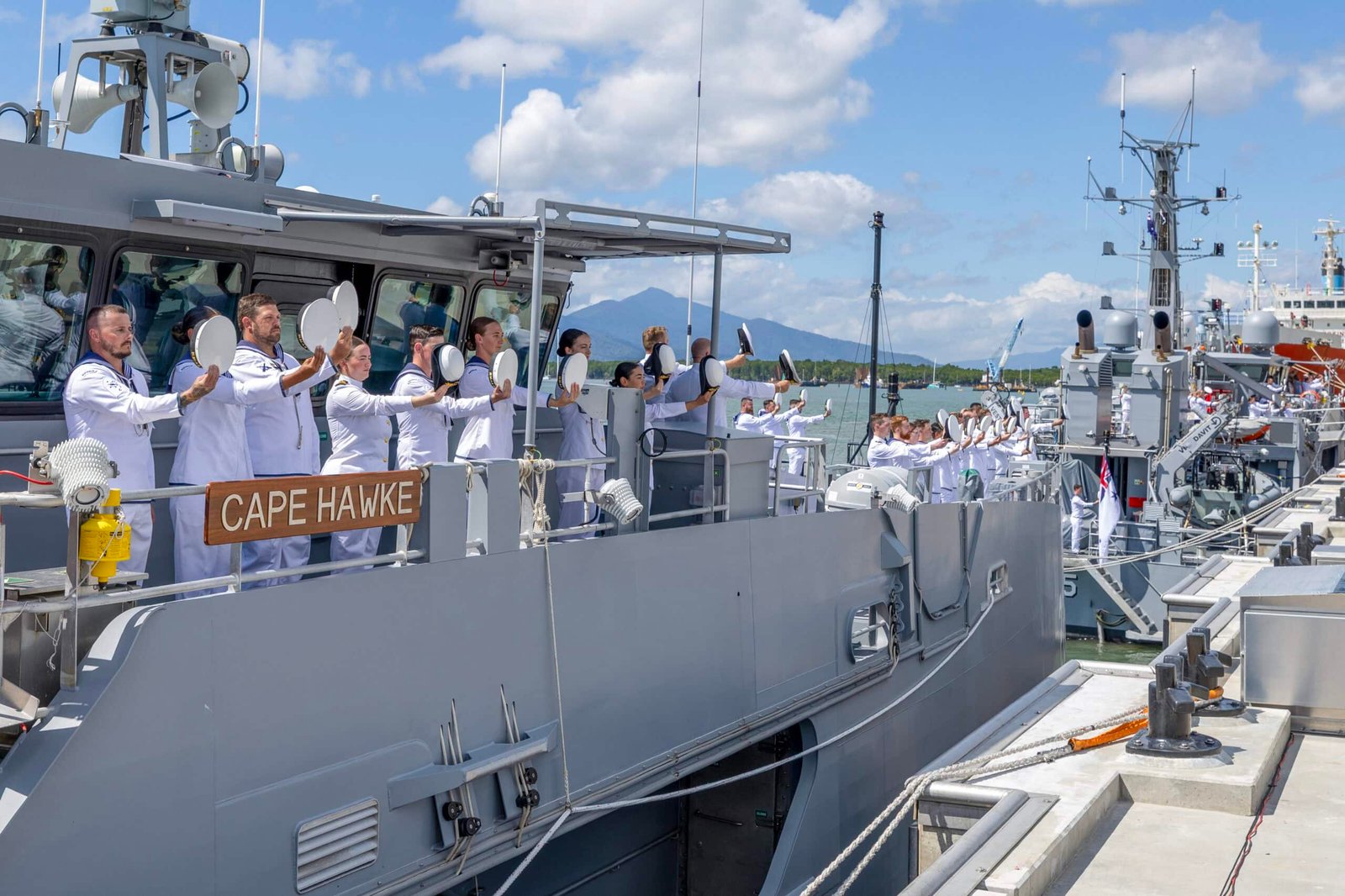
The Royal Australian Navy’s (RAN) fleet of patrol vessels has reached a full complement of ten, after the final two Evolved Cape-class vessels were commissioned on 27 August.
The new two adherents to the class are HMAS Cape Spencer and HMAS Cape Hawke, both inducted at a ceremony in Cairns.
Commodore Antony Pisani, Commander Surface Force, said, “Today’s commissioning formally welcomes HMAS Cape Spencer and HMAS Cape Hawke into service, and represents another important step in growing and modernising navy’s fleet to meet Australia’s future maritime security requirements.”
This brings Project Sea 1445 Phase 1 to a close, with all the vessels constructed by Austal at its shipyard in Henderson, Western Australia.
The Evolved Cape class featured modifications and improvements compared to the preceding Armidale class, of which all 14 have been withdrawn. The 58.1m-long Evolved Cape vessels carry out border protection, maritime constabulary, law enforcement support and international engagement operations.
They have a 4,000nm range and improved accommodation for the 32 crew, as well as more space for any detainees. Their constabulary role is reinforced by the fact that their armament is just a pair of 12.7mm machine guns.
The other patrol boats in this class that are already in service are HMAS Cape Schanck, Cape Solander, Cape Pillar, Cape Naturaliste, Cape Woolamai, Cape Capricorn, Cape Peron and Cape Otway. These were delivered to the RAN on average every six months.
These patrol boats are backed up by what will eventually be a fleet of six Arafura-class offshore patrol vessels. Two have been commissioned so far, with the remaining four scheduled to enter service from 2026-29.

Completion of the Evolved Cape class also enables Austal Defence Australia to now refocus its efforts on building 18 Landing Craft Medium and eight Land Craft Heavy for the Australian Army under Project Sea 8710. Canberra is investing some A$1 billion (US$720 million) and A$4 billion into these respective shipbuilding projects, with contracts signed with Austal in February this year.
In other news relating to the RAN, a request for tender for an Australian Watercraft and Seaboats Standing Offer Panel will close on 2 November 2026.
The aim of the panel is to “create a streamlined and strategic procurement mechanism for the acquisition of seaboats and small watercraft”. The panel will give Defence access to Australian manufacturers capable of designing, integrating, manufacturing and supporting such watercraft capabilities.
Seaboats, although small, are vital for the RAN since they support rescue and recovery, personnel and equipment transfer, boarding operations, force protection activities and other specialist missions.
Defence wants to establish long-term relationships with seaboat and small watercraft suppliers.
by Gordon Arthur
