

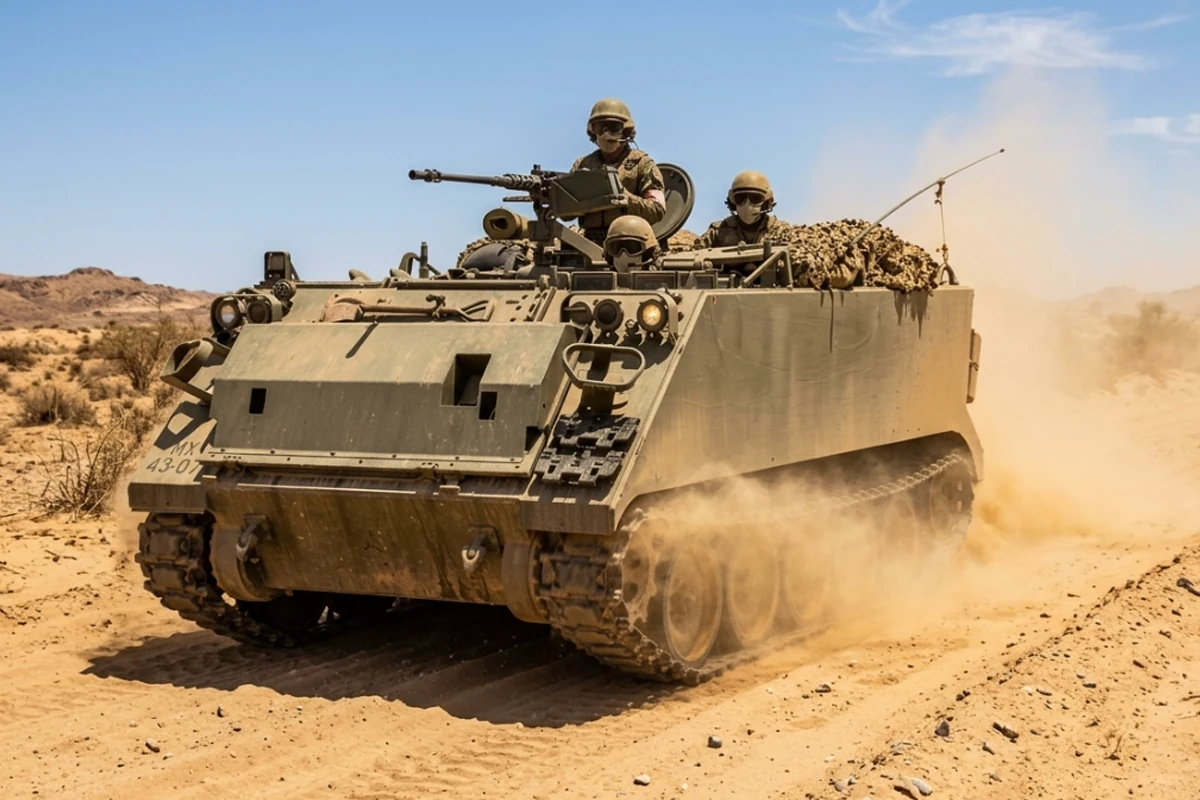
More than six decades after entering service, the M113 APC is still moving soldiers across battlefields. That alone is remarkable.
Designed during the Cold War, the M113 APC predates drones, digital networks, loitering munitions and many of the anti-armor weapons that now define modern warfare. By today’s standards, its aluminum armor and simple tracked design look almost primitive.
Yet the M113 APC refuses to disappear.
Its survival isn’t really about nostalgia. Militaries have learned that an armored vehicle doesn’t always need to be the most advanced machine in the fleet. Sometimes, being reliable, available and adaptable matters more.
The problem is that the battlefield has changed. Protection that was once considered adequate can be dangerously thin today, particularly against modern anti-armor weapons, mines, artillery and drones.
So, is the M113 APC obsolete in 2026?
The answer depends on what you ask it to do. As a frontline fighting vehicle, its limitations are obvious. But as a flexible platform for troop transport, medical evacuation, command duties and other support missions, the old workhorse still has plenty to offer.
And that is the real story of the M113 APC: not how it survived unchanged, but how it kept finding new jobs.
Here’s the revised first H2, with a more natural flow from the introduction and a stronger focus on why the M113 APC’s original design was so important.
M113 APC Specifications: The Design That Changed Armored Infantry
The M113 APC was never supposed to be a tank. That was precisely the point.
When the vehicle entered U.S. Army service in 1960, its job was relatively simple: carry infantry through dangerous terrain with enough protection to keep small-arms fire and battlefield debris from turning a transport mission into a disaster. The result was a lightweight tracked vehicle that looked basic but represented a major shift in how mechanized infantry could move.
Its aluminum armor kept the vehicle relatively light, while the tracked layout allowed it to cross terrain that would challenge ordinary trucks. The M113 APC could also be transported by aircraft and, in its original configuration, cross water under its own power. Those characteristics made it unusually flexible for its era.
| Specification | M113A3 |
| Type | Tracked armored personnel carrier |
| Crew | 2 |
| Engine | 275-hp diesel |
| Maximum road speed | About 67 km/h |
| Combat weight | About 12.3 tonnes |
| Main armament | M2 .50-caliber machine gun |
| Operational range | About 480 km |
The M113A3, the most important late-generation version, was considerably more capable than the original vehicle. It received a more powerful engine and improved transmission, better driver controls, external fuel tanks and other upgrades designed to keep the platform useful without replacing it entirely.
That last point matters.
The U.S. Army eventually concluded that replacing the entire M113 APC family with newer vehicles was technically, logistically and financially difficult. Upgrading the existing fleet made more sense in many roles.
And the numbers explain why. More than 85,000 M113-family vehicles were produced in roughly 35 variants, creating an enormous global fleet and a huge support ecosystem.
Read also: Strykers armored vehicles Expand Mobile Surveillance
That is the secret hiding inside those rather ordinary-looking specifications. The M113. APC was not revolutionary because it was exceptionally powerful. It was revolutionary because it was simple enough to become many different vehicles without actually becoming a new vehicle.
That flexibility would ultimately become more important than its original role as an infantry carrier.
Why the M113 APC Became the Army’s Armored Swiss Army Knife
The M113 APC started life as an infantry carrier, but armies quickly discovered that its real value was the chassis underneath the passenger compartment.
Once you have a tracked, armored platform that is relatively light and mechanically straightforward, you can keep changing what sits inside it. Need a command vehicle? Modify the hull. Need to move a mortar team? The same basic platform can do it. Need casualty evacuation, ammunition transport or engineering support? Again, the M113 APC can be adapted.
That versatility turned M113 APC into something closer to an armored Swiss Army knife than a conventional APC.
During the Vietnam War, for example, M113s were adapted for roles far beyond simply carrying infantry. Some were fitted with additional machine guns for fire support, while others served as command, medical and mortar vehicles. The basic hull remained recognizable, but its battlefield personality could change dramatically depending on the mission.

This modularity also helped explain why the M113 APC spread so widely. More than 85,000 vehicles and derivatives were produced, giving dozens of countries a platform they could modify around their own requirements.
And that matters even more today.
A modern infantry fighting vehicle may offer dramatically better sensors, protection and firepower, but it is also more complicated and expensive. Not every mission requires that level of capability. Sending an advanced IFV to perform a relatively routine logistics or support task can be a bit like using a smartphone to hammer a nail; possible, perhaps, but hardly the smartest use of the tool.
The M113 APC’s longevity therefore comes from an unusual combination: low complexity, a huge existing fleet and an adaptable chassis.
Its weakness is equally clear. The more militaries push it toward frontline combat, the harder it becomes to compensate for its aging protection.
That tension, between versatility and vulnerability defines the M113 APC’s place in modern warfare.
M113 APC Modernization: How Old Armor Gets a New Lease on Life
The easiest way to misunderstand the M113 APC is to think of modernization as an attempt to turn it into a modern infantry fighting vehicle. That isn’t really the goal.
Instead, upgrades have generally focused on keeping the old chassis useful for missions where its basic design still makes sense.
The M113A3 is the clearest example. Compared with earlier versions, it received a more powerful diesel engine, improved transmission and steering controls, external fuel tanks, better driver protection and provisions for additional armor. These changes improved mobility, survivability and reliability without requiring armies to abandon the enormous infrastructure already built around the M113 APC family.
That approach is important because replacing thousands of vehicles is not simply a matter of buying something newer. New vehicles require new training, spare parts, maintenance systems, transport arrangements and crews. An upgrade can be considerably less disruptive.
Some operators have gone much further, adding modern communications, thermal sights, remote weapon stations, improved suspension components and specialized mission equipment. The result can look surprisingly modern from the outside, even though the hull underneath may trace its lineage back decades.

But there is a hard ceiling.
The M113 APC’s lightweight aluminum hull was one of its original advantages. Adding armor, electronic equipment and other improvements inevitably increases weight. That creates a trade-off between protection and the mobility that made the vehicle attractive in the first place.
There is also the fundamental problem of geometry. The M113 APC was designed around a different threat environment. No software update can completely change the physical protection offered by a relatively thin, box-shaped hull.
So modernization works best when it extends the M113 APC’s useful life rather than pretending to erase its age.
That distinction explains why the platform continues to receive attention in 2026. Militaries aren’t necessarily trying to make the M113 APC young again. They’re trying to make an old machine useful enough for one more job.
M113 APC in Ukraine: Useful Workhorse or Vulnerable Relic?
Ukraine has given the M113 APC something that few military vehicles receive after more than 60 years in service: a very visible second act.
Since Russia’s full-scale invasion, Ukraine has received M113s from several Western countries, with different variants and configurations entering service. They have been used primarily as protected troop carriers and support vehicles rather than as substitutes for modern infantry fighting vehicles.
That distinction matters.
The M113 APC can still provide something valuable on a battlefield where soldiers are exposed to artillery fragments, small-arms fire and dangerous terrain. Its tracked chassis gives it useful cross-country mobility, while its relatively simple design makes it easier to maintain than many newer armored platforms.
But Ukraine has also demonstrated exactly where the old M113 APC’s limits begin.
The modern battlefield is saturated with drones. Small unmanned aircraft can spot vehicles from above, while FPV drones can attack vulnerable areas that older armor designs were never intended to defend against. Anti-tank weapons and artillery create additional risks.

The M113 APC’s aluminum armor was never designed to withstand the kind of threats facing armored vehicles today. Adding external armor or other protective equipment can improve survivability, but it cannot fundamentally transform the vehicle into a heavily protected modern IFV.
Yet calling it useless would miss the point.
Ukraine’s experience illustrates a more practical role for the M113 APC: keep soldiers and equipment moving without consuming scarce numbers of newer combat vehicles for every support mission.
In a war where almost every piece of equipment has to justify its existence, an old APC that can still transport troops, evacuate casualties or support frontline units has value.
The M113 APC doesn’t need to win a duel with a modern armored vehicle.
It simply needs to remain useful without becoming an easy target.
Next section, shifting from battlefield use to the M113 APC’s surprisingly broad family of specialized variants.
How the M113 Became More Than an Armored Personnel Carrier
If you only picture the M113 APC carrying infantry, you’re missing perhaps the most important reason it survived for so long.
The M113 APC was never just one vehicle. It became a family of vehicles built around the same basic chassis, and that turned it into a kind of armored utility platform for armies that needed many capabilities without buying an entirely different vehicle for each job.
The basic hull has been adapted for command-and-control, medical evacuation, mortar transport, ammunition carrying, recovery and engineering missions. Some variants have also been modified for air defense and other specialized battlefield roles.
That sounds like a small detail, but it has enormous logistical consequences.
Imagine an army operating a fleet where dozens of specialized vehicles share a common mechanical foundation. Training becomes easier. Spare parts can overlap. Maintenance crews already understand the platform. Even when the equipment inside changes dramatically, the underlying vehicle remains familiar.
This is where the M113’s age becomes almost an advantage.
A newer armored vehicle might be better protected and packed with sophisticated electronics, but replacing a specialized M113 variant can mean purchasing an entirely new platform. In contrast, an existing M113 can sometimes be modified for a new mission without starting from scratch.

The result is a vehicle family that looks strangely diverse despite having the same DNA.
A medical M113, for instance, has a completely different purpose from a mortar carrier, yet both benefit from the same tracked mobility and protected hull. The platform can therefore follow an army’s changing requirements without demanding that the entire fleet be redesigned.
Of course, versatility doesn’t erase vulnerability. A command vehicle or ambulance based on an M113 still inherits the limitations of its underlying armor.
But that’s the point: the M113’s legacy isn’t really about being the best APC. It’s about being useful enough to become almost anything an army needs.
That may be the most underrated reason this Cold War vehicle is still around in 2026.
Why Militaries Still Keep Buying, Upgrading and Using M113 APCs
The M113 APC survives for a reason that has little to do with glamour: armies have a lot of them, and replacing them all is expensive.
More than 85,000 M113-family vehicles and derivatives were produced, creating a huge global fleet. That matters because military equipment is rarely judged by purchase price alone. A replacement also brings new spare-parts chains, training requirements, maintenance equipment, ammunition systems and logistics procedures.
For many countries, the question isn’t simply, “Is there a better armored vehicle?” There almost certainly is.
The more useful question is, “Do we need to replace every M113 APC right now?”
Often, the answer is no.
The M113 APC’s relatively simple architecture makes it particularly attractive for secondary and specialized roles. A country can keep its newer infantry fighting vehicles focused on missions where their stronger armor, weapons and sensors actually matter, while older M113s handle transport, command, medical evacuation or other support duties.
Cost also matters. The U.S. Army itself previously determined that replacing the entire M113 APC family was technically, logistically and fiscally impractical, which helped drive continued modernization instead.

There is another advantage that is easy to overlook: availability.
An army doesn’t have to wait years for an entirely new vehicle programme before getting more capability from an M113 APC already sitting in its inventory. Upgrading an existing fleet can be faster and less disruptive than creating a replacement ecosystem from scratch.
This explains why the M113 APC continues to appear in military inventories decades after its introduction.
It isn’t necessarily surviving because commanders believe it is the ideal armored vehicle.
It’s surviving because militaries rarely get to choose between old and perfect. More often, they choose between old and available or new and expensive.
And for many missions, the old option still makes sense.
Can the M113 APC Survive the 2026 Battlefield and What Comes Next?
The uncomfortable answer is: yes, but not everywhere—and certainly not in every role.
The modern battlefield is a brutal environment for an old APC. Drones make vehicles easier to detect, while modern anti-armor weapons can defeat protection that was considered adequate when the M113 was designed. Its aluminum hull was never built for this threat environment.
But that doesn’t mean every M113 APC is automatically obsolete.
Its survival increasingly depends on where and how it is used. An M113 APC transporting personnel, evacuating casualties or performing support duties faces a very different risk profile from one operating at the front alongside heavily armored combat vehicles.
Upgrades can improve mobility, communications and protection, but they cannot fundamentally change the vehicle’s age. The smarter approach is therefore not to turn the M113 APC into something it was never designed to be, but to use it where its strengths still outweigh its weaknesses.
That is also likely to shape its future.

Newer infantry fighting vehicles will increasingly replace the M113 APC in frontline roles because they offer better protection, sensors and firepower. But the M113’s enormous global fleet means retirement is unlikely to happen all at once. Some vehicles can continue serving in specialized roles while newer platforms take over the most demanding missions.
After more than six decades, that may be the M113 APC’s strangest achievement.
It was designed for a Cold War battlefield that no longer exists, yet it continues to find work because armies still need relatively simple platforms to move people, carry equipment, evacuate casualties and support combat units.
So, is the M113 APC obsolete in 2026?
For some jobs, absolutely.
But as a flexible military workhorse, it remains surprisingly difficult and expensive to replace.
Is the M113 APC obsolete in 2026? Explore its upgrades, battlefield role, Ukraine use, limitations, and why militaries still rely on this aging workhorse.
