

ATSUGI, Japan — U.S. and Japanese military, government, medical and emergency
response organizations demonstrated combined disaster response capabilities during Big
Rescue Kanagawa 2026, a large-scale joint disaster drill held Sept. 1 in Kanagawa
Prefecture.
The drill brought together the Japan Self-Defense Forces, U.S. military, Kanagawa
Prefecture, local hospitals and civilian emergency response organizations to demonstrate
coordinated rescue, medical and disaster response capabilities during a simulated large scale disaster.
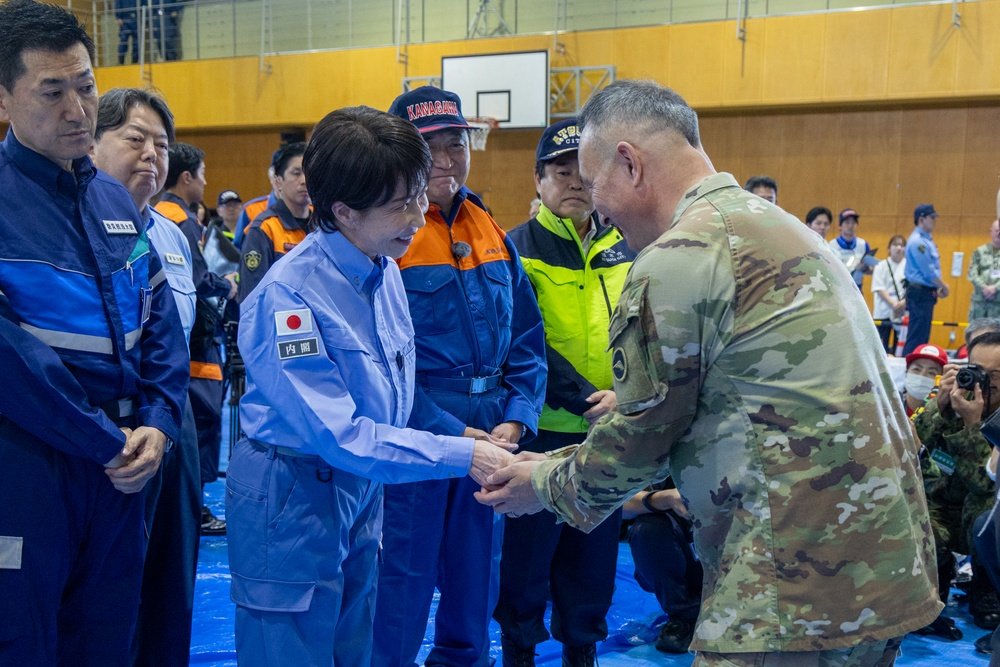
Japanese Prime Minister Sanae Takaichi, along with other local officials, including the
foreign minister, defense minister and Kanagawa governor, attended the drill and observed
rescue, medical and emergency response demonstrations conducted by participating
organizations. U.S. Army Maj. Gen. James Dooghan, commanding general of U.S. Army
Japan, met with the prime minister on behalf of the United States, highlighting the enduring
U.S.-Japan partnership and the importance of close coordination before a disaster occurs.
U.S. Army Japan participated alongside the Japan Ground Self-Defense Force, U.S. Navy
and U.S. Air Force, demonstrating capabilities U.S. forces stationed in Japan can provide in
support of Japan during a disaster.
For U.S. Army Japan, the drill highlighted how Army aviation and medical capabilities
support humanitarian assistance and disaster response while strengthening relationships
needed for an effective real-world response.
U.S. Army Aviation Battalion-Japan demonstrated Army aviation’s ability to rapidly move
personnel and provide aerial support, particularly when ground transportation may be
limited or disrupted.
Medical personnel from U.S. Army Medical Department Activity-Japan worked alongside
Japanese medical partners and a tri-service U.S. medical team that included U.S. Naval
Hospital Yokosuka and the 374th Medical Group. Together, they demonstrated patient
reception, bilateral triage and treatment, casualty movement and coordination among
military and civilian medical systems.
“Big Rescue Kanagawa demonstrates that during a crisis, medical response knows no
branch or border,” said Col. Michele Kehrle, commander of U.S. Army Medical Department
Activity-Japan. “By working shoulder-to-shoulder with our Navy, Air Force and Japanese
medical partners, we practice the joint and bilateral triage and treatment procedures
necessary to evaluate and treat casualties seamlessly. This close coordination ensures
that wherever a patient receives care, our combined medical systems can provide rapid,
lifesaving support when every second counts.”
The medical demonstration underscored the importance of relationships established
before a disaster. During a crisis, an effective medical response depends not only on
individual capabilities but also on the ability of organizations to communicate, coordinate
and move patients across different medical systems.
Japan’s history of earthquakes, typhoons and other natural disasters makes disaster
preparedness an enduring priority. Drills such as Big Rescue Kanagawa allow U.S. and
Japanese organizations to practice coordination, identify how their respective capabilities
complement one another and strengthen relationships before a disaster occurs.
Through continued disaster preparedness efforts with the Japan Self-Defense Forces, local
governments, hospitals and emergency response organizations, U.S. Army Japan continues
to strengthen the partnerships and coordination needed to support Japan and its
communities during emergencies.
