

The best attack helicopters in the world are no longer judged simply by how many missiles they can carry or how fast they can fly. Modern gunships are closer to flying sensor-and-weapons networks, able to find targets, share information, strike from standoff distances, and keep operating when the battlefield gets messy.
That shift matters in 2026. An attack helicopter may look spectacular on paper, but its real value comes from how well its sensors, weapons, protection, communications, and crew systems work together.
A helicopter with a slightly smaller weapons load can be more capable if it can detect a target earlier, identify it at night, pass the information to another platform, and engage without exposing itself unnecessarily.
So, which aircraft deserve a place among the top 5 best attack helicopters in the world in 2026?
This ranking looks beyond the usual “biggest gun equals best helicopter” argument. Each aircraft is assessed across firepower, sensors, survivability, mobility, combat experience, networking, and modernization potential. That creates a more useful comparison between very different machines, from the American AH-64E Apache Guardian to Russia’s Ka-52M and Mi-28NM.
One important caveat: there is no universal scoreboard for attack helicopters. Published specifications can also vary by variant, configuration, and source. The rankings below therefore focus on overall battlefield capability, not one impressive number pulled from a brochure.
How We Ranked the Best Attack Helicopters in 2026
Ranking the best attack helicopters is trickier than it first appears. A simple comparison of top speed, missile count, or maximum range can make an impressive spreadsheet, but it doesn’t necessarily tell you which aircraft is the more capable combat system.
For this list, the ranking looks at six factors: sensors and targeting, firepower, survivability, mobility, combat experience, and networking. Sensors receive particular attention because seeing and identifying a threat before it can respond can matter more than arriving at the fight a few minutes faster.
That is why the AH-64E Apache Guardian leads many current 2026 comparisons despite not being the fastest gunship in its class. One recent ranking puts the Apache first, followed by the AH-1Z Viper, Ka-52M, Mi-28NM, and Tiger.
What matters most?
| Ranking factor | What we look at |
| Sensors & targeting | Radar, thermal imaging, target acquisition and night capability |
| Firepower | Cannons, rockets, missiles and precision-strike capability |
| Survivability | Armor, redundancy, countermeasures and crew protection |
| Mobility | Speed, range, endurance and performance with combat loads |
| Combat record | Operational experience and lessons from real deployments |
| Networking | Data links, battlefield connectivity and drone integration |
The last category has become especially important. The AH-64E, for example, can control unmanned aircraft and share battlefield information through modern digital networking, turning the helicopter into more than a weapons carrier.
The U.S. Army describes its role as providing real-time situational awareness while supporting ground forces and engaging multiple types of targets.
There is also a useful reality check: published specifications are not the same thing as battlefield performance. Configuration, ammunition, fuel, weather, mission profile, crew training, and opposing air defenses can dramatically change what a helicopter can actually accomplish.
So, rather than asking which gunship wins a theoretical race, this ranking asks a more practical question: which attack helicopter gives its crew the strongest overall combat package?
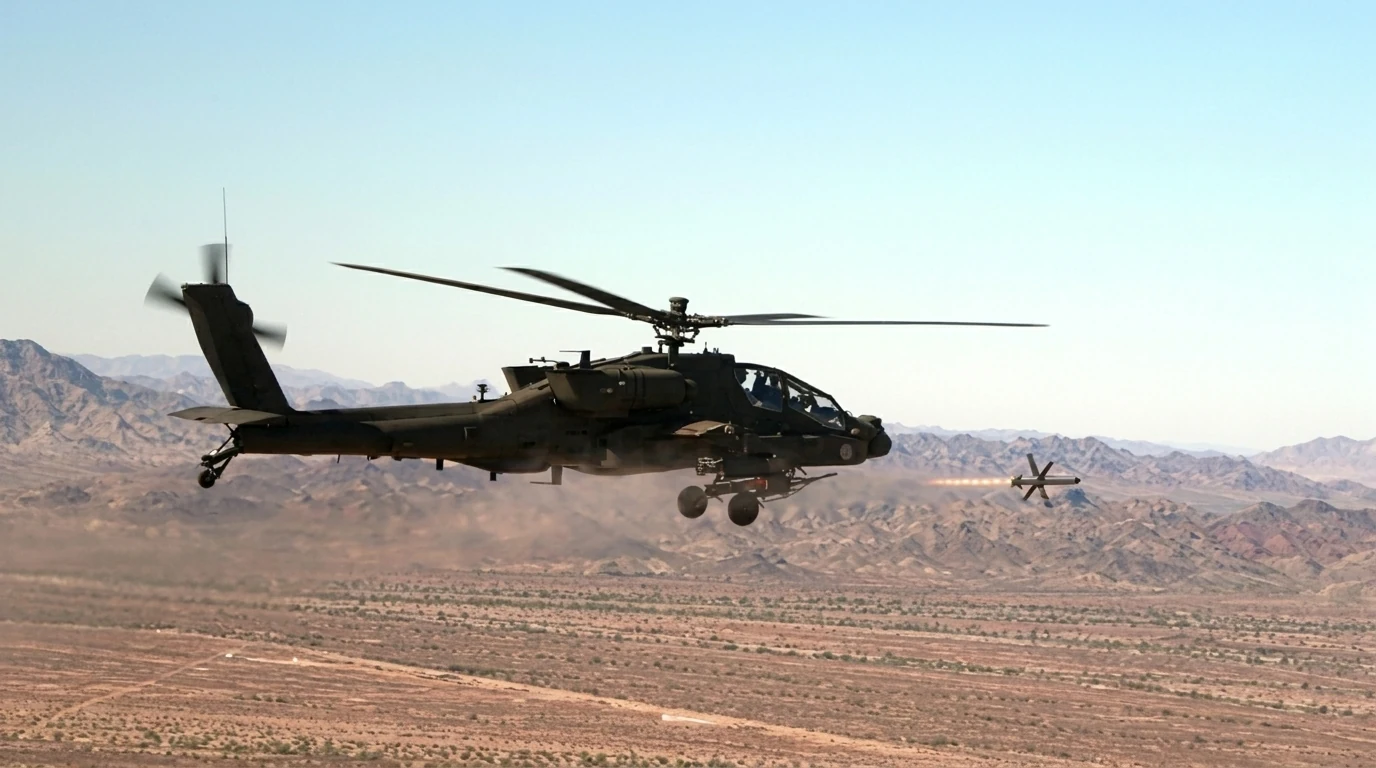
1. Boeing AH-64E Apache Guardian — United States
At number one, the Boeing AH-64E Apache Guardian earns its place as the best attack helicopter in the world, not because it wins every individual specification, but because few rivals combine firepower, sensors, survivability, combat experience, networking, and modernization so effectively.

The Apache’s biggest advantage is that it has evolved from a conventional gunship into something closer to a flying command-and-sensor node.
Boeing describes the latest AH-64E as a “quarterback of the battlefield,” with the aircraft increasingly connected to unmanned systems, other sensors, and wider battlefield networks. In 2026, Boeing is developing Version 6.5 with an open digital architecture intended to make future upgrades easier.
| Feature | AH-64E Apache Guardian |
| Role | Attack and reconnaissance |
| Crew | 2 |
| Main cannon | 30 mm M230 |
| Primary guided weapons | Hellfire missiles |
| Other weapons | 70 mm rockets, air-to-air missiles |
| Key systems | Longbow radar, advanced targeting sensors |
| Networking | Link 16 and MUM-T |
| Global operators | 19 countries |
| Worldwide fleet | 1,300+ Apaches |
The numbers behind the Apache are significant. Boeing reported in August 2026 that more than 1,300 Apaches are operating worldwide across 19 nations, with Poland set to become the 19th operator after ordering 96 AH-64Es.
Its combat history adds another layer of confidence. This is not a helicopter whose reputation exists mainly on a specification sheet. Decades of operational use have generated experience that feeds into training, maintenance, tactics, and successive upgrades.
And then there is the future. In testing, an AH-64E recently defeated 13 of 14 drone targets during a live-fire event, while Boeing is developing Launched Effects and additional counter-drone capabilities.
That adaptability is ultimately why the Apache takes #1. The most impressive part isn’t one missile or one radar. It’s the ecosystem around the aircraft, and its ability to keep absorbing new technology as the battlefield changes.
2. Bell AH-1Z Viper — United States
The Bell AH-1Z Viper takes the second spot on our list of the best attack helicopters in the world. And there’s a good reason it stands apart from the Apache: the Viper was built around the needs of the U.S. Marine Corps, where an attack helicopter may have to operate from ships, support amphibious forces, escort other aircraft, or provide close air support far from a conventional airbase.
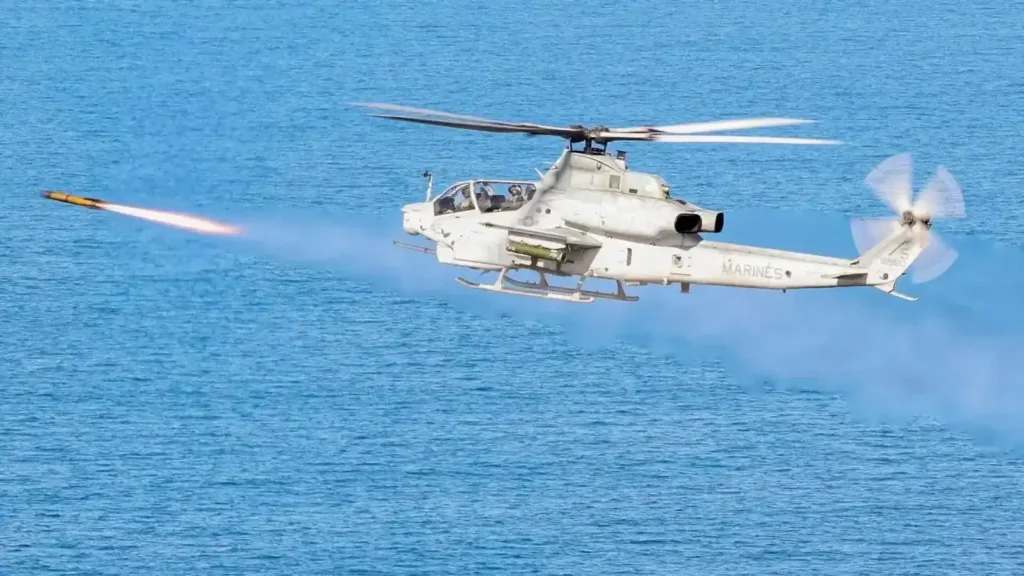
The Viper is powered by two General Electric T700-GE-401C engines, each producing 1,800 shp. Bell lists a maximum speed of 200 knots (about 370 km/h), a maximum range of 310 nautical miles, and a combat radius of 131 nautical miles under a specified combat-load configuration. Its maximum gross weight is 18,500 pounds.
| Feature | AH-1Z Viper |
| Role | Attack, escort, reconnaissance |
| Crew | 2 |
| Engines | 2 × T700-GE-401C |
| Engine power | 1,800 shp each |
| Maximum speed | 200 knots (~370 km/h) |
| Combat radius | 131 nm (~243 km) |
| Maximum range | 310 nm (~574 km) |
| Main cannon | 20 mm |
| Weapon stations | 6 wing stations |
| Key sensor | Target Sight System |
| Special strength | Expeditionary and maritime operations |
Its weapon system is where the Viper becomes particularly interesting. The helicopter can carry Hellfire missiles, 70 mm rockets, and AIM-9 Sidewinders, giving it both ground-attack and air-to-air capability.
The Marine Corps also declared the AGM-179A JAGM operational on the AH-1Z in 2022, adding a newer precision-guided weapon that combines laser and millimeter-wave radar guidance.
The Viper’s Target Sight System is another major advantage. Its sensors allow crews to identify, track, and designate targets at long distances, including during night and poor-weather operations.
But perhaps the smartest feature is less glamorous: the AH-1Z shares about 85% parts commonality with the UH-1Y Venom. That reduces the logistical burden for Marine units operating both helicopters.
And the Viper isn’t standing still. In July 2026, Bell announced a $300 million SPINE upgrade contract covering up to 49 Marine Corps H-1 aircraft, including 28 AH-1Zs, with deliveries of upgraded aircraft planned from 2028.
That combination of speed, sensors, precision weapons, air-to-air capability, survivability, and shipboard flexibility makes the AH-1Z a remarkably versatile gunship, and earns it the #2 position.
3. Kamov Ka-52M Alligator — Russia
The Kamov Ka-52M Alligator takes the third spot among the best attack helicopters in the world. It is one of those aircraft that looks unconventional even before you examine its specifications. Instead of a traditional main rotor and tail rotor arrangement, the Ka-52 uses two coaxial counter-rotating rotors mounted on the same shaft.

That unusual layout eliminates the need for a tail rotor and gives the helicopter strong maneuverability in confined spaces. It also lets the aircraft maintain control without the sideways thrust normally produced by a tail rotor. The result is a gunship designed as much around handling characteristics as raw weapons capacity.
The Ka-52M is an extensively modernized version of the Ka-52. Its upgrades focus on weapons, sensors, communications, and battlefield integration. Russian sources describe the aircraft as capable of operating alongside other helicopters, aircraft, and unmanned systems, reflecting the broader shift toward networked warfare.
| Feature | Ka-52M |
| Role | Attack/reconnaissance helicopter |
| Crew | 2 |
| Rotor configuration | Coaxial counter-rotating |
| Main cannon | 30 mm 2A42 |
| Primary weapons | Guided missiles and rockets |
| Key strength | Agility and sensor integration |
| Night capability | Yes |
| Modernization focus | Sensors, weapons, communications |
One of its most interesting features is its crew-protection philosophy. The Ka-52 uses an ejection-seat system, unusual for helicopters, giving the crew a means of escaping the aircraft in extreme emergencies.
Its weapons ecosystem has also evolved considerably. The Ka-52M can employ precision-guided weapons, including the LMUR/Izdeliye 305, a longer-range missile designed for attacks against armored vehicles and fortified targets.
Russian reporting states that this weapon can reach up to 14.5 km, although claims about weapon performance should be treated cautiously because independent battlefield verification is limited.
The Ka-52 therefore earns #3 not because it dominates every category, but because its combination of unusual aerodynamics, crew protection, sensors, and precision weapons makes it one of the most distinctive modern attack helicopters.
4. Mil Mi-28NM Havoc — Russia
The Mil Mi-28NM Havoc takes fourth place among the best attack helicopters in the world. If the Tiger represents a relatively lightweight European approach, the Mi-28NM goes in almost the opposite direction: heavy protection, a powerful cannon, substantial weapons capacity, and systems designed for operations in difficult conditions.

The Mi-28NM is the modernized version of the Mi-28 family. It retains the basic two-seat attack-helicopter layout but introduces upgraded engines, avionics, sensors, defensive systems, and weapons.
Available specifications list a maximum takeoff weight of about 12,100 kg, a maximum speed of roughly 324 km/h, and a combat range of approximately 450–500 km.
| Feature | Mi-28NM |
| Role | Attack / multipurpose combat helicopter |
| Crew | 2 |
| Maximum takeoff weight | 12,100 kg |
| Maximum speed | ~324 km/h |
| Combat range | ~450–500 km |
| Main cannon | 30 mm 2A42 |
| Cannon ammunition | 300 rounds |
| External hardpoints | 4 |
| Maximum warload | ~2,300 kg |
| Engines | 2 × VK-2500P |
Firepower is one of the Havoc’s calling cards. Its 30 mm 2A42 cannon can carry 300 rounds, while its external stations can accommodate anti-tank missiles, rockets, air-to-air weapons, and other stores. Some published configurations also list the Vikhr anti-tank missile and the newer Izdeliye 305 air-to-ground weapon among its options.
Protection is equally important. The Mi-28 family was built with armored crew areas, redundant flight systems, self-sealing fuel tanks, and defensive warning and countermeasure equipment.
The design reflects a fairly blunt philosophy: if the helicopter has to enter a dangerous engagement zone, give the crew a substantial protective envelope and keep critical systems functioning after damage.
That approach makes the Mi-28NM an imposing battlefield machine. Still, its ranking at #4 reflects the broader competition: modern attack helicopters are increasingly judged by sensor fusion, networking, precision weapons, and integration with other platforms, not armor and firepower alone.
5. Eurocopter Tiger — Europe
The Eurocopter Tiger takes the fifth spot among the best attack helicopters in the world. It may not have the sheer size or weapon load of some rivals, but the Tiger was designed around a different philosophy: stay agile, reduce its battlefield signature, and give the crew accurate information without turning the helicopter into a flying brick.

The Tiger HAD is a medium-weight, twin-engine attack helicopter with a maximum takeoff weight of 6,600 kg. Airbus lists a fast cruise speed of 271 km/h, an armed range of about 740 km, and a standard mission duration of roughly 2.5 hours. With external fuel tanks, endurance can reach up to five hours.
Its weapons package is substantial for its size. The Tiger HAD carries a 30 mm cannon with 450 rounds, while its air-to-ground arsenal can include Hellfire and Spike missiles with self-designated ranges of up to 8 km. It can also carry 68 mm or 70 mm rockets and four Mistral air-to-air missiles.
| Feature | Tiger HAD |
| Role | Attack / armed reconnaissance |
| Crew | 2 |
| MTOW | 6,600 kg |
| Fast cruise speed | 271 km/h |
| Armed range | Up to 740 km |
| Main cannon | 30 mm |
| Cannon ammunition | 450 rounds |
| Anti-tank missiles | Hellfire / Spike |
| Missile range | Up to 8 km in self-designation mode |
| Operational roles | Ground attack, escort, reconnaissance, anti-tank, air-to-air |
The Tiger’s real strength, however, is the combination of agility and survivability. Its narrow profile, redundant systems, self-sealing fuel tanks, ballistic protection, and countermeasures are intended to make it harder to detect and harder to knock out. Its roof-mounted sight also combines thermal imaging, cameras, laser designation, and target tracking.
And 2026 brings an interesting twist. The Tiger MkIII modernization is adding new digital avionics, sensors, weapons, communications, and drone-interoperability features. Airbus says the first MkIII flight is targeted for 2026.
That future upgrade could change the Tiger’s standing. For now, though, its relatively modest size and aging baseline keep it at #5.
Which Is the Most Powerful Attack Helicopter in the World?
If you define “most powerful” purely by weapons carried, the answer becomes surprisingly messy. A helicopter can carry a huge payload and still be less effective if its sensors, targeting systems, communications, or survivability lag behind the competition.
For 2026, the AH-64E Apache Guardian is the strongest choice for best overall attack helicopter. Its advantage comes from the way multiple capabilities reinforce each other. Boeing lists a maximum operating weight of 10,433 kg, with a published weapons configuration of up to 16 Hellfire missiles, 76 2.75-inch rockets, and 1,200 rounds for its 30 mm chain gun.

But the more interesting advantage is what happens before the weapons are fired.
The Apache’s AN/APG-78 Longbow fire-control radar can automatically detect, locate, classify, and prioritize targets, while the aircraft’s broader networked architecture allows it to exchange information with other platforms. Lockheed Martin describes Longbow as the only dedicated attack-helicopter fire-control radar of its kind.
| Category | Best pick | Why |
| Best overall | AH-64E Apache | Sensors, weapons, networking and combat experience |
| Fastest in this ranking | AH-1Z Viper | Up to ~370 km/h |
| Best agility | Ka-52M | Coaxial rotor configuration |
| Heavy firepower & protection | Mi-28NM | 30 mm cannon and heavily protected design |
| Best European option | Tiger HAD | Agility, sensors and modernization potential |
The Apache is also adapting to a battlefield increasingly crowded with drones. Boeing reported that an AH-64E defeated 13 of 14 drone targets during a live-fire event, while current modernization work is focused on extending its sensing, networking and manned-unmanned teaming capabilities.
That is the key distinction. Power isn’t just the ability to hit harder; it’s the ability to find the right target, understand the situation, strike effectively, and remain useful as the battlefield changes.
By that broader measure, the Apache remains the benchmark among the best attack helicopters in the world.
