

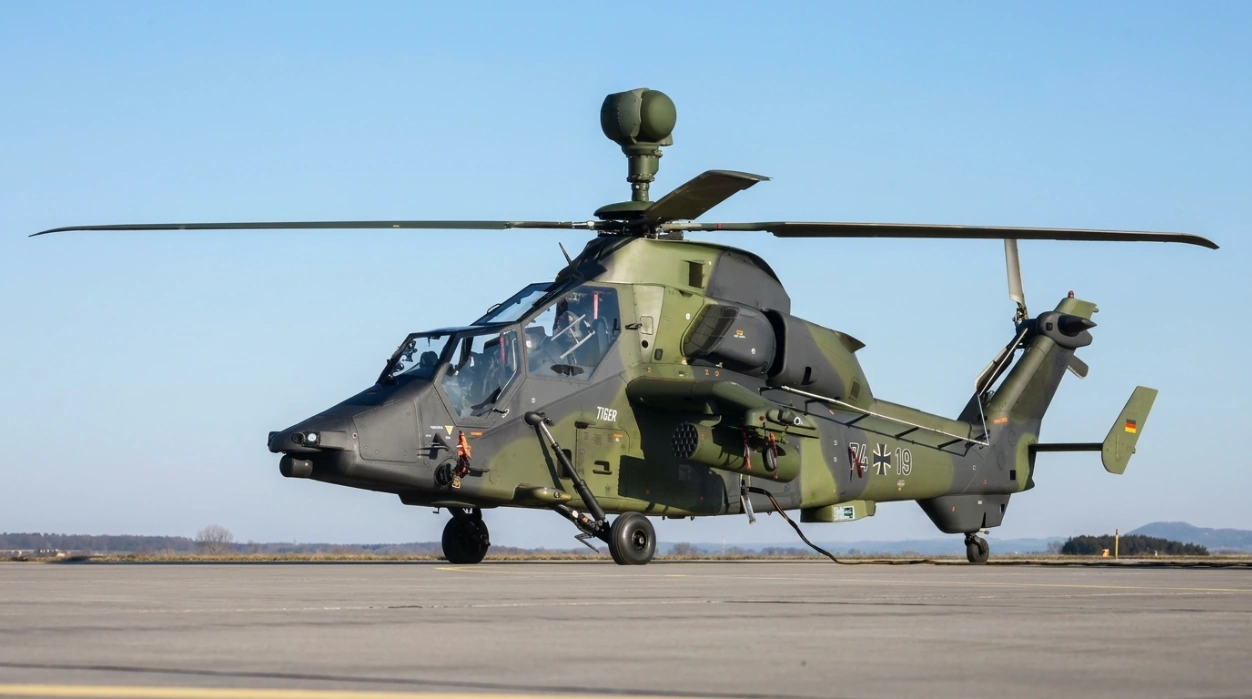
Europe’s plan to build its own advanced attack helicopter sounded simple in the 1980s: combine French and German engineering, share the costs, and create a capable alternative to American and Soviet designs.
It turned out to be far more complicated.
The Eurocopter Tiger became one of Europe’s most ambitious military aviation projects, later joined by Spain and produced in several national variants. It delivered advanced sensors, composite construction, night-fighting capability and precision weapons, but also exposed the difficulties of European defense cooperation.
The Eurocopter Tiger programme began in 1984, driven largely by Cold War requirements for anti-tank and armed reconnaissance missions. Then the strategic environment changed. The Cold War ended, procurement numbers fell, national requirements diverged and development challenges accumulated.
Instead of one standardized helicopter, Europe ended up with several configurations tailored to individual countries.
That’s what makes the Eurocopter Tiger more than an attack helicopter. It was also a test of whether Europe could combine money, technology and industrial expertise to build a major weapons system independently.
Decades later, France and Spain are still upgrading their Tigers through the MkIII programme, while Germany has chosen a different replacement path.
So was the Eurocopter Tiger a costly procurement headache or a genuine step toward European strategic autonomy?
The answer is somewhere in between and understanding why requires looking beyond the helicopter itself.
Why France and Germany Wanted Their Own Attack Helicopter
When France and West Germany began developing the Eurocopter Tiger in 1984, they wanted more than a replacement helicopter. The goal was to create an advanced European combat aircraft while strengthening the continent’s own defense industry and reducing reliance on foreign suppliers.
The Cold War shaped the requirement. Both countries wanted a battlefield helicopter capable of missions including anti-tank warfare, reconnaissance, escort and ground support.
But their priorities were different. Germany emphasized anti-tank and armed reconnaissance, while France wanted a more flexible platform for escort and fire-support missions.
The original plan was straightforward: share development costs, combine industrial expertise and produce a common European helicopter in significant numbers.
Then reality intervened.
The programme underwent major changes in the late 1980s, while the end of the Cold War later reduced Europe’s demand for large numbers of attack helicopters. Procurement plans fell, further complicating the programme’s economics.
This created the Tiger’s central paradox.
Europe wanted one common helicopter to strengthen strategic autonomy, but its partners never had exactly the same idea of what that helicopter needed to do.
Read also: Top 5 Best Attack Helicopters in the World
Eurocopter Tiger Specifications and Combat Capabilities
The Eurocopter Tiger was designed as a relatively light but heavily equipped attack helicopter, combining speed, maneuverability and a sophisticated sensor suite in a roughly six-ton class airframe.
It was never meant to carry the payload of a much larger helicopter. Instead, its philosophy was to make a smaller aircraft harder to detect and capable of performing several battlefield missions.
| Specification | Eurocopter Tiger |
| Type | Multirole attack helicopter |
| Crew | 2 |
| Maximum takeoff mass | Approx. 6.6 tonnes |
| Length | Approx. 14.1 m |
| Maximum speed | Approx. 290 km/h |
| Typical endurance | Around 3 hours |
| Engines | 2 × MTR390 |
| Main cannon | 30 mm |
| Rockets | 68 mm |
| Air-to-air missiles | Mistral |
| Anti-tank missiles | Hellfire / variant-dependent |
French defense authorities list the Eurocopter Tiger at a maximum mass of around 6.6 tonnes, with a crew of two and a maximum speed approaching 290 km/h. The French HAD version can employ a 30-mm cannon, 68-mm rockets, Mistral air-to-air missiles and Hellfire air-to-ground missiles.
One of the Eurocopter Tiger’s defining characteristics is its tandem cockpit, giving the pilot and gunner separate but closely integrated positions. The helicopter also uses composite materials and incorporates design features intended to improve survivability on the battlefield.
Its sensor and weapons configuration varies between national versions, which is important when discussing the Eurocopter Tiger as a single aircraft.
Germany’s UHT, for example, was optimized around reconnaissance and anti-tank missions, while French and Spanish variants placed greater emphasis on armed escort and direct ground attack.

That flexibility was intentional.
Europe wasn’t trying to build a helicopter that did just one thing exceptionally well. The goal was a platform that could adapt to different missions while sharing a common European foundation.
And therein lies the Eurocopter Tiger’s engineering appeal, a relatively compact helicopter carrying the sensors, weapons and survivability features expected from a much larger combat system.
The specifications look impressive on paper. But the more revealing question is whether France, Germany and Spain could actually agree on how that common machine should be equipped and used.
Read also: RAH-66 Comanche: Why the Stealth Helicopter Was Canceled
The Eurocopter Tiger Became Three Different Helicopters
The Eurocopter Tiger was designed as a common European attack helicopter, but France, Germany and Spain eventually operated different versions. The result shows both the strengths and weaknesses of multinational defense cooperation.
Germany’s UHT focused heavily on reconnaissance and anti-tank missions, while France initially used the HAP for armed escort and protection before adopting the more capable HAD variant. Spain also selected the HAD, with modifications for its requirements.
| Operator | Variant | Delivered |
| Germany | UHT | 68 |
| France | HAP/HAD | 71 |
| Spain | HAP/HAD | 24 |
The different configurations made the Eurocopter Tiger more useful to each military, but they also complicated the idea of a truly standardized European platform.
This is the Eurocopter Tiger’s central paradox: Europe shared the basic helicopter, but not always the same idea of how it should fight.

Different sensors, weapons and mission requirements can increase development, testing, training and logistics costs. The programme therefore achieved cooperation, but only through a series of national compromises.
That makes the Eurocopter Tiger an important case study in European defense autonomy.
Building one European weapon is difficult. Getting several countries to agree on exactly the same weapon can be even harder.
Why the Eurocopter Tiger Programme Took So Long and Cost So Much
The Eurocopter Tiger was conceived during the Cold War, but much of its development took place after the Soviet Union collapsed. That left Europe trying to finish an expensive attack helicopter while its strategic priorities were changing.
The Eurocopter Tiger programme began in 1984 and went through major changes and cost concerns during development. Procurement numbers were also reduced, making it harder to spread development costs across a large fleet.
Different national requirements added another complication. Germany, France and Spain wanted different sensors, weapons and mission capabilities, resulting in several Tiger configurations built around the same basic platform.
That sounds efficient in theory. In practice, every variation can mean more testing, integration work, training and logistics.

The Eurocopter Tiger therefore became a classic European defense dilemma: the countries could cooperate on the platform, but they couldn’t fully agree on what the platform should be.
The challenge wasn’t simply building an advanced helicopter. It was building one affordably, on schedule and around requirements shared by multiple countries.
That is why the Eurocopter Tiger remains such an interesting case of European defense cooperation. It proved that Europe could develop sophisticated military technology independently, but also showed how quickly the benefits of standardization can disappear when national priorities begin pulling in different directions.
From Afghanistan to Modern Warfare: Has the Eurocopter Tiger Stayed Relevant?
The Eurocopter Tiger was designed for a very different battlefield from the one European militaries are preparing for today. Its original concept emerged from Cold War concerns about armored formations, but the helicopter eventually entered service in an era dominated by expeditionary warfare, counterinsurgency and asymmetric conflicts.
That gave the Eurocopter Tiger a chance to prove its flexibility.
French Eurocopter Tigers were deployed to Afghanistan, supporting coalition operations in a difficult environment where reconnaissance, fire support and precision attacks were often more important than the massive anti-tank battles originally envisioned in Europe.
France later deployed Tigers during Operation Harmattan over Libya in 2011, demonstrating the helicopter’s ability to operate from naval and land bases in expeditionary operations.
But the battlefield has changed again.

The rise of inexpensive drones, persistent surveillance, electronic warfare and increasingly capable air-defense systems has made life considerably harder for attack helicopters. A platform that can maneuver close to the battlefield must now assume that its movements may be detected by sensors that cost a fraction of the aircraft.
That doesn’t make the Eurocopter Tiger obsolete, but it changes the requirements.
Modern attack helicopters need better connectivity, improved sensors, stronger electronic protection and weapons capable of engaging targets without unnecessarily exposing the aircraft.
This is precisely why the Eurocopter Tiger MkIII modernization matters. France and Spain aren’t simply trying to make their helicopters faster or more heavily armed. They’re attempting to adapt an existing platform to a battlefield where information and survivability can matter as much as raw firepower.
The Eurocopter Tiger’s operational history therefore tells an interesting story.
It successfully transitioned from a Cold War concept to expeditionary combat, but now faces a new test: whether a helicopter designed decades ago can remain useful in an era increasingly shaped by drones, networked warfare and dense air defenses.
The answer may depend less on the original Eurocopter Tiger design than on how successfully Europe can modernize it.
Tiger MkIII: Europe’s Bid to Keep the Attack Helicopter Relevant
The Eurocopter Tiger MkIII is effectively Europe’s attempt to give the Eurocopter Tiger another lease on life rather than replacing the platform immediately. France and Spain launched the modernization programme in 2022, with Airbus describing it as a major upgrade designed to keep the helicopter relevant against future battlefield threats.
The Eurocopter Tiger programme covers 42 French and 18 Spanish helicopters, with an option for another 25 French aircraft. The modernization is expected to introduce upgraded avionics, communications, sensors and weapons, helping the Tiger operate in increasingly networked combat environments.
For France, the objective is particularly ambitious. The country’s defense procurement agency has said the modernization is intended to extend the Eurocopter Tiger’s operational relevance beyond 2050, including in high-intensity coalition warfare.
That is a long service life for an aircraft whose origins stretch back to the Cold War.

The upgrade also highlights an important reality of modern military aviation: replacing an entire fleet is expensive and slow. If an existing airframe still has useful characteristics, improving its electronics, sensors, communications and weapons can be a more practical solution.
But the Eurocopter Tiger MkIII also exposes the limits of that approach.
Germany chose not to participate in the same modernization path and instead moved toward a different replacement strategy. That means the original three-nation vision has already fragmented further, even as France and Spain invest in extending the platform.
So the MkIII is both an upgrade and a test of European defense cooperation.
If successful, it could keep the Eurocopter Tiger relevant for another generation while preserving European expertise in attack-helicopter technology.
But it also leaves Europe with an awkward question: is modernizing an aging common platform the smartest way to preserve strategic autonomy, or does it simply postpone the difficult decision to build something new?
The Eurocopter Tiger’s Real Legacy for European Strategic Autonomy
The Eurocopter Tiger leaves Europe with a complicated but valuable lesson. It proved that European countries could combine their industrial expertise to create an advanced attack helicopter, but it also showed how difficult that cooperation becomes when national priorities, budgets and requirements start pulling apart.
The Eurocopter Tiger was never just an aircraft programme. It was also an attempt to preserve Europe’s ability to design, develop and manufacture sophisticated military technology without depending entirely on outside suppliers.

That objective was largely achieved. France, Germany and Spain built an indigenous combat helicopter and created industrial expertise that continues through modernization efforts such as Tiger MkIII. But the programme also exposed the cost of pursuing autonomy through fragmented requirements and relatively small production runs.
That lesson is becoming increasingly relevant.
Europe is now trying to strengthen its defense-industrial base across areas ranging from combat aircraft and tanks to missiles and drones. The Eurocopter Tiger shows that having the engineering capability is only one piece of the puzzle.
A genuinely autonomous defense industry also needs stable funding, common requirements, predictable procurement and long-term political commitment.
Otherwise, countries can end up developing similar technologies separately or building a common platform that becomes increasingly different from one operator to another.
That is perhaps the most useful way to remember the Tiger.
It wasn’t a perfect programme, and calling it one would miss the point. It was a bold experiment that delivered a capable helicopter while exposing the weaknesses of European defense cooperation.
For the Eurocopter Tiger, the legacy is therefore neither triumph nor disaster.
It is a warning and a proof of concept.
Europe demonstrated that it could build its own advanced attack helicopter. The harder challenge is making that kind of strategic autonomy affordable, standardized and sustainable for the next generation.
