

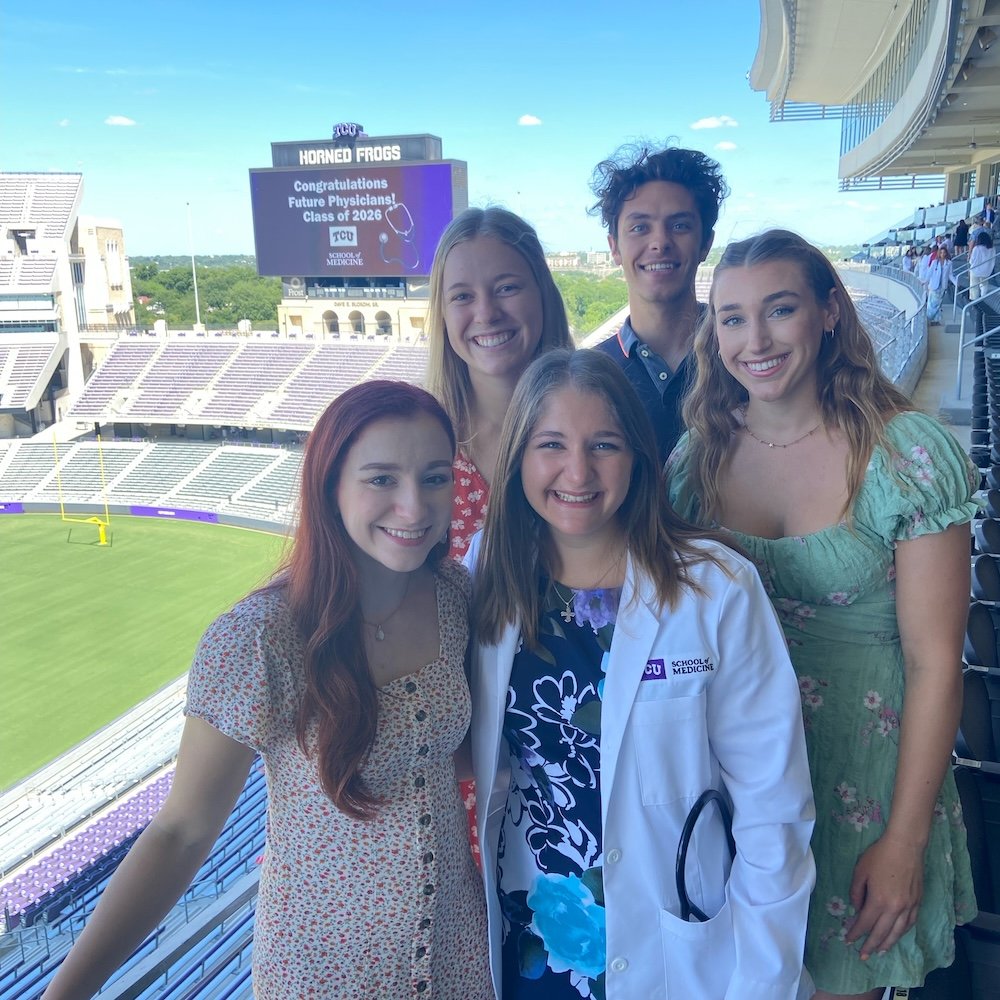
When Connie Linardos ’22 first came to Texas Christian University, she wasn’t just
choosing a college; she was setting the stage for her future career in medicine. From
studying neuroscience at TCU’s College of Science & Engineering to entering her fourth
year as a medical student at the Anne Burnett Marion School of Medicine at TCU, Linardos is preparing for her career
in pediatrics.
As part of her work as a fourth-year medical student, Linardos is conducting research
on how the viscosity, or thickness, of a liquid medication impacts a child’s willingness
to take it.
“A significant factor behind medication noncompliance in pediatric populations is
the actual administration of the medication,” Linardos said. “My mentor, Dr. Gregory
Kearns (the medical school’s associate dean of research), inspired me to think about
the logistical challenges behind effective treatment. It’s easy for us to prescribe
an antibiotic, but to have a toddler successfully take a full dose when they don’t
like the taste of it is a completely different challenge that parents often face.
Our goal is to isolate viscosity as a factor in taste preference to identify potential
areas of improvement in liquid medication development.”
In what has become a cross-disciplinary research project, Linardos is also collaborating
closely with faculty in TCU’s Harris College of Nursing & Health Sciences.
Teresa Drulia, Harris College’s associate professor of communication sciences and
disorders, is helping her refine the way the experiment is run. Ultimately, oral medication
and its viscosity are related to swallowing and speech-related functions, so this
made for a perfect partnership.
“Engaging in interdisciplinary research studies, such as this one, promotes growth
and fosters innovation at TCU,” Drulia said. “I was eager to partner with Connie and
Dr. Kearns once I heard their project would address the palatability of pediatric
medication. Although the impact of viscosity has been examined in studies for persons
experiencing difficulty swallowing (dysphagia), this study will add valuable insight
into children’s perceptions of viscosity.”
Linardos’ inspiration for working with children comes from personal experience. Diagnosed
with celiac disease at a young age, Linardos spent much of her childhood in doctors’
offices. What stood out to her most from these memories wasn’t the diagnoses or treatments,
but the way her pediatricians made her and her family feel.
“I was inspired by how pediatricians spoke to patients and parents, making them feel
comfortable and safe,” Linardos, also a graduate of TCU’s John V. Roach Honors College, said.
That inspiration, combined with her curiosity about neuroscience and sparked by her
grandfather’s experience with Alzheimer’s disease, set her on a path toward caring
for young patients.
Karen Hennington, director of TCU’s Miller Speech & Hearing Clinic, is helping Linardos
reach those to participate in the study by sharing information with families who visit the clinic, but Linardos hopes add
even more families.
“I’m also hoping to reach a wider pool of participants before the end of October,”
Linardos explained. “There is no medication in the liquid that’s provided in the study.”
-McKenzie Lane
