

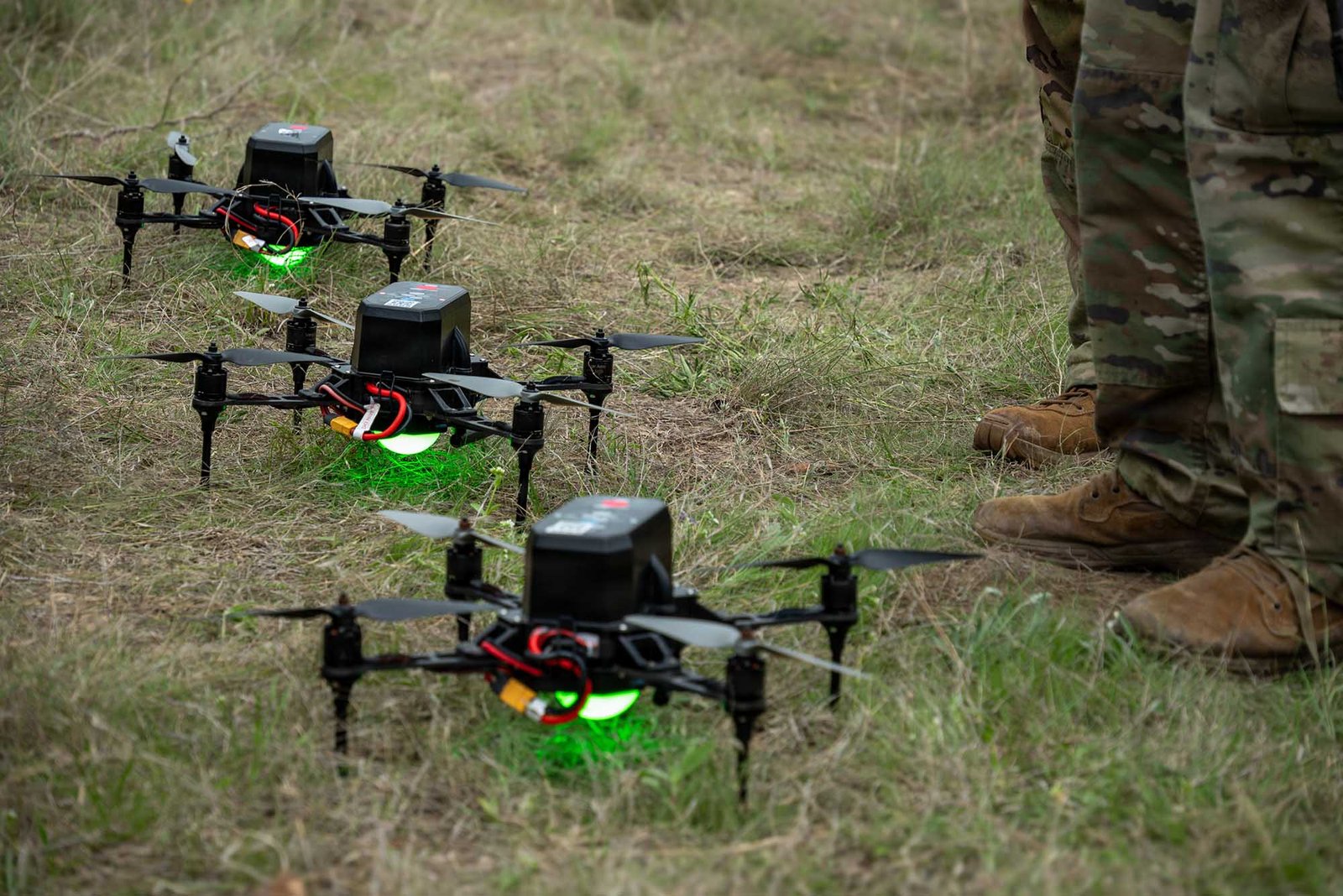
Not a day passes without mention of drones in various conflicts around the world. Is it all doom and gloom or can such threats be neutralised? One factor that is clear is that the modern drone threat is leading to new approaches to procurement and the integration of emerging technologies with extant military doctrine.
In the 1960s, First Secretary of the Communist Party of the Soviet Union Nikita Khrushchev began the debate surrounding the concept of a ‘revolution in military affairs’ when he referred to low-yield nuclear weapons and the emergence of guided weapons changing the face of warfare. Although this phrase and its underlying inference that technology and geo-political factors have the ability to alter the nature of warfare is supported or decried in equal numbers by military historians and analysts of conflict alike, there are examples where technology has generated major change.
In 1973 during the Yom Kippur war for example, Israel was shocked by the impact, both metaphorically and physically, of wire-guided man-portable anti-armour weapons such as the AT-3 Sagger. The use of such weapons led to the development of countermeasures that included added armour, the adoption of Explosive Reactive Armour (ERA) and simple but effective steel mesh skirts to detonate the HEAT warhead before it could strike the vehicle. Despite predictions at the time, the arrival of man-portable anti-armour weapons did not herald the demise of the main battle tank.
Overtime, the armour – anti-armour argument has settled with weapons such as the Sagger and subsequent iterations of HEAT warhead armed missiles losing their initial edge as counters were developed to nullify them.
It can be argued that such technologies and associated countermeasures pale in comparison to modern threats posed by drones but are we really facing a revolution in military affairs as far as the ubiquitous new platform is concerned? Firstly, it is worth defining what is meant by drone. The ‘drone’ description was initially derided by the military as a lazy description for a UAV but today the word ‘drone’ is used to describe a low-cost UAV that ranges from the First Person View (FPV) ‘hobbyist’ platforms up to longer range and more capable Iranian Shahed and Russian Geran variants. Drones probably sit at the bottom of the unmanned taxonomy with conventional UAVs such as the MQ-9 Reaper and Bayraktar TB2 in the middle, while Collaborative Combat Aircraft (CCA) such as the MQ-28A Ghost Bat occupy the top strata.
The general ubiquity of drones on the modern battlefield in theatres such as Ukraine and the Gulf are only the tip of the iceberg. So-called ‘grey zone’ operations in Europe have managed to close airports in countries such as Belgium, Denmark, the Netherlands, Germany and the UK and disrupt a state’s day-to-day enterprises. They highlight the ability of the lowcost drone to derail both military and commercial activities. As far as the former kinetic use of drones is concerned, German intelligence sources said that in March, Russia suffered 35,000 casualties in Ukraine and 96% of these were caused by drones. This monthly drone casualty causation figure is in excess of the longer term 80% that is often quoted by the Ukrainian MoD.
Without doubt, drones have caused a ‘revolution in military affairs’ but it can be argued that mitigation of this threat can reduce their impact as was the case with portable anti-armour weapons in the mid-seventies. Apart from the rise in counter-UAS (C-UAS) technologies, the drone threat has also affected a raft of other factors including, procurement methods, military tactics and doctrine, and finally, the ability to shape potential nascent political allegiances [C-UAS technologies were examined in ESD 04/2026 by Sidney E. Dean]. These other factors will be examined in more depth later in this feature but what of the drone threat itself?
The low-cost drone presents four major threats to the enemy. The first is a strike capability that is aimed at dismounted infantry, defensive positions, wheeled vehicles and armour. Away from the battlefield and as witnessed by Ukraine’s actions against Russia, these strikes can include airfields, ships, factories and oil storage/refinery facilities. The second threat may be defined as reconnaissance and surveillance to provide the commander with the intelligence, time and space to conduct offensive strikes and alter tactics in real time to counter the enemy’s manoeuvres. A sub-set of this is using drones to direct artillery fire. In essence, this is the creation of the ‘transparent battlefield’ where the all-seeing drone drives the narrative.
Closely associated with the strike capability is the use of overwhelming mass, the so-called ‘drone swarm’. These drones may deliver a strike capability but their overall aim is to subdue and defeat countermeasures, sow confusion and create cognitive overload for commanders and perhaps, to obscure other forms of attack such as ground or air strikes. Finally, and slightly outside the scope of this feature, is the use of drones to undertake resupply. Given the low-cost drone’s small size, payloads would of course be limited but this has not stopped Ukraine using drones to drop rations and ammunition to its forward deployed troops.
The worth of any type of weapon or combined arms force depends upon C4ISR and turning again to Ukraine as an example, this is provided by its cloud-based DELTA situational awareness platform. Developed by the Ukrainian Army starting in 2021, the system has been acclaimed by armed forces around the world and shows the benefits of in-house development to provide a highly capable and user-friendly system in a short timescale. “DELTA is Ukraine’s combat digital ecosystem that has become a game-changer in modern technological warfare,” explained Ukraine’s Minister of Defence, Mykhailo Fedorov. “It has played a key role in numerous operations. Today, it is the single source for data exchange and coordination of actions.”
Drones: Development & Procurement
One of the key spin-offs from the use of drones in the Russo- Ukrainian conflict has been compression of the procurement cycle in terms of how drones and C-UAS technologies are developed and procured. This responsive and nimble approach to procurement is vital if the drone is to prevail over the countermeasures used against it. Not all countries adopt the ‘compressed procurement’ process adopted in Ukraine. In March, The Times reported that in Germany, “Some new devices turned out to be entirely out of date by the time they were delivered and there were inadequate numbers of jammers, lasers and drone-hunting devices that are required to defend bases.”
Technology is advancing rapidly and so as new C-UAS systems are deployed, drones must adapt. According to observers, the Russians “rework drones and tactics every few months.” An example is the addition of fibre-optic cables to some drones to counter EW countermeasures. Another trend is for drones to become more autonomous to remove the need for a drone pilot. With Ukraine often mounting 9,000 drone sorties daily, manpower requirements become paramount.
The major difference between Ukraine and Russia, and with the rest of the world, is that those two countries are at war and therefore drone development takes place hand-in-hand with the emergence of new battlefield tactics. This creates a need for speed to address the enemy’s current tactics and force technological breakthroughs at pace. And pace is the key. So far in 2026 [as of mid-April], 181,000 ‘pieces of equipment’ including drones, unmanned ground vehicles (UGV) and EW systems have been delivered to frontline Ukrainian forces; the vast majority being drones.
According to the Ukrainian MoD, the country’s integrated development and procurement approach has been given an added boost by the creation of Defence City. Launched in January 2026, this venture has become part of ‘a new defence ecosystem’ that has seen the manufacturer of the Vampire and Shrike drones by its inaugural industrial member, SkyFall. “The special framework grant manufacturers exemptions from land, property, and environmental taxes, as well as from corporate income tax, provided profits are reinvested,” a model that many European nations should be aspiring to perhaps given that Ukraine is delivering 1,500 drones per day to the frontline?
Where Europe and the USA differ in terms of their approach to drone deployment compared with Ukraine and Russia is melding requirements with tactical needs. The conventional procurement cycle results in a much longer time to get products to market. In attempting to rectify this time lag, the French DGA procurement agency has created Expert Reference Centres (CER) to focus on what it terms ‘short-cycle technologies’ such as drones and C-UAS. The DGA says that the mission of the CERs, “is to conduct forward-looking research on technologies in their respective fields, potentially leading to acquisitions for the benefit of the armed forces. Bringing together the DGA’s various areas of expertise (technical, procurement, and financial) locally, the CERs have dedicated budgets and work collaboratively with the armed forces and industry.”
One aspect of current French C-UAS efforts feature the DGA’s Cerlad CER that is attached to the DGA’s missile testing (DG EM) division. Major work efforts concentrate on integrating Mistral 3 air-to-air missile with Tiger and anti-drone and laser guided rockets on Rafale and Tiger. The first test firings are expected at the end of June.
In the UK, companies such as Modini and Callen-Lenz are being provided with small-scale contracts to develop low-cost drones and C-UAS. One of the major players is QinetiQ through its Drone- Works programme that is currently working with around 100 SMEs. The challenge is to bring together these drone/C-UAS technologies to work in lock-step with developments on the battlefield or indeed, extant and developing military doctrine.

Plus ça change
At present, countries are lacking a coordinated approach to address the mass use of drones on the battlefield and their effect on battlefield doctrine. The threat is recognised, though few countries are assessing the impact this threat is having on current doctrine.
In the USA for example, a recent live-fire serial as part of the Army’s Golden Shield initiative integrated sensors, ‘kinetic and non-kinetic effectors and C2 to create and autonomous cohesive defence against small UAS.’ The aim is for the US Army to maintain its current armoured forces and tactics and deploy integrated C-UAS defence to counter the drone threat and to allow established armoured tactics to prevail.
“The intent is to take these systems we tested this week and begin to integrate them within our armoured formations’ training,” said MAJ Kevin Correa, 1st Cavalry Division’s air and missile defence chief. “In that way, we are able to fully exercise not only the systems, but the tanker’s ability to manage these systems while conducting their normal operations.” This is a brave response to the growing drone threat. In May 2025, 16,000 NATO troops took part in Exercise Hedgehog 25 to test Estonia’s ‘defensive multi-domain response’ to attack. As well as its own drones/UAVs, the Estonians brought in ten drone operators with their own drones and DELTA C2 systems from Ukraine. First reported by The Wall Street Journal, the Ukrainian drone operators ‘destroyed’ 17 armoured vehicles and struck 30 other targets which resulted in the ‘destruction’ of two battalions and therefore prevented a NATO brigade from crossing the start-line for an attack on Estonian forces.
The real lesson learned from this experience on Hedgehog 25 is that established tactical shortfalls such as paying lip-service to camouflage, moving armoured vehicles in convoys, failing to digin, setting-up command posts in tents and a lack of appropriate C-UAS will end in disaster. NATO and its allies are simply not prepared. Drone operations and C-UAS systems cannot be developed in a vacuum but must be tied to wider doctrine.
A case in point is the British Army’s 11 Brigade that recently carried out trials using Anduril’s Altius drone to engage ground targets in conjunction with the company’s Lattice battle management system. Altius, an autonomous drone system that simply requires the operator, to press ‘search’, ‘arm’ and then ‘engage target’. Great in theory but when vehicle identification and weapon engagement rules are added to the process, the ability to train an operator in a few days is meaningless.
If anything, the excitement shown by the UK MoD and many other NATO members over the minor steps being taken to adopt drone/C-UAS technologies mean nothing when treated as an add-on capability. More effort needs to be taken to integrate the technology and alter current doctrine as and when required. Following Exercise Hedgehog 25, the head of Ukraine’s unmanned systems forces, COL Vadym Sukharevski stated that, “based on my observations and discussions, not a single NATO military is equipped to counter the influx of drones.”

Political Inroads?
Ukraine’s clear technological lead on drone/C-UAS technologies means that they occupy the ‘drone fighting high-ground’ and this has given the country the opportunity to open some political inroads to potential supporters in their war with Russia. Already working closely with the UK Government and companies in the UK, the current conflict in the Persian Gulf has seen, according to President Zelensky, 200 – other sources claim 228 – Ukrainian drone specialists sent to Kuwait, Qatar, UAE and Saudi Arabia. Ukraine had previously signed 10-year security partnerships with countries in the region, including Jordan.
The cost to the Gulf countries in destroying Iranian drones has been phenomenal considering the countries have been using US$3 million Patriot missiles to down Shahed-136 drones costing US$30,000. Add to that the three F-15E aircraft destroyed by Kuwait when carrying out anti-drone sorties and the cost-leveraging factor alone indicates why Ukraine is gaining increasing credibility in the region. Although President Trump told Fox News in late March that, “We don’t need their [Ukraine] help in drone defence. We have the best drones in the world actually,” it is understood that US CENTCOM has been talking to Ukraine about C-UAS options. This can only benefit Ukraine in its goal of increasing its weapon stocks, generating income and gaining political support. An example of the former has seen Qatar and Ukraine discussing a deal to transfer 12 Mirage 2000-5 aircraft while income has been generated by drone/C-UAS exports.
Conclusion
Drones and the methods of countering them have become the most discussed aspect of modern conflicts. They have created a ‘revolution in military affairs’ but whether that is a long-term change is open to debate. What is clear is that the drone/C-UAS debate must not be considered in a vacuum because their capabilities have a significant and manifold impact on the way an army fights a war. In short, and as seen in Ukraine, doctrine must change to reflect the ubiquity of the drone.
The other key element that the modern ‘drone war’ has highlighted is the need to alter the accepted peacetime procurement cycle both in respect to how equipment is defined and the speed of procurement. Ukraine has shown that by bringing together the military with the developers and manufacturers, lessons learned from the battlefield are fed into the development process early and this iterative development leads to efficient procurement and more capable weapon systems.
Author: Dr Trevor Nash, Freelance Editor
Click here to read the latest issue of ESD.
