

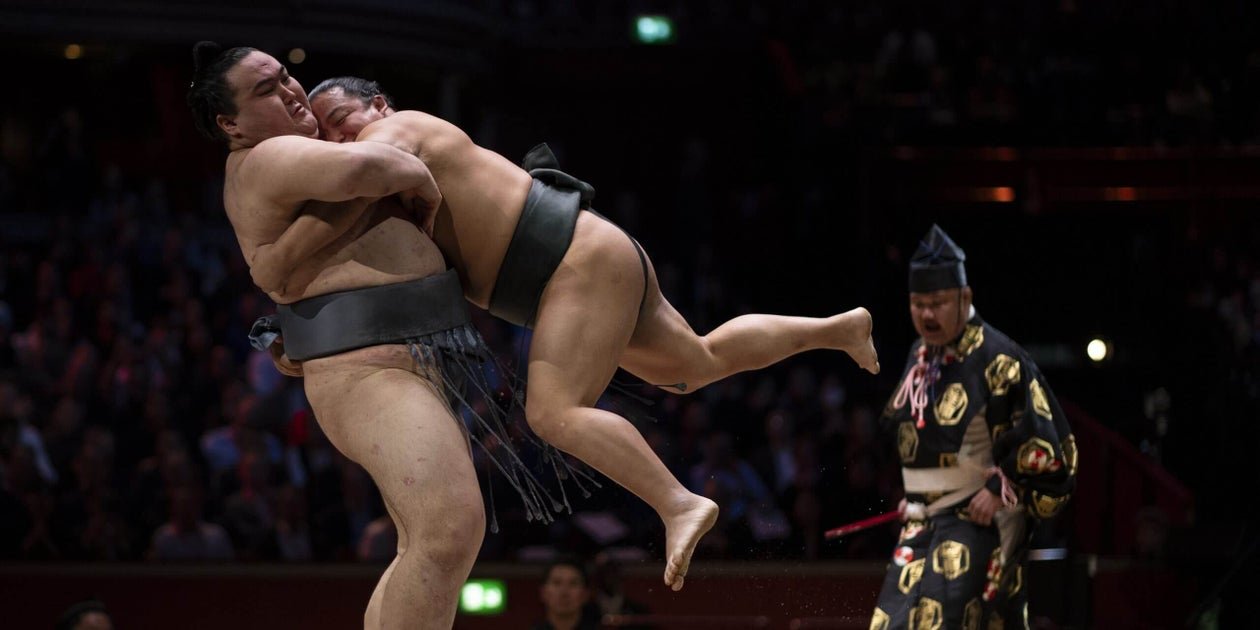
It was a sight to behold. A sell-out crowd, many of whom had travelled from all over Europe to witness the spectacle, were engrossed. Even the warning signs to the spectators seated on ornate cushions around the ring, saying they could be in danger of being squashed, were not a deterrent.
At the Royal Albert Hall, one of England’s pre-eminent concert halls, this week, the Grand Sumo Tournament is being held outside of Japan for just the second time in history — the first was at this same oval hall in the English capital in 1991. It is a grand, spectacular venue for the giants of an ancient sport.
Sumo is explosive yet respectful, a combat sport full of traditions and rituals. For five nights, Japan’s national sport is here in London, offering a rare chance to watch the country’s sporting superstars as the 40 top-ranked wrestlers, called Rikishi (which means Power Men in English), go head-to-head.
It is an arresting sight: the spotlights at full wattage on the dohyō, the raised circular ring in the centre of the hall where the fights take place, while the lights are dimmed on the 5,000 fans encircling the stage. The roof above the dohyō, called a tsuriyane, is designed to resemble the Ise Shrine, the most sacred Shinto temple in Japan.
For those in the cheaper seats (though with a ticket for the final night on Sunday available on one site for over £1,000/$1,343 when The Athletic checked on Thursday, we are speaking figuratively), there’s a giant screen showing the action. There’s a respectful hush during the ceremonial moments, but then the knowledgeable crowd comes to life during the wrestling, some even shouting the Rikishi’s names.
The Rikishi, who compete in the top-ranked Makuuchi division, have certainly caught the eye during their time in London, their daily outings in kimonos and sandals turning into events in themselves. They have been seen buying souvenirs and enjoying the local food — even hot dogs and a McDonald’s — visiting Buckingham Palace, and have been photographed riding the city’s e-bikes.
The tournament has made the bulletins of the UK’s main news channels, the BBC is broadcasting it live on its website and streaming service, and much has been written about the Rikishi, from them having to travel in two separate flights because of their combined weight of around 6.6 tonnes (7.4 U.S. ton) to organisers bringing their own straw from Japan to surround the ring with.
A general view of the opening night at the Royal Albert Hall (Ryan Pierse/Getty Images)
Indeed, it isn’t just transporting the Rikishi to England that has required some heavy lifting. The dohyō took three days to build, using clay and rice-straw bales. The work was done by hand, with beer bottles used for tamping and shaping the 6.7-metre-wide structure.
Steve Pateman, president and chairman of the British Sumo Federation, tells The Athletic that the sport is “all about reactions”.
“These strong men are very intelligent and have worked things out very quickly,” he says. “They have a good sense of balance and strength. They are quite fast and can learn techniques quickly.”
Diet is, quite clearly, incredibly important to the Rikishi. They must match incredible strength and technique with physical size. Each Rikishi can eat between 10,000 and 20,000 calories per day, depending on their physical needs and training regimen.
Their weight ranges from Onosato, a Yokozuna (the highest-ranked wrestler) and one of the sport’s biggest stars, who weighs 191kg, to the smallest of the 40 competitors, Fujinokawa, who weighs in at 117kg. But most range between 140kg and 180kg. Perhaps it comes as no surprise to learn that chairs and toilets have had to be reinforced for their visit.
Their Kensington hotel in the west of the city has had to order around 75kg of rice per day for the Rikishi’s carb-rich diets, and there have even been reports of a shortage of noodles for their special stew, Chanko Nabe, which is often washed down with beer.

Some of the competitors are pictured in front of Buckingham Palace (Ryan Pierse/Getty Images)
The diet may be extreme, but these are no ordinary men. They live in an intense training environment, burning up to 10,000 calories during four-hour morning training sessions. Eating and sleeping are the other important elements of their preparation.
Currently, there are around 600 professional Rikishi registered with the Japanese Sumo Association, each belonging to one of 45 heya or sumo-beya, usually translated as ‘stables’, where wrestlers live and train together in a hierarchical environment.

Onosato, one of the sport’s biggest stars, walks near the Houses of Parliament during a tour of London (Ryan Pierse/Getty Images)
The younger and lower-ranked trainees tend to the higher-ranked Rikishi by cooking and cleaning for them. Revered in Japan, they earn a base salary of around £25,000 per year, but can earn up to £1million through prize money and sponsorships.
The opening night in London was a spiritual affair. Two and a half hours before the wrestling began, a Dohyo-Matsuri was held — an ancient, spiritual ceremony in which the dohyō is purified by placing offerings of salt, rice, sake, seaweed and dried squid at its centre, followed by prayers and purification rituals. It is how sumo honours its roots in Shinto practice, invoking safety, respect and a sense of sacred tradition before the bouts begin.

The Yokosuna perform a ritual where they have a braided rope weighing 9kg tied around their waists to symbolise their dignity (Ryan Pierse/Getty Images)
Then came the Rikishi en masse for a welcome ceremony, a line-up of behemoths, athletes unlike any other in the world, who split into two groups — east and west — and returned wearing their elaborate aprons (Kesho-Mawashi) to be announced to the crowd individually.
And the rituals didn’t stop when the wrestlers came on stage to fight — in fact, it was 45 minutes before the first bout began. The Rikishi entered from the east or west of the ring and stepped into the dohyō; they then bowed to each other before drinking chakar-mizu (power water) and wiping their mouths with chikara-gami (power paper).
Then came the performance of muscle-draining leg stomps (the wrestlers do between 500 and 1,000 of these a day in training). It is a show of power to drive away evil and is also meant to intimidate opponents.
They threw rice to purify the dohyō, clapped their hands to summon divine attention, and opened their palms to show they had no weapons: a fair and honourable fight will be had.

Onosato performs his ring entry ceremony at Royal Albert Hall (Ryan Pierse/Getty Images)
The rules are simple. To win, a wrestler must either push or lift his opponent out of the circle or topple him so that any part of his body besides the soles of his feet touches the ground. But how he achieves this can be complex, as there are 82 kimarite, which are winning techniques that can involve brute force, or speed and technique, or grappling at a belt called a Shimekomi.
The wrestling itself was fast and furious. The initial charge has been described as being hit by a car at 30mph, such is the force, and the sound of the two giant bodies, skin and flesh slapping against each other, echoed around the arena.
And it wasn’t always the bigger man who won. On the opening night, the quick-footed Tobizaru, at 135kg, faced Shonannoumi, weighing 181kg, and won by tossing his bigger opponent out of the ring.

Ryuden and Nishikigi compete during the first day of The Grand Sumo Tournament (Ryan Pierse/Getty Images)
Each of the 20 bouts lasted a minute at the most, the size and standard of the Rikishi improving as the night wore on, with the two Yokozuna — it is rare for there to be two Yokozuna in the same tournament — fighting in the last two bouts.
Despite being uniquely Japanese and rarely on TV in the UK, sumo is a growing sport in the country. Sonny Bell, an English sumo wrestler and founder of the London Sumo club, has been competing for five years and says the sport has been “booming in the past year”, with 10 clubs opening up across the UK, he says. “There were probably only three active clubs a year ago and there are probably about 100, ballpark, now competing in the UK,” the 22-year-old says. “We are all amateurs and these guys are on another level.”
As the popularity of the sport increases, this may not be the last time London hosts the sport. But wherever it is held, the might and majesty of sumo is something every sports fan should experience.
