

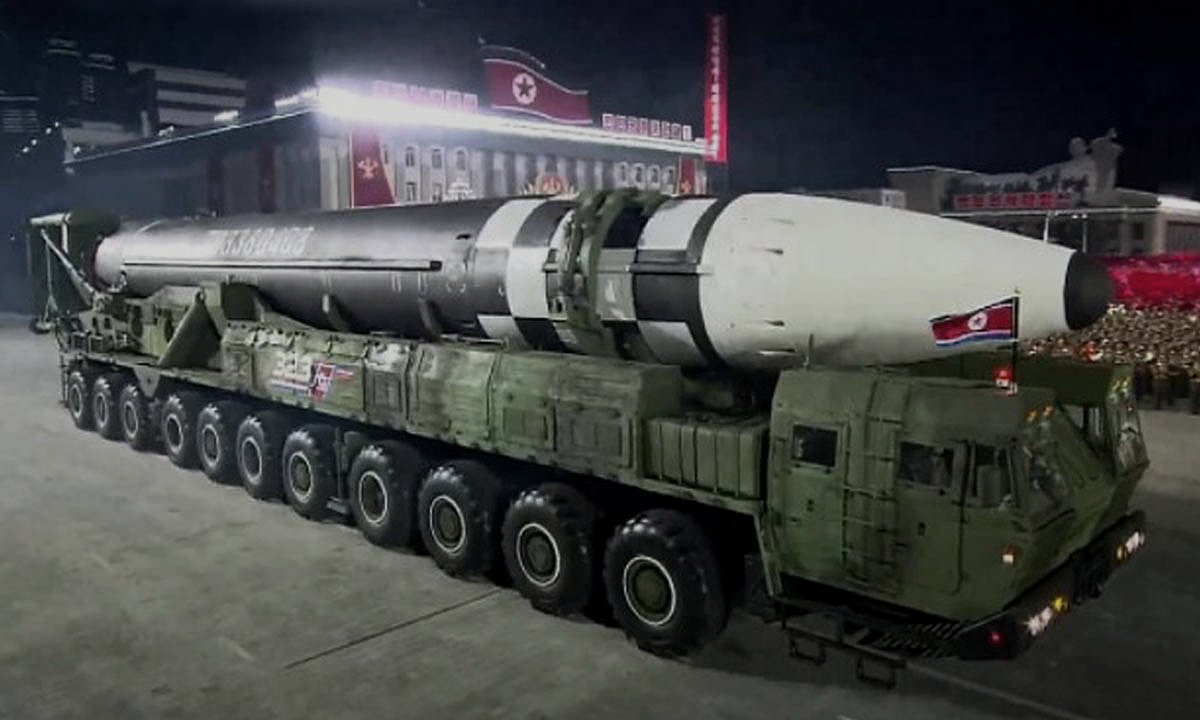
On March 5, 2022—four days before South Korea held what would become its closest presidential election in history—North Korea fired a suspected ballistic missile eastward into the sea. It was the regime’s ninth weapons test of the year, and it landed in the final week of campaigning with its timing too precise to read as coincidence. The pattern is now well-documented enough to have earned a name among Korea watchers: the “provocation window.” North Korea has a documented habit of conducting missile or nuclear tests in the run-up to, and importantly, the aftermath of, South Korean elections. Over the last decade-plus of South Korean democratic life, Pyongyang’s weapons calendar and Seoul’s electoral calendar have overlapped too consistently and too closely to be random noise.
Research into North Korean provocations dating back to the 1950s shows that Pyongyang has historically increased its military activity around South Korea’s National Assembly and presidential election dates. The clearest modern examples tell the story. In 2012, North Korea announced a long-range rocket launch during the April parliamentary campaign—the attempt, framed as a satellite deployment, directly straddled the April 11 National Assembly vote. Later that year, its December rocket launch, which succeeded in placing a satellite into orbit, coincided with the presidential election on December 19, dominating the final stretch of that campaign.
In 2017, North Korea conducted six ballistic missile launches in the weeks around the snap presidential election, and fired its new Hwasong-12 intermediate-range missile four days after liberal Moon Jae-in was inaugurated. Four missile tests preceded the April 2020 National Assembly elections. Nine weapons tests accumulated before South Koreans went to the polls on March 9, 2022, with a launch as late as March 5—four days out. On the morning of April 2, 2024—eight days before that year’s parliamentary vote—North Korea launched an intermediate-range ballistic missile powered by a new hypersonic engine, prompting South Korean officials who had publicly warned the North might try to disrupt the election to note, grimly, that they had been right. In May 2025, Kim Jong-un personally oversaw short-range ballistic missile tests simulating tactical nuclear strikes just weeks before South Korea’s June 3 snap presidential election, triggered by the impeachment and removal of Yoon Suk-yeol. After liberal Lee Jae-myung won, North Korea fired ballistic missiles again during Lee’s first state visit to China.
The timing pattern is consistent, but it is not, on the evidence, growing tighter. The 2022 test landed four days before the vote; the 2024 test landed eight. What has changed over the decades is less the precision of the countdown than the range of moments Pyongyang is willing to test around: campaigns, inaugurations, and a new leader’s first diplomatic moves abroad, as with Lee’s trip to Beijing. The window has widened to cover the full transition of power, not narrowed to a tighter prevote countdown.
Why Elections Matter to Pyongyang
North Korea’s provocations cluster around South Korean elections for reasons that come down to agenda-setting. Elections determine who controls the legislative architecture of inter-Korean policy—budgets for engagement programs, oversight of intelligence operations, ratification of agreements, the composition of committees that shape how South Korea responds to its northern neighbor. A hawkish National Assembly is a structural obstacle to the concessions Pyongyang seeks; a liberal one is an opening, and a new president arrives with a North Korea policy that will define the bilateral relationship for years.
The April 2020 election is the clearest case of this mechanism actually operating. Four missile tests preceded the vote, which delivered Moon Jae-in’s Democratic Party a supermajority in the National Assembly. This control was substantial enough to advance the party’s engagement-oriented agenda, including legislation on inter-Korean cooperation, with limited need for opposition buy-in. Whether the pre-election tests measurably shaped that outcome or simply preceded it is difficult to isolate from the data available. Even so, the sequence is the clearest illustration in the record of this dynamic. Provocations arrived just before the vote that would determine who controls the very levers that Pyongyang had an interest in.
Bracketing a Presidency, not Swaying a Campaign
Every South Korean election produces a new government that believes, at least initially, that it might handle North Korea differently than its predecessor. Liberals arrive promising engagement while conservatives arrive promising pressure. North Korea’s response, with striking regularity, is to launch something before that government has even taken office. The clearest test of what this accomplishes is not what happens to public opinion during the campaign, but what happens to policy afterward. Lee Jae-myung took office in June 2025 having campaigned on a more conciliatory approach toward Pyongyang than his predecessor. North Korea’s tactical-strike simulations in the weeks before his election, followed by further missile launches during his first state visit to China, arrived at precisely the moments when Lee’s approach to the North was being formed and then first tested on the world stage. Whether that sequencing measurably tempered the pace or content of Lee’s early North Korea policy—as opposed to simply coinciding with a transition that was already cautious—is the open question the available public record does not yet answer. But the pattern is consistent with a strategy aimed less at swaying an electorate than at bracketing a presidency from its first weeks, ultimately reminding an incoming government, before it sets policy, that the security environment is not a variable it gets to control.
The Desensitization Paradox
In 2023, North Korea conducted thirty-six missile tests. Analysts noted that South Korean voters had become largely desensitized to weapons testing—that while the public continues to regard North Korea as a genuine security threat, individual launches no longer move the needle much in either direction electorally. This creates what looks, at first, like a paradox: If provocations no longer sway voters, why does Pyongyang keep timing them to elections?
The resolution is that desensitization at the ballot box does not mean the strategy has failed—it may mean the electorate was never the primary target to begin with. Few citizens decide how to vote based on a missile test four days out—the economy and heath care carry far more weight at the ballot box. But it does something a poll number cannot capture. It sets the security backdrop against which the winning candidate must govern from day one. The 2020 supermajority and Lee’s 2025 transition both suggest that the more durable audience for these tests may be governments-in-formation, not voters mid-decision. Pyongyang’s answer to declining electoral impact has not been to test less. It has been to escalate in capability, with solid-fuel intercontinental ballistic missiles, hypersonic-powered missiles, and the Hwasong-19, which flew the longest recorded flight time in North Korean history. That escalation makes more sense as an effort to keep a fixed audience of incoming leaders attentive than as an attempt to move a desensitized public.
The provocation window is now so predictable that South Korean campaigns have learned to absorb it. Candidates draft their statements in advance, military commands quietly raise alert levels, and the news cycle drifts north for a few days before returning to the economy, health care, and whatever other issues were dominating the race. North Korea has become, in a sense, a fixture of South Korean democratic life rather than a disruption to it. That may be the most telling verdict on the strategy. Four decades of nuclear coercion have made Pyongyang impossible to ignore and increasingly difficult to take seriously as a political actor, loud enough to show up in every election cycle but not consequential enough to change the outcome of one.
Lauren Cho is a political analyst based in Washington DC. She has previously spent time at the Office of the Director of National Intelligence, NASA, and the International Crisis Group. Her research interests include nuclear intelligence, North Korea’s nuclear weapons program, and the broader implications of emerging technologies on East Asia regional security. She holds a BA in international and public affairs from Brown University.
The views expressed are those of the author and do not reflect the official position of the United States Military Academy, Department of the Army, or Department of Defense.
Image credit: North Korea Public Relationships
