

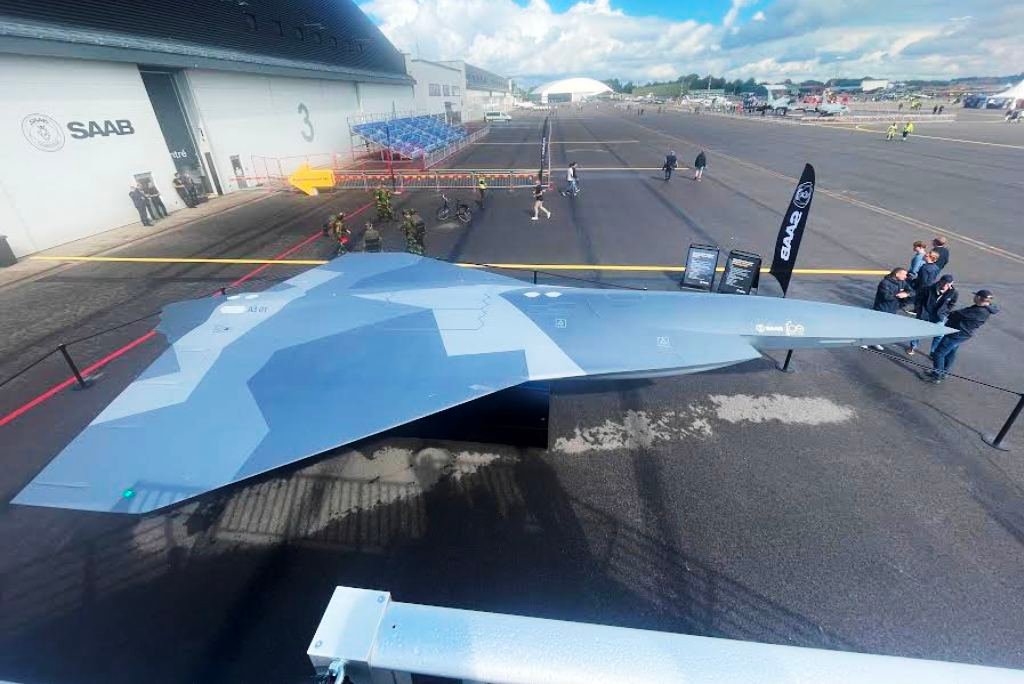
Saab has displayed a full-scale model of a potential new collaborative combat aircraft (CCA), the Swedish company prefers to call Autonomous Collaborative Programme (ACP). And what better place to make the project’s first public viewing than at the Swedish Air Force’s 100th anniversary at Malmen air base, Linkoping, during August 22-23 airshow
The ACP is Saab’s unmanned concept model for the Swedish Air Force Future Fighter System and the one on display is the imaginatively named A3 prototype. Not to be confused as an actual fighter system, as some of the local media suggested.
Peter Nilsson, Head of Saab’s Advanced Programmes told reporters: “This is a high-end ACP, that a lot of potential industry newcomers cannot do [as they are on lower-end Collaborative Combat Aircraft] because of the cost and [the need for too] much capability. We have built thousands of fighters at Linkoping and we are good at building big sized fighters.
“If anyone could build a high end ACP which would not cost billions Saab can, because we can leverage knowledge from the Gripen.” No details on metrics were provided considering the stage of development, however the length of the mock up was comparable to that of the Gripen E parked next to it.
Firstly, Saab will develop two flyable ACP demonstrators, A1 and A2. Both programmes are being funded by the Swedish Defence Materiel Administration (Försvarets MaterielVerk, FMV), and the timelines dictates that both will fly by 2030 as the Swedish Air Force considers what it will need after Gripen E in around 2050-55.
Nilson explained the needs and roles of the two demonstrators. “A1 is a supersonic platform, driven by artificial intelligence and powered by a GE F414 powerplant.
I want to demonstrate we can build a Low Observable (LO) configuration, although that will not be the only requirement. My customer [FMV] has asked me to go from concept to first flight in 36 months.
“We are building it right now and wind tunnel subsonic tests will be carried out in the Netherlands. A lot of activities are going on and we would expect it to fly within 15 months and A2 by 2030.”
Nilson explained aided by a visual roadmap, that if given the go ahead, first flight for prototype A3 could take place in 2031 and the ACP in service by 2035, with core fighter development taking place between 2036-50.
He later revealed that 15 technical demonstrators are being worked on the ground, and some of the results will be found in Demonstrator A2, including new materials, new protection methods and new sensors.
“In Demonstrator A2, which will also be powered by a F414 engine, we will develop the materials, sensors and an internal weapon bay. In A1 I have made room for an internal weapon bay, but I won’t shoot anything from it whereas with A2 it could be possible to fire a weapon. We think they will lead us into a possible product, A3.”
It is intended for high-risk missions in heavily defended air space such as electronic warfare/jamming enemy air defences (SEAD), deep precision strike and air-to-air combat missions. Saab will replicate the software architecture of the Gripen E, that allows the jet to be upgraded if required in a day, into the ACP.
If Saab is contracted by the Swedish Air Force to develop A3, it could lead the company into further evolution, with an A4, A5 and A6 leading into a core product that could be manned or unmanned.
“We would like to offer the SwAF a high end ACP to compliment the GlobalEye and Gripen E in the new era. I think that inside the next five years, Sweden will be looking at a future support solution for fighters and we have decided to be first mover into that sector/segment.
If the go ahead is given Saab could offer ACPs to the SwAF, to other Gripen E/F customers and even non-Gripen air forces.
Photo by A. Warnes
