

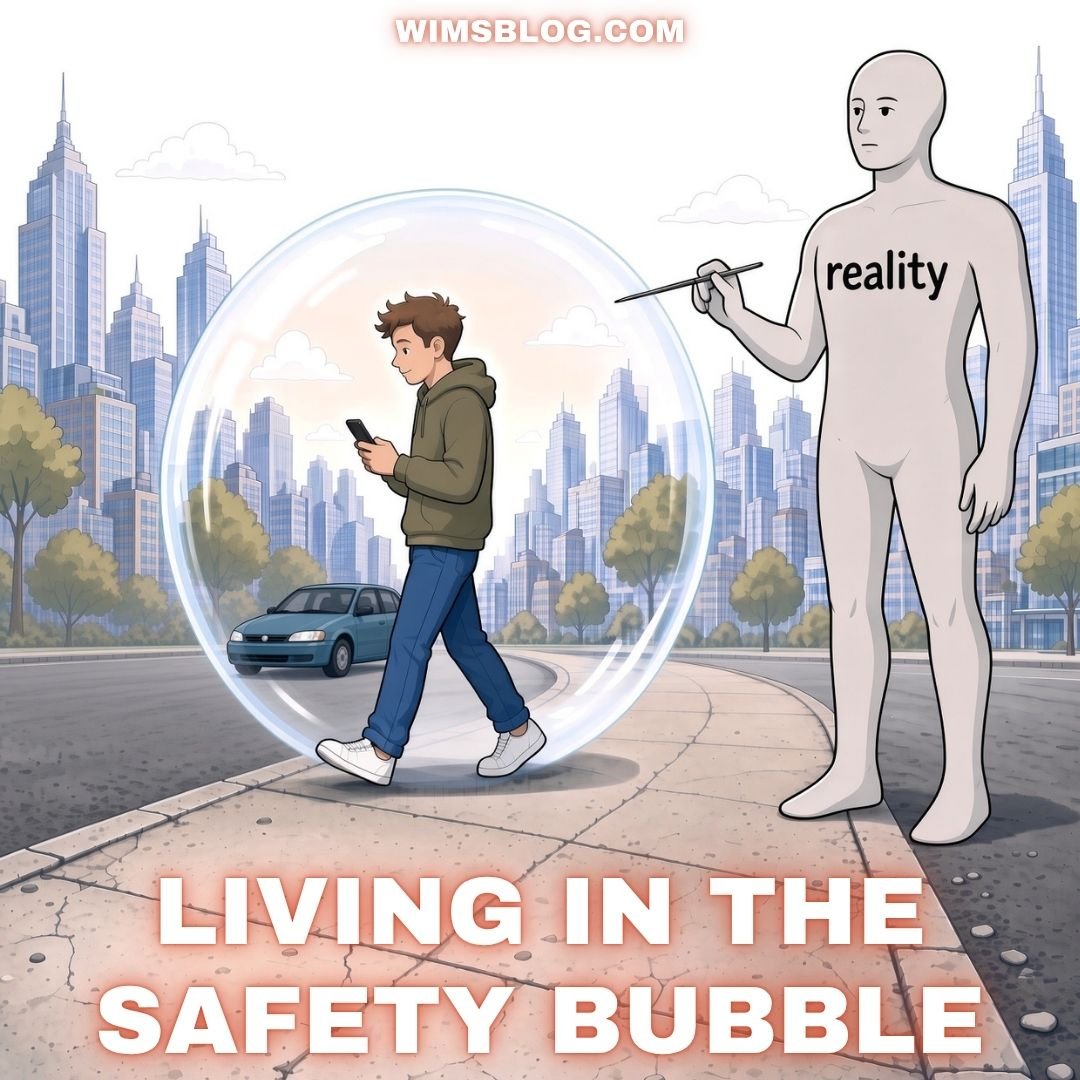
A few weeks ago, we left the house to get ice cream and drove our car down the street. A bit down the road, a woman was walking in the same direction we drove, so she had her back to us and couldn’t see our car. As we came up to her, she suddenly, without warning or bothering to look first, crossed the road.
Right in front of our car…
It took some quick action and fancy maneuvering not to hit her. Which succeeded, and as we drove on, we could see her only reaction was a mild look of surprise. Then she moved on with her day.
This situation was entirely of her own making; it’s not unreasonable to look both ways before crossing the street. We teach it to children when they can barely walk. The only reason she is not severely injured or dead is our quick reaction speed. She lives in an imaginary safety bubble where the world around her isn’t her concern. Others have to adapt to her behaviour to ensure her safety; she outsources her agency to her environment.
This is far from the only example. I’ve noticed plenty of reckless behaviour and have asked many people if they spotted the same rising trend of it. They confirmed. What do I mean?
- Dozens of teenagers on their bikes to school during rush hour: both hands on their phone as they fiddle with it, staring down for seconds on end, only occasionally glancing up. Seen this over and over these past few years.
- People chatting away while standing on the edge of the sidewalk with their heels hanging over thin air, their backs to traffic. As cars zoom by at high speeds. A gust of wind, a loss of balance, a car making a small steering mistake, and they get crushed. Seen this in plenty of places, including my own town.
- The whole swerving trend. Statistically, it will eventually end in catastrophe for the cyclist, the person/car he hits or both. Most of all, these idiots rely on others to not freak out and make the wrong move when they aggressively barrel right at them.
- As a fight breaks out behind you, just sit there and continue eating. Not get up and create distance. Not put the phone down. Instead act like nothing can happen to you and stay in the blast radius.
Two things:
First, yes, sample size, anecdotal, confirmation bias, etc. I only give them as examples of what I observe as a larger trend. More on statistics later.
Next, to a large degree, this is just people being people as they have been for millennia. More on that below too, but for now, also note this post fits in a larger whole of changes to Western countries and how this relates to self-defense.
What is happening?
I see a combination of two main issues:
Entitlement and incapacity.
- Entitlement is, to oversimplify, main character syndrome: people are the protagonist in the movie that is their life and the rest of the world are just extras. Extras don’t get a say and don’t count as the movie is not about them. Worse, other people are also the antagonists, the bad guys. You are not supposed to have empathy for them; in fact, you have to fight them. In short, it’s all about you and everybody else sucks. This mindset can quickly lead to violence when the protagonist doesn’t get to do whatever he wants.
- Incapacity is the inability to see the risk. People have lost touch with common sense when it comes to danger and violence. They don’t see how their actions put them at risk or actually provoke violence. Taking into account second- and third-order consequences is almost a superpower now. Again, this is not new, but I make the case that it is worse than in the past. For reference, I wrote about this a few times over the years:
It gets more complicated, but I don’t want this post to become too long.
Why though?
I suspect it is insulation from corrective feedback.
Modern life in most Western countries has for the longest time and in large part, insulated people from their mistakes. From their lack of forethought. From mistaken assumptions about violence, but also from other people. I see a combination of several root causes for this. This list is incomplete, but this is a start:
- Cellphones and social media. This combination of constant dopamine hits, TL;DR mentality, viral content, etc. This has reduced the attention spans of many, and they are unable or have difficulty focusing.
- The rise of influencers. Having many followers is now equated with knowledge and trustworthiness. Social media influencers who dumb down complex topics to soundbites are seen as experts. After a generation of this, a large part of the population thinks it is informed but, only truly has surface-level knowledge or is just wrong about many topics. They do have outspoken opinions and speak with unearned authority.
- Information overload. Before the internet, you had to watch the TV news or read the newspaper. Typically, it was mostly about local events. Today, anything that happens anywhere in the world can instantly get shared and go viral. News and social media are 24/7. Then there is email, texts, WhatsApp and the like, phone calls, podcasts, YouTube shows, etc. The flow of information (regardless of quality) is constant. The time to process it all is short and too often inadequate. So jumping to conclusions or not digging deeper into a topic is often the standard response.
- Historically low levels of violence. Compared to the previous milennia, the last 50 years were quite peaceful in Western countries. Compared to the peak of violent crime in the 1990’s, the last 30+ years have been calm. Violence obviously existed, but historically speaking it was mostly absent. Which led to generations growing up without what used to be commonly understood about how violence happens in society. Which led to normalizing behaviour that eventually triggers violence.
- Education policy. Postmodernism crept into education and inclusion became more important than actual learning. In my country, it was introduced over the last two decades as the M-decreet, which friend and enemy today (if begrudgingly) admit was a disaster: the bar was lowered for all students so those with difficulties could clear it. Result: students graduating with a significant lack in reasoning skills, let alone a suitcase filled with knowledge. The PISA scores showed the downfall without a doubt.
- Abundance breeds complacency. John D. Rockefeller was one of the richest men ever in the early 1900s. Even the best medical care he could buy was horrid compared to what the average citizens can get today. The standard of living and technology have never been this high. But too many people don’t understand what makes it all possible. They make many assumptions and don’t see the enormous, complex infrastructure needed to let a modern city of half a million people function, let alone bigger cities. They fail to see how it could very quickly end, despite living through COVID and experiencing a rather mild breakdown firsthand.
- Ideological and political polarization. In large part due to postmodernism and the reactions to it, Western societies are extremely polarized. Almost everything is political and ideological now. There is virtually no common ground anymore, no neutral territory where people can come together as a society. Which means only conflict is left.
- Impaired reasoning. As a result of the previous (and lots of other factors), many people can’t coherently reason their way out of a wet paper bag. Or they don’t know the basics of how everyday life functions. Like where milk comes from. Or how taxes work at a basic level. Or how much of their clothes are made out of oil. But they still have strong opinions on these, regardless of the consequences these might have:
- If you advocate for overly strict limits on the number of livestock to save the planet, you will reduce the output of milk.
- If you don’t even know how you have to pay taxes, how can you judge how much others should pay?
- If you advocate for an immediate ban on drilling for oil, how will you replace everything made from oil?
Why should you care about all this?
Because for a variety of reasons, many Western countries are moving from a high-trust/abundance society towards a low-trust/scarcity one. Such societies have much more violence than we are used to now. People in bubbles are unprepared for such a change. They don’t have the knowledge or experience to recognize the danger that comes along with this shift. Their sense of what is normal is still calibrated to the old, safer world.
As change happens at different speeds in different places, it might take a while before the violence manifests. Until it does, it is easy to persist in behaviour that leads to violence, because there are still no consequences. Normalization of deviance teaches us that when things finally do go wrong, they can end in catastrophe.
My claim is that we are well on the way in this process of change and it manifests in a variety of ways:
Political and ideological violence is on the rise. Trust in government and institutions is low. According to the statistics, certain forms of violence are rising again, while others are apparently down. However, as we have seen in the cases of retail theft in California and the Rotherham rape gangs, there is a dark number of incidents that never get reported or incorporated into the statistics for political reasons. Because too many citizens no longer see a point to it or the institutions don’t want to admit the problem exists.
I believe in the coming years, statistics will catch up to what I see becoming every day reality: two groups coming into conflict with each other:
- The bubble people are increasingly at risk of violence they don’t see coming, especially the kind their own actions create. When it does happen, it is a rude awakening and risks radicalizing them, making them the ideal target audience of demagogues and populists.
- Those who were never in the bubble but grow tired of the previous group’s obliviousness and the general polarization. This makes them vulnerable to populists too, just from a different faction.
Which means the potential for violence of all kinds goes up.
Ideological and political, as polarization keeps ramping up.
Domestic abuse, bullying, social violence, as tensions in society increase.
Protests and riots are punished harshly by law enforcement as governments try to maintain or even regain control over the public space.
Any resource going to the above means fewer resources to fight actual criminals. So those can ply their trade more freely, thriving on chaos, furthering the path toward a low-trust society.
To be clear: I am not saying these two groups are the only ones and everybody has to fall in one or the other. I am saying this looming conflict is problematic if it manifests.
Conclusion
People have always been like this, human nature doesn’t change. But in the past, increased risk came with repercussions much faster. Today’s population density, technological advances, the instant globalization of everything through the internet, that is the difference I think matters. “Last straw” incidents that push things over the tipping point can spread much faster to more people than ever before. This makes it harder to treat it as somebody else’s problem, somewhere else, later, than in the past. That is an unprecedented, unstable situation: people can stick to bad habits and actions long enough for the changed environment to suddenly punish them all at once. Because recalibrating takes time, and there won’t be enough of that anymore.
It would be absolutely awesome if I were wrong, wouldn’t be the first time. But hope is not a plan.
If I’m right and you are in the bubble group, I suggest treating it as a skill and information issue instead of a moral or identity position. If you are in the other group, understand that seeing and treating the others as NPCs is not the solution either. For all, I suggest adjusting your mindset:
Keep this potentially emerging dynamic in mind and see if it tracks with your experience. Don’t expect others to do the work for you: put your phone down, look before you move through traffic, create distance first when a situation escalates. That’s a good start to keep yourself safe and there is plenty more you can do. And even if I am only half right about the above, this mindset still pays off in keeping you safe right now.
Most of all: history also suggests that given enough time, eventually, the chaos will more than likely subside and some new equilibrium will arrive. The goal is for you and your loved ones to make it to this other side safe and sound.
Sources:
For more background regarding the above, you can spend some time at the links below.
- The Origins and Consequences of Affective Polarization in the United States – Annual Review of Political Science:
- Political Polarization – Pew Research Center:
- Polarization, Democracy, and Political Violence in the United States – Carnegie Endowment for International Peace:
- Normalization of deviance – Wikipedia:
- When Doing Wrong Feels So Right: Normalization of Deviance – PubMed:
- Drifting into failure: theorising the dynamics of disaster incubation – Dekker & Pruchnicki:
- Book summary of “Drift into Failure” by Sidney Dekker:
- Filter bubble – Wikipedia:
- Filter bubble – overview, Internet Policy Review:
- Risk compensation – Wikipedia:
- Evidence on risk compensation and safety behaviour – ScienceDirect:
- Risk Homeostasis Theory: An Overview – Wilde, 1998, ResearchGate:
- The Theory of Risk Homeostasis – Wilde, Risk Analysis, 1982:
- Belgium PISA reading scores, year-by-year data – TheGlobalEconomy.com:
- Education GPS – Belgium student performance, PISA 2022 – OECD:
- Niveau van leerlingen in Vlaanderen daalde nog nooit zo snel – VRT NWS, Dec 2023:
- Waarom scoren Vlaamse tieners slechter in PISA-onderzoek? – VRT NWS, Dec 2019:
- Waarom blijft het niveau van leerlingen in Vlaanderen maar dalen? – VRT NWS, Dec 2023:
- The Average American Today Is Richer than John D. Rockefeller – FEE:
- Richer than Rockefeller? – Econlib:
- Public Trust in Government: 1958-2025 – Pew Research Center:
- Americans’ Declining Trust in Each Other and Reasons Behind It – Pew Research Center:
- 2026 Edelman Trust Barometer Reveals Trust is In Peril As Society Slides from Grievance into Insularity – Edelman:
- Bowling Alone – Wikipedia:
- Bowling Alone: America’s Declining Social Capital – Journal of Democracy:
- Key Political Violence and Resilience Trends From 2025 – Bridging Divides Initiative, Princeton:
- Criminal Victimization, 2024 – Bureau of Justice Statistics:
- When Crime Statistics Diverge – Council on Criminal Justice:
- Ferguson effect – Wikipedia:
- Criminal Justice Data: Organized Retail Crime – Congressional Research Service:
- RILA Researches the Underreporting of Retail Theft – Loss Prevention Media:
- Shoplifting Trends: What You Need to Know – Council on Criminal Justice:
- Retail theft in US cities: Separating fact from fiction – Brookings:
- Lies, damn lies, and shoplifting statistics – Judd Legum, Popular Information:
- Rotherham child abuse: What was the Jay Report? – BBC:
- Grooming gangs scandal – Wikipedia:
- Estimating the Incidence of Rape and Sexual Assault – National Academies Press:
- Comparing National Data Sources: NCVS vs. NISVS – VALOR US:
- Homicide data: how sources differ and when to use which one – Our World in Data:
- Toward a Better Estimate of Domestic Violence in America – Council on Criminal Justice:
- Potential Sources of Error: Nonresponse, Specification, and Measurement – National Academies Press:
- 2023 Youth Risk Behavior Survey Results – CDC:
- Crime, violence concerns spike, but data shows country is becoming safer – KATV:
