

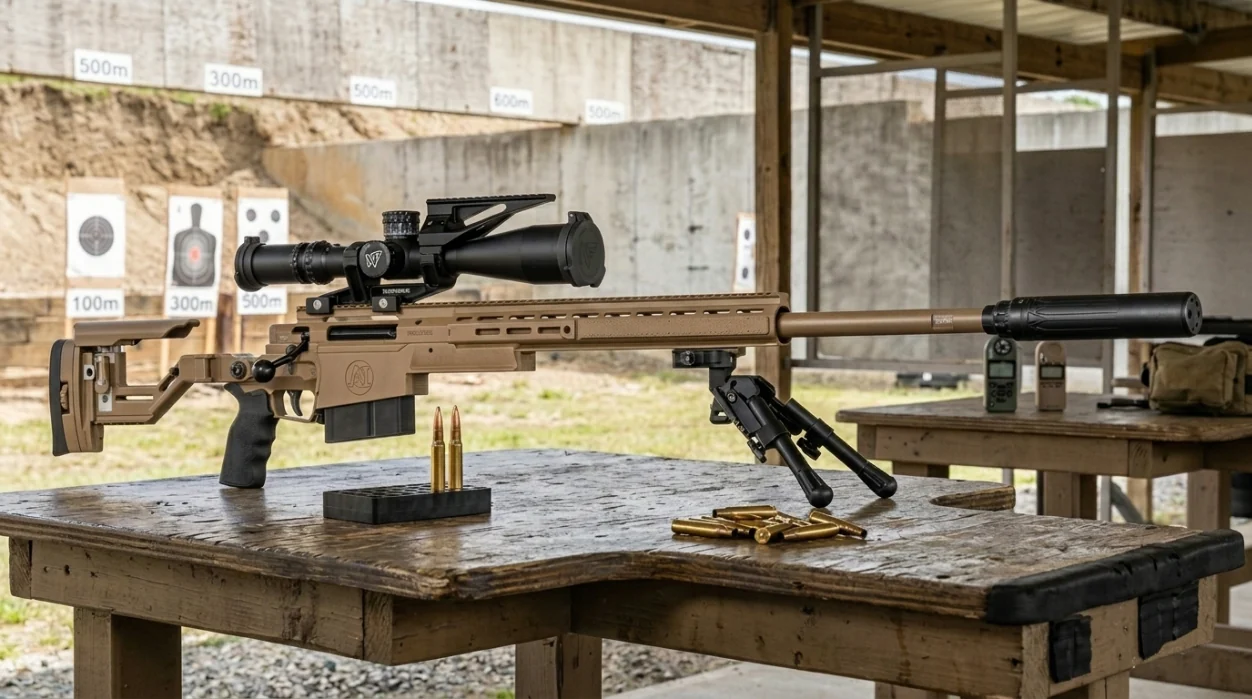
What if a military sniper rifle didn’t have to belong to just one caliber?
That question sits at the heart of the Accuracy International AXSR, a precision rifle designed around a concept that challenges the traditional idea of matching one rifle to one cartridge. Instead, the Accuracy International AXSR can be configured for different calibers, allowing the same basic platform to adapt to different operational requirements.
That sounds simple on paper. In practice, it raises a much more interesting question: does a multi-caliber rifle actually make a military unit more flexible, or does it simply move the complexity into barrels, bolts, magazines and ammunition?
Accuracy International developed the AXSR from its long-running Arctic Warfare and AX rifle lineage, taking the company’s experience with precision rifles into a more modular direction. Its QuickLoc system allows users to configure the rifle around different barrel and caliber combinations while retaining the same core platform.
And that is what makes the Accuracy International AXSR worth examining.
This isn’t just another discussion about accuracy or maximum range. The bigger story is how modern military precision weapons are increasingly being designed as configurable systems rather than fixed rifles and what that means for the soldiers expected to carry and maintain them.
What Is the Accuracy International AXSR?
The Accuracy International AXSR is a modular, bolt-action precision rifle developed around a simple but ambitious idea: the rifle itself doesn’t have to be locked to a single caliber.
Accuracy International built the AXSR from the company’s established Arctic Warfare and AX family, but pushed the platform toward greater configuration flexibility. Rather than treating different calibers as completely separate rifles, the AXSR uses a common rifle architecture that can be adapted to different requirements.

The platform is particularly notable for its long-action design and QuickLoc barrel system. Depending on configuration, the AXSR can support cartridges ranging from the familiar .308 Winchester and 6.5 Creedmoor to larger Magnum-class rounds such as .300 Winchester Magnum and .338 Lapua Magnum. Accuracy International also offers additional long-action configurations in its broader AXSR lineup.
That flexibility changes how we should think about the rifle.
A conventional precision rifle is usually built around a specific cartridge and mission. The Accuracy International AXSR flips that relationship: the platform comes first, while the caliber can be selected according to the job.
For a military unit, that could mean maintaining common controls, stock geometry and handling characteristics across different configurations. A sniper familiar with one AXSR setup isn’t suddenly learning an entirely different rifle when moving to another caliber.
But modularity has a price. Barrels, bolts, magazines and ammunition still have to be managed, and each configuration brings its own ballistic characteristics.
Read more: Accuracy International AWM: What Makes It So Accurate?
So the Accuracy International AXSR isn’t magic. It doesn’t eliminate complexity.
It attempts to organize that complexity around one common precision-rifle platform and that’s the real idea behind the Accuracy International AXSR.
From Arctic Warfare to AXSR: How Accuracy International Evolved
The Accuracy International AXSR makes more sense when you look at it as the latest step in a long design journey rather than a rifle that appeared fully formed.
The story begins with Accuracy International’s PM/L96, the British precision rifle that established the company’s reputation. That architecture evolved into the Arctic Warfare family, which placed particular emphasis on reliability in harsh environments. From there came the AWM, adapting the basic concept to more powerful Magnum cartridges such as .300 Winchester Magnum and .338 Lapua Magnum.
The AX family later pushed the design toward greater modularity and modern accessory integration. The AXSR takes that progression further by making multi-caliber configuration one of the platform’s defining characteristics.
Read also: 5 Most Accurate Sniper Rifles in the World
There is a useful pattern here. Accuracy International hasn’t repeatedly thrown away its previous rifle designs and started from scratch. Instead, each generation has added another layer to the same basic idea: build a precision rifle that can survive demanding conditions while adapting to changing military requirements.
The AXSR is therefore less of a revolution than a culmination.
Its development was also influenced by the U.S. Special Operations Command Advanced Sniper Rifle (ASR) requirement, which sought a more flexible precision-rifle capability. Accuracy International’s AXSR emerged from that development effort, bringing the lessons of the program into a production rifle.
That history matters because it explains why the AXSR’s modularity feels so deliberate. The company wasn’t simply adding interchangeable barrels to an existing rifle. It was increasingly designing the rifle around the idea that its configuration might need to change with the mission.
And that’s where the Accuracy International AXSR begins to look less like a traditional sniper rifle and more like a configurable weapons platform.
Why the Accuracy International AXSR Is Different
The most interesting feature of the Accuracy International AXSR isn’t its weight, barrel length or even its accuracy. It’s the decision to make caliber flexibility part of the rifle’s architecture.
A precision team might have very different requirements depending on the mission. A lighter-recoiling cartridge can make sense for one task, while a Magnum cartridge may be better suited to another. Instead of requiring completely different rifle platforms, the AXSR allows users to configure the same basic system around different cartridges.
Read more: 5 Best Sniper Rifles in the World Ranked by Performance
For the four-caliber focus of this article, the key configurations are 6.5 Creedmoor, .308 Winchester, .300 Winchester Magnum and .338 Lapua Magnum. Accuracy International’s professional materials list these options, while the broader AXSR platform supports additional long-action cartridges depending on configuration and market.
| Caliber | General Character |
| 6.5 Creedmoor | Lower-recoil precision option |
| .308 Winchester | Established 7.62mm-class capability |
| .300 Winchester Magnum | Extended-range Magnum option |
| .338 Lapua Magnum | Heavy long-range precision |
The important point isn’t that one cartridge is automatically “better.” Each represents a different compromise between range, recoil, ammunition weight and mission requirements.
That gives the Accuracy International AXSR an unusual advantage. The rifle’s controls, chassis and general handling can remain familiar while the ballistic characteristics change with the configuration.
But there’s a catch.

A military unit still needs the appropriate barrel, bolt, magazine and ammunition for each caliber. The Accuracy International AXSR doesn’t eliminate logistics; it changes the way those logistics are organized.
And that may be the most important lesson of the rifle. Its multi-caliber capability isn’t really about giving soldiers more choices. It’s about giving commanders more ways to configure the same precision-rifle platform for different missions.
How the AXSR Sniper QuickLoc System Makes Modularity Possible
The AXSR’s multi-caliber concept would be far less useful if changing configurations required rebuilding the rifle from scratch. That’s where Accuracy International’s QuickLoc system becomes important.
The system is designed around a removable barrel architecture, allowing the Accuracy International AXSR to be configured for different caliber and barrel combinations while retaining the same basic rifle platform. Accuracy International says the barrel can be removed and refitted using a hex key stored beneath the cheekpiece.
But calling it simply an “interchangeable barrel system” misses the bigger picture.
A caliber conversion involves a matched set of components, including the barrel, bolt and magazine. The rifle therefore isn’t magically transformed by swapping one tube. Instead, the Accuracy International AXSR uses a controlled system in which the components required for a particular cartridge are changed together.
That creates an obvious military advantage: the shooter keeps the same basic controls, chassis and ergonomics while the rifle’s configuration changes.
But there’s a less glamorous side to modularity.
A unit still needs to store and maintain those additional barrels, bolts and magazines. Ammunition inventories also become more complicated, and configuration management matters because the rifle is no longer one fixed combination of components.
So the Accuracy International AXSR’s real innovation isn’t that it makes complexity disappear. It moves complexity away from maintaining several completely different rifle platforms and toward managing a common platform with different mission-specific configurations.

For a specialist unit, that trade could be valuable. The same rifle can follow the mission instead of forcing the mission to follow the rifle.
The Accuracy International AXSR becomes more interesting when you stop looking at it as simply a rifle and start viewing it as a modular weapons system. The action is only the center of the package. Around it sits a collection of components that can be configured according to the mission.
The most obvious example is the caliber system. Different configurations require their corresponding barrel, bolt and magazine, while the core rifle retains the same basic chassis, controls and ergonomics. That means an operator can work with a familiar platform even when the ballistic role changes.
Then there is everything mounted around the rifle.
The AXSR provides interfaces for modern optics and accessories, including STANAG 4694 and MIL-STD-1913 rails, while its chassis can accommodate equipment used by contemporary precision teams.
That matters because today’s precision capability rarely comes from the rifle alone. A sniper team may operate with day optics, night-vision or thermal equipment, suppressors, rangefinding tools and other observation equipment. The rifle needs to function as the stable foundation connecting those pieces.
There is a trade-off, of course. More modularity means more components to manage, more configuration choices and potentially more training considerations.
Still, that’s the interesting shift represented by the AXSR.
The rifle is no longer necessarily the complete weapon system. It is the configurable core of one.
And that may ultimately be the AXSR’s most important contribution: making flexibility part of the rifle’s architecture rather than treating it as an accessory added later.
The Accuracy International AXSR Specifications
The Accuracy International AXSR is not a lightweight precision rifle, and that is partly the point. Its specifications reflect the mechanical demands of supporting multiple long-action cartridges while carrying the hardware needed for a modern military precision system.
| Specification | AXSR |
| Action | Bolt-action |
| Bolt | 6-lug, 60° rotation |
| Magazine | 10-round detachable |
| Stock | Folding |
| Chassis | Aluminum |
| Barrel system | QuickLoc |
| Rail | STANAG 4694 / MIL-STD-1913 |
| .338 barrel | 27 inches |
| Approx. .338 configuration weight | 7.39 kg |
Accuracy International lists the AXSR at approximately 7.39 kg in its .338 configuration, with a 27-inch barrel. The rifle uses a six-lug bolt with a 60-degree lift and a 10-round double-stack magazine.
At first glance, nearly 7.4 kg may seem excessive for a rifle. But the number makes more sense once you consider what the AXSR is carrying: a rigid aluminum chassis, folding stock, long-action receiver, heavy barrel system and interfaces for modern optics and accessories.
And there is another trade-off hidden in the weight.

Modularity isn’t free. A rifle capable of handling several demanding cartridges needs enough structural strength and rigidity to support them consistently. The same architecture that gives the AXSR flexibility also contributes to its substantial mass.
Its specifications therefore tell us something more useful than simply how long or heavy the rifle is. They reveal the compromise at the center of the design: the AXSR prioritizes adaptability and precision over minimal weight.
For a military precision team, that may be an acceptable trade. The question is whether carrying one relatively heavy platform with several configurations is more useful than carrying multiple rifles optimized for individual roles. That brings us to the real test of the AXSR concept.
Does One Rifle Really Replace Several Precision Rifles?
The idea behind the Accuracy International AXSR sounds compelling: instead of maintaining several precision rifles for different cartridges, a military unit could use one common platform and configure it for the mission.
But there is a catch. The Accuracy International AXSR does not actually eliminate the equipment burden. It reorganizes it.
A unit using multiple AXSR calibers still needs the appropriate barrels, bolts and magazines for those configurations, along with separate ammunition stocks. Each caliber also brings different ballistic characteristics, so shooters and support personnel still need to understand the specific setup they are using.
So where does the advantage come from?
One benefit is commonality. A shooter can become familiar with the same basic stock, controls, chassis and handling characteristics rather than learning several completely different rifle systems. Training and maintenance can potentially be centered around one platform architecture.

There is also a mission-planning advantage. A unit could configure an AXSR around a cartridge suited to a particular requirement without completely changing its weapon ecosystem. A .308 configuration, for example, occupies a very different niche from a .338 Lapua Magnum setup.
But the Accuracy International AXSR’s modularity isn’t automatically cheaper or simpler. Maintaining multiple caliber configurations means maintaining the components that make those configurations possible.
This creates an interesting procurement trade-off:
Instead of buying four completely different rifles, a military may maintain one sophisticated platform with four different configuration packages.
Whether that is actually more efficient depends on the unit’s size, mission profile and logistics system.
The Accuracy International AXSR therefore shouldn’t be viewed as a magical replacement for every precision rifle. Its real value is more subtle: it gives military planners the ability to standardize the rifle platform while preserving mission-specific flexibility.
