

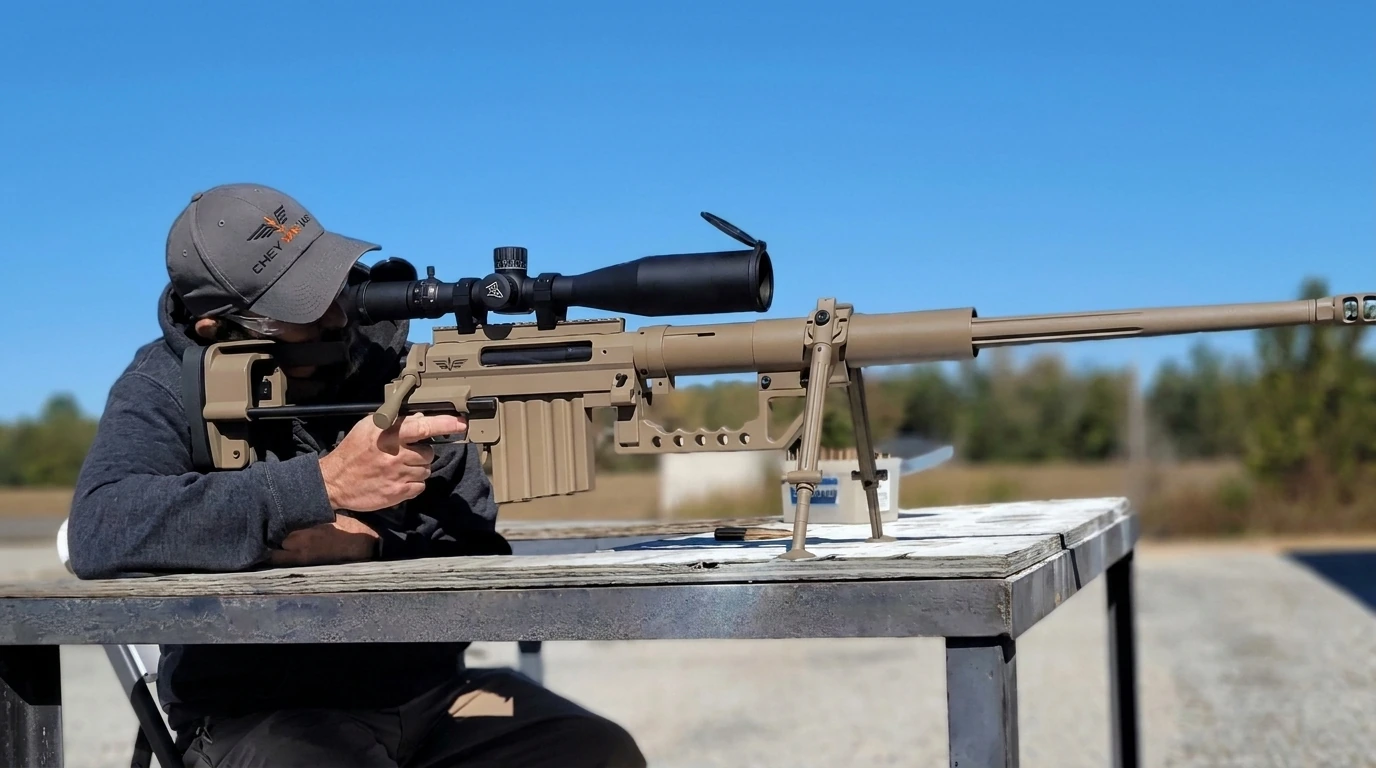
At first glance, the CheyTac M200 Intervention looks almost too specialized to be practical. It is enormous, unusually shaped, and built around a problem most rifles never have to solve: maintaining precision at distances measured in miles rather than hundreds of yards.
Introduced in the early 2000s, the M200 was conceived as part of an extreme-long-range system rather than simply another heavy sniper rifle.
CheyTac’s approach combined the rifle with purpose-developed ammunition and ballistic technology, creating a platform intended to push precision well beyond the range normally associated with conventional sniper rifles.
That distinction matters. The M200 Intervention isn’t famous merely because it is big or powerful. Its identity comes from the way its components were designed around extreme-distance shooting.
The current M200 can be chambered for either .408 CheyTac or .375 CheyTac, and CheyTac lists a weight of about 31 pounds without an optic. Its current specification also lists a 29-inch interchangeable barrel and a 40 MOA scope rail.
Then there’s the pop-culture factor. If you’ve encountered the M200 in Shooter or picked the Intervention in Call of Duty: Modern Warfare 2, you may already recognize its unmistakable silhouette. CheyTac says its gaming appearances helped introduce the rifle to a much wider audience.
So, what makes this rifle different from an ordinary long-range platform? The answer lies in its unusual combination of cartridge, rifle design, precision engineering, and extreme-range ambition. That’s where the M200 story gets interesting.
History of the CheyTac M200 Intervention
The history of the CheyTac M200 Intervention is less straightforward than its futuristic appearance suggests. The rifle didn’t emerge from a single clean-sheet design process. Instead, its story grew out of an existing platform that was adapted to a new cartridge and then repeatedly refined.
The roots trace back to EDM Arms and its Windrunner rifle. According to CheyTac’s own historical account, Bill Ritchie of EDM Arms originally designed the M200-style system.
CheyTac approached EDM to scale down the Windrunner platform so it could accommodate the newly developed .408 CheyTac cartridge. Early rifles were subsequently tested before CheyTac modified the design with features including its distinctive over-the-barrel bipod and handguard system.
That origin is important because it explains one of the M200’s strangest characteristics: it looks more like a scaled-down piece of heavy equipment than a conventional precision rifle. The modular takedown architecture inherited from the Windrunner remained part of the concept, allowing the large rifle to be broken down for transportation and then reassembled.
The early 2000s were also a period of considerable change for the project. CheyTac’s historical material describes a legal dispute with EDM Arms during that decade, after which the companies continued producing their respective .408-caliber rifles. CheyTac subsequently continued developing and manufacturing the M200 through other production arrangements.
Meanwhile, the company was building more than a rifle. Its Advanced Ballistic Computer (ABC) was developed to help process the complicated ballistic information associated with extreme-range shooting. That system became an important part of the M200’s broader identity: rifle, cartridge and computing technology working as one package.

Today, the M200 remains CheyTac’s flagship extreme-long-range platform, although the rifle has continued to evolve rather than simply being preserved as a piece of early-2000s firearms history.
CheyTac M200 Intervention Specifications
The CheyTac M200 Intervention is not a rifle you casually describe as “large.” At roughly 31 pounds (14.1 kg) without an optic, it belongs in a different category from the lightweight precision rifles most people picture when they hear the words long-range rifle.
CheyTac’s current specifications also list an overall length of 55 inches with the stock extended and 48 inches collapsed, making the M200 a substantial piece of equipment even before an optic and other accessories are added.
Here is a quick look at the current factory specifications:
| Feature | CheyTac M200 Intervention |
| Action | CheyTac long action |
| Caliber | .408 CheyTac / .375 CheyTac |
| Weight | 31 lb (14.1 kg), without optic |
| Barrel length | 29 inches |
| Barrel type | Fluted, interchangeable |
| Magazine | 7-round detachable box |
| Overall length | 55 in extended / 48 in collapsed |
| Scope rail | 40 MOA Picatinny rail |
| Stock | Five-position adjustable |
| Monopod | Integrated |
| Accuracy claim | Sub-MOA |
| Manufacturer-stated effective range | 2,500+ yards |
One detail worth noticing is the interchangeable barrel system. The current M200 is offered in both .408 CheyTac and .375 CheyTac, with CheyTac listing a 1:10 twist for the .408 barrel and 1:9.5 for the .375 version. The barrel is also fluted and designed as a takedown component, reinforcing the rifle’s emphasis on being transportable despite its considerable size.

The M200 also uses a 40 MOA scope rail, a five-position adjustable stock, and an integrated monopod. These aren’t decorative touches. Together, they show what the rifle was built around: a stable, highly specialized platform for extreme-range precision rather than a rifle intended to be carried lightly over long distances.
Read also: 5 Most Accurate Sniper Rifles in the World
That distinction is easy to miss when looking at a photograph. The M200 may have become famous for its futuristic appearance, but its specification sheet tells a more interesting story: nearly every major feature is there to support the same goal, consistent precision at extraordinary distances.
Design and Features of the M200 Intervention
The CheyTac M200 Intervention makes more sense when you stop thinking of it as a conventional rifle and start viewing it as a carefully assembled long-range platform. Its unusual proportions are not accidental.
The long barrel, substantial chassis, adjustable stock and specialized support system all serve a particular purpose: creating a stable foundation for precision at extreme distances.
One of the M200’s most recognizable features is its modular takedown design. The barrel can be removed for transport, while the stock can also be collapsed, reducing the rifle’s footprint from its deployed configuration. CheyTac traces this design philosophy to the EDM Windrunner from which the early M200 evolved.

The current rifle uses a 29-inch, fluted 416R stainless-steel barrel with 5R rifling. The .408 CheyTac version uses a 1:10 twist, while the .375 CheyTac version uses a 1:9.5 twist. CheyTac also specifies a 40 MOA Picatinny-style optic base, giving the platform substantial built-in elevation bias for long-range optics.
Then there’s the support system. The M200’s distinctive clamp-style bipod surrounds the barrel rather than simply hanging beneath it. CheyTac says this arrangement keeps the pivot closer to the bore’s centerline, helping maintain a more consistent relationship between the rifle and its support.
At the rear, the five-position adjustable stock and integrated monopod allow the rifle to be configured around different users and shooting positions. The result is a platform that looks almost industrial, more like an engineered machine than a traditional rifle.
And that’s perhaps the best way to understand the M200. Its design isn’t trying to be elegant in the conventional sense. Every prominent feature seems to ask the same question: how do you build a large precision system that remains controllable, transportable and repeatable at extreme range? The answer is the very distinctive machine sitting in front of you.
CheyTac M200 Caliber: .408 CheyTac and .375 CheyTac
The story of the CheyTac M200 Intervention really starts with its ammunition. The rifle is unusual, certainly, but its reputation was built around cartridges designed specifically for extreme long-range performance.
The current M200 is offered with interchangeable barrels for .408 CheyTac and .375 CheyTac. CheyTac lists a 29-inch barrel for both versions, with a 1:10 twist rate for .408 CheyTac and 1:9.5 for .375 CheyTac.
Why .408 CheyTac Matters
The .408 CheyTac became closely identified with the M200 because it was developed around the idea of retaining useful aerodynamic performance far beyond conventional small-caliber precision cartridges. Rather than simply making a projectile larger, the CheyTac concept focused heavily on reducing drag and maintaining stability during an exceptionally long flight.
That matters because extreme range changes the equation. At shorter distances, small differences in trajectory can be relatively easy to manage. Stretch the distance dramatically, though, and atmospheric conditions become a much bigger part of the story.

The original CheyTac system therefore wasn’t just a rifle and cartridge. Historical CheyTac documentation describes it as a complete long-range system incorporating ballistic-computing technology and environmental data.
What About .375 CheyTac?
The newer .375 CheyTac gives the M200 another extreme-range option. CheyTac says the .375 version provides a flatter trajectory, reduced wind drift and greater effective range compared with the .408 configuration. Those are manufacturer claims, so they should be treated as such rather than as universal results under every condition.
That makes the two calibers less about a simple “which is bigger?” contest and more about how the M200 system is intended to perform at very long distances.
In other words, the M200’s impressive reputation doesn’t come from horsepower alone. The cartridge is half the story, and arguably the part that makes the rifle’s extreme-range identity possible.
How Far Can the CheyTac M200 Intervention Shoot?
Few specifications attract as much attention as the claimed range of the CheyTac M200 Intervention. CheyTac currently lists the rifle with an effective range of 2,500+ yards, while its website also describes the platform as capable of engaging targets at 2,500 meters and beyond. Those figures sound similar, but they are not the same distance: 2,500 meters is roughly 2,734 yards.

That small distinction is worth keeping in mind when reading about the M200. A manufacturer’s advertised capability isn’t automatically the same thing as a guaranteed hit distance under ordinary field conditions.
Extreme range is a messy business. Gravity is only one part of the equation. Wind, air density, temperature, altitude, ammunition consistency and other environmental variables can all influence where a projectile ultimately travels. At several kilometers, tiny changes that seem insignificant at the firing position can become much more consequential downrange.
The M200 was designed around this problem from the beginning. Historical CheyTac documentation describes the Intervention as a complete long-range system, rather than merely a rifle, with ballistic-computing technology developed to account for environmental and ballistic variables.
That system-oriented approach helps explain why the rifle became associated with distances that sound almost unreal.
| Range figure | What it means |
| 2,500+ yards | Current manufacturer-listed effective range |
| 2,500 meters+ | Distance cited by CheyTac on its current FAQ |
| 1 mile | About 1,760 yards, considerably shorter than the manufacturer’s maximum-range claims |
| 2,500 meters | About 2,734 yards |
So, how far can the CheyTac M200 actually shoot? The safest answer is the manufacturer’s stated 2,500+ yard class of capability, with some current CheyTac material using the higher 2,500-meter figure.
Real-world performance, however, depends heavily on conditions and equipment, and extreme-range claims should not be mistaken for an everyday expectation.
CheyTac M200 Intervention vs. Other Long-Range Rifles
Putting the CheyTac M200 Intervention beside other famous long-range rifles reveals something interesting: these rifles may occupy the same broad category, but they don’t necessarily solve the same problem.
The M200 sits firmly in the extreme-range niche. Its design revolves around the .408 and .375 CheyTac cartridges, a heavy modular platform, and a system-level approach to long-distance precision.

CheyTac currently describes the M200 as a platform capable of 2,500+ yards, placing it well beyond the practical envelope associated with many conventional precision rifles.
The McMillan TAC-50, for example, has a very different identity. It is closely associated with the .50 BMG cartridge and has gained a reputation as a powerful long-range military and law-enforcement rifle.
The Barrett M107 goes in another direction again, emphasizing the established .50 BMG family and a semi-automatic action.
A simplified comparison helps put the M200 into perspective:
| Rifle | Typical chambering | Action | Defining characteristic |
| CheyTac M200 | .408 / .375 CheyTac | Bolt action | Extreme-range precision system |
| McMillan TAC-50 | .50 BMG | Bolt action | Heavy .50-caliber precision rifle |
| Barrett M107 | .50 BMG | Semi-automatic | Long-range power with rapid follow-up capability |
| Accuracy International AX series | Multiple | Bolt action | Modular military precision platform |
The key difference isn’t simply caliber. The M200 was designed around a specific extreme-range ecosystem, where the rifle, ammunition, and ballistic-support technology are intended to work together.
CheyTac’s own history describes the platform as more than a standalone firearm, emphasizing its ballistic computer and specialized ammunition as part of the original concept.
That makes the M200 something of a specialist among specialists. A Barrett may be better known, a TAC-50 may be more familiar to military-history readers, and an Accuracy International rifle may be more recognizable to precision-shooting enthusiasts.
But the M200 occupies its own unusual corner: a purpose-built platform where extreme distance is the central design priority, not merely one capability among many.
Why Is the CheyTac M200 So Famous?
The CheyTac M200 Intervention has an unusual claim to fame: a rifle designed for a highly specialized real-world role became almost as recognizable in entertainment as it is among shooting enthusiasts.
That transformation didn’t happen overnight. The M200 appeared in games before it became a household name, including Söldner: Secret Wars in 2004 and Operation 7 in 2006.
But its visibility accelerated dramatically with the 2007 film Shooter and then exploded after its appearance in Call of Duty: Modern Warfare 2 in 2009. CheyTac’s own history of the rifle’s gaming appearances identifies Modern Warfare 2 as the major breakthrough moment.
Why this particular rifle?
Part of the answer is visual. The M200 doesn’t look like the generic bolt-action rifle that appears in countless military films. Its angular receiver, folding stock, integrated bipod and long proportions give it a silhouette that can be recognized almost instantly. Filmmakers and game designers don’t have to explain what the audience is looking at. One shot of the rifle on screen can do the job.
Then came Modern Warfare 2. The Intervention became closely associated with quickscoping and trickshot culture, particularly during the early YouTube era. That mattered because players weren’t simply using the rifle, they were turning it into part of an online identity. Montages, clans and trickshot videos helped push the M200 far beyond its original niche.
There’s an interesting irony here. The real CheyTac M200 Intervention is a roughly 31-pound extreme-long-range system, while its digital counterpart became famous for speed, reflexes and flashy multiplayer techniques.
That contrast is part of the rifle’s appeal. In the real world, it represents engineering built around distance; in popular culture, it became a symbol of precision, style and one-shot drama.
