

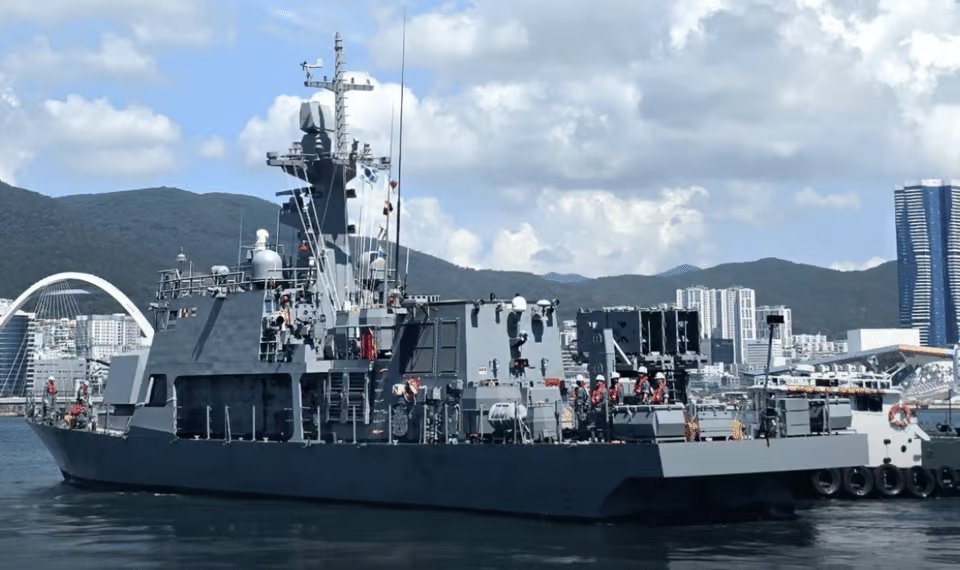
The Republic of Korea Navy (ROKN) has received the first of what will be an eventual 18 Geomdoksuri-B (PKX-B) Batch-II fast patrol boats, with the vessel due to be commissioned later after force integration.
The Defense Acquisition Program Administration (DAPA) announced that this first-of-class vessel was handed over by shipbuilder HJ Heavy Industries on 14 August.
It had been built at HJ Heavy Industries’ Yeongdo shipyard in Busan, and three more craft are slated for handover before the end of this year. All four had been launched at a ceremony on 8 December 2025.
Also known as the PKMR, which denotes Patrol Killer Medium Rocket, this PKX-B Batch-II project was launched in 2022. Sixteen craft are already under contract, and they will replace Chamsuri-class PKM patrol boats dating from the 1970s-80s.
The ROKN operates 16 PKX-B Batch-I vessels that were constructed from 2017-22, with both batches sharing the same bow-mounted Hyundai WIA 76mm naval gun, stern-mounted 12-cell Biryong130mm guided-rocket launcher and two 12.7mm remote weapon stations.
However, Batch-II offers upgrades to the combat system that better integrate the main armaments, plus a more effective electronic-warfare suite. The search radar has been enhanced too. Heating of their SAQ-560K electro-optic tracking system has been increased from 200W to 600W to address performance in cold, wintertime conditions.
These fast patrol craft are destined for coastal service, especially near the disputed Northern Limit Line with arch-nemesis North Korea.
The PKX-B Batch-II is 44m long, has a beam of 7m and displaces some 230 tonnes. Crewed by 20-23 sailors, these craft are propelled by waterjets that offer a top speed of 40kt. They also have Rheinmetall’s MASS soft-kill system that incorporates off-board corner reflectors.
Choi Sang-deok, head of DAPA’s Naval Ship Program Department, commented: “The first PKX-B Batch-II vessel is equipped with overwhelming on-scene response capabilities that will deter the enemy from attempting provocations. Based on proven domestic technologies, we will complete the construction and delivery of the follow-on vessels without disruption and establish a robust coastal defence posture in the frontline waters of the Northern Limit Line.”

In other news, the 177th Defense Project Promotion Committee that met on 11 August approved research and development of an upgraded Haeseong-II long-range, anti-ship missile possessing improved detection and tracking.
DAPA elaborated that this project “is expected to increase the ability to respond to enemy maritime threats” thanks to its “improved long-range precision”. In fact, the new missile will aim to double the original version’s strike range thanks to a new turbofan engine.
Scheduled to start in 2028, this project received a budget of KRW1.63 trillion (US$1.01 billion). DAPA wants it ready by 2033, with production for the ROKN to start the following year. They will arm future KDDX destroyers, for example.
Finally, Hanwha Systems announced on 14 August that it is supplying electro-optic/infrared (EO/IR) systems for a quartet of ROKN vessels. These include a logistics support ship, a submarine rescue ship and two surface rescue ships. Such vessels need better surveillance sensors for search and rescue, as well as for detecting the growing threat posed by drones and unmanned surface vessels.
The EO/IR sensors are based on Hanwha Systems’ Target Acquisition Designation System (TADS), which was originally developed for the ROK Army’s Light Armed Helicopter. They will also be coupled to a video transmission system that can feed real-time imagery to other naval platforms and command centres.
Deliveries will be completed by the end of 2028, Hanwha Systems shared.
by Gordon Arthur
