

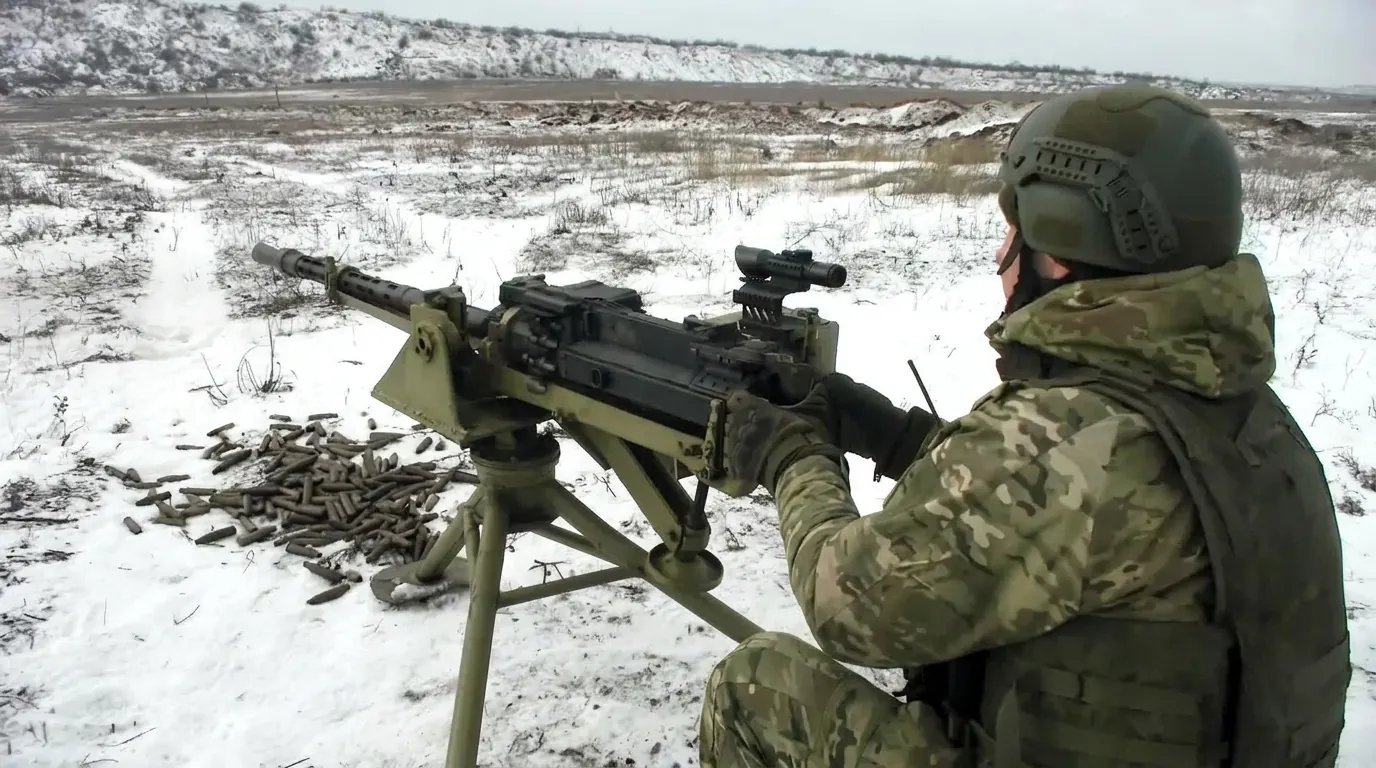
A machine gun can look deceptively simple: a barrel, an ammunition belt, a receiver, and a mechanism that keeps cycling. But once you start comparing the most powerful machine guns ever fielded, the numbers get serious.
Some fire bullets large enough to threaten lightly armored vehicles, while others combine long-range reach with sustained automatic fire that can dominate a wide area.
And here’s the interesting part: “most powerful” doesn’t simply mean “largest caliber.”
A 14.5mm machine gun has an obvious advantage in projectile size over a 12.7mm weapon, but raw caliber is only one piece of the puzzle. Effective range, ammunition performance, rate of fire, reliability, recoil, and the ability to keep firing under demanding conditions all shape how much practical power a machine gun delivers.
That makes ranking the most powerful machine guns in the world trickier than it first appears.
In this post, we’ll compare five heavy machine guns that stand out for their combination of firepower and battlefield capability: the NSV, Kord, DShK, M2 Browning, and KPV. Rather than judging them by reputation alone, we’ll look at what their cartridges, designs, roles, and operational histories tell us.
Think of it less like picking the loudest engine and more like comparing heavy-duty trucks. Horsepower matters, sure, but so do range, durability, payload, and how well the machine performs when the road gets rough.
So, which weapon deserves the top spot? The answer depends on what you mean by “powerful”, and that’s where the comparison gets interesting.
How We Ranked the Most Powerful Machine Guns
Ranking the most powerful machine guns sounds straightforward until you try to define “power.” A bigger bullet matters, but it doesn’t tell the whole story. A weapon also has to deliver that power at useful distances, maintain reliable operation, and make sense in the role it was designed to perform.
For this ranking, we’re looking at five main factors: caliber, projectile performance, effective range, rate of fire, and battlefield versatility. Weight and reliability also matter, because a weapon that is exceptionally powerful on paper can become less practical if its mounting system, ammunition load, or handling requirements severely limit how it is employed.
Caliber is the obvious starting point. The KPV, for example, fires the 14.5×114mm cartridge, while weapons such as the M2 Browning, DShK, NSV, and Kord belong to the 12.7mm class. That difference gives the KPV an important advantage in raw projectile size and energy.
But bigger isn’t automatically better.
The M2 Browning illustrates why. Its .50-caliber cartridge, long service history, multiple mounting options, and combination of range and sustained-fire capability have made it an unusually versatile heavy machine gun. Canada’s military specifications, for instance, list a 38 kg weapon, a maximum rate of 635 rounds per minute, and a maximum firing range of 1,850 meters.
We’ll also consider practical differences between weapons that look similar on paper. The NSV and Kord both use 12.7×108mm ammunition and weigh about 25 kg as standalone guns, yet their operating characteristics and design details differ.
So, this isn’t a contest for the biggest number. It’s a comparison of how much capability each machine gun packs into its design, and what that capability actually means in the field.
1. KPV — 14.5×114mm Heavy Machine Gun
If the question is which of the most powerful machine guns on this list delivers the greatest raw cartridge power, the KPV has a very strong case for taking the top spot.
The KPV (Vladimirov heavy machine gun) was developed in the Soviet Union during the 1940s and entered service in 1949. Unlike the 12.7mm weapons ranked below it, the KPV fires the much larger 14.5×114mm cartridge, originally developed for Soviet anti-tank rifles. That heritage tells you something about the job this ammunition was expected to do.

The difference isn’t merely cosmetic. Depending on the ammunition, 14.5mm projectiles can weigh roughly 60–65 grams and leave the barrel at around 1,000 m/s. One reference lists muzzle energies exceeding 30,000 joules for several 14.5×114mm loads. That is substantially above the muzzle energy typically associated with .50 BMG-class ammunition.
| KPV characteristic | Approximate figure |
| Caliber | 14.5×114mm |
| Gun weight | ~49 kg |
| Barrel length | ~1.35 m |
| Cyclic rate | ~550–650 rounds/min |
| Muzzle velocity | ~1,000 m/s |
| Effective range | Up to ~3,000 m |
| Feed | Belt-fed |
The trade-off is obvious: power comes with bulk. The KPV weighs roughly 49 kg as a gun, making it considerably heavier than the roughly 25 kg NSV or Kord.
That weight helps explain why the KPV evolved toward vehicle and anti-aircraft applications. Its derivatives have been used on armored vehicles and in the famous ZPU family of anti-aircraft mounts. The U.S. Air Force Museum, for example, documents a ZPU-4 mounting four KPV 14.5mm guns.
So, why #1? Raw projectile performance. The KPV sacrifices portability to deliver a level of cartridge power beyond conventional 12.7mm heavy machine guns. It isn’t the most practical weapon in every situation, but if “powerful” means putting exceptional energy behind a machine-gun projectile, the KPV is hard to ignore.
2. Browning M2 — 12.7×99mm Heavy Machine Gun
Some weapons become famous because they are revolutionary. The Browning M2 became famous because it simply refused to become obsolete.
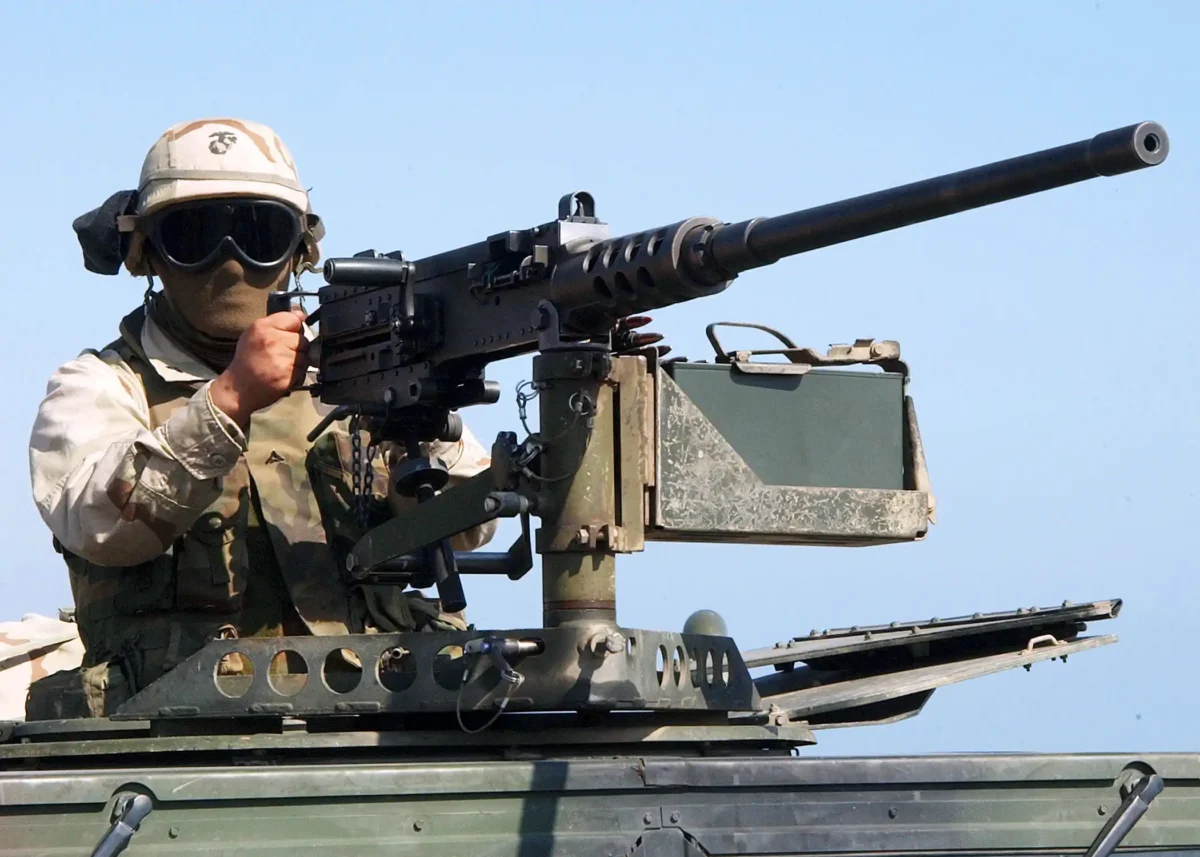
Often called “Ma Deuce,” the M2 is one of the most recognizable heavy machine guns ever produced. Its roots go back to John Browning’s work after World War I, and the weapon was officially adopted in the early 1930s. More than nine decades later, the basic M2 concept remains in military service. The U.S. Army describes it as a versatile automatic weapon used in both ground and vehicle-mounted roles.
Its ammunition is the 12.7×99mm NATO (.50 BMG) cartridge. The standard M2 weighs about 38 kg and has a cyclic rate of approximately 450–600 rounds per minute. The U.S. Army lists an effective range of about 1,830 meters, while other specifications put the maximum range considerably farther.
| M2 characteristic | Approximate figure |
| Caliber | 12.7×99mm |
| Gun weight | ~38 kg |
| Barrel length | ~1.14 m |
| Cyclic rate | 450–600 rounds/min |
| Effective range | ~1,830 m |
| Maximum range | ~6,800 m |
| Operation | Short recoil |
But raw numbers only tell half the story. The M2’s real advantage is versatility. It can be mounted on vehicles, tripods, boats, helicopters, and other platforms, and is intended for targets ranging from personnel to lightly armored vehicles and low-flying aircraft.
That flexibility is why the M2 ranks #2 among the most powerful machine guns here. It doesn’t fire the largest cartridge on this list, that distinction belongs to the KPV, but it combines substantial projectile power with an unusually broad range of applications.
In other words, the M2 isn’t merely powerful. It’s usefully powerful, which may be the more important distinction.
3. DShK — 12.7×108mm Heavy Machine Gun
Long before the modern Kord and NSV appeared, the DShK had already established the basic formula for a Soviet heavy machine gun: a large cartridge, a rugged operating system, and enough range to make it useful against more than just exposed personnel.

The DShK was developed in the Soviet Union in the late 1930s by Vasily Degtyaryov and Georgi Shpagin. Its name is essentially a shortened reference to the two designers and its large-caliber role. The weapon entered service before World War II and later evolved into the DShKM, an improved version that became the more common form.
Its defining feature is the 12.7×108mm cartridge. With a muzzle velocity around 850 m/s and a cyclic rate of approximately 600 rounds per minute, the DShK combines a substantial projectile with sustained automatic fire. Its commonly cited effective range is around 2,000 meters, although practical performance depends heavily on ammunition, mounting, target type, and conditions.
| DShK characteristic | Approximate figure |
| Caliber | 12.7×108mm |
| Gun weight | ~34 kg |
| Overall length | ~1.625 m |
| Muzzle velocity | ~850 m/s |
| Cyclic rate | ~600 rounds/min |
| Effective range | ~2,000 m |
| Feed | 50-round belt |
What makes the DShK especially interesting is its longevity. It has been used in ground, vehicle-mounted, and anti-aircraft roles, and variants have appeared across numerous countries.
It became a familiar feature on armored vehicles and defensive positions, where its combination of reach and heavy ammunition gave operators considerably more capability than ordinary rifle-caliber machine guns.
The DShK therefore lands at #3 among the most powerful machine guns in this ranking. It isn’t the largest-caliber weapon here, nor is it the newest. Its strength is something less glamorous but arguably more important: a proven design that has remained relevant for generations.
4. Kord — 12.7×108mm Heavy Machine Gun
If the NSV represents the end of one design era, the Kord is what came next. Developed in Russia during the 1990s, the Kord was introduced in 1998 as a successor to the NSV after the breakup of the Soviet Union disrupted production arrangements for its predecessor.

At first glance, the two weapons can look remarkably similar. Underneath, however, the Kord incorporates substantial mechanical changes. It fires the same 12.7×108mm cartridge, but its redesigned operating system and muzzle brake were intended to improve controllability and accuracy. That matters with a cartridge producing substantial recoil.
The numbers put the Kord firmly in heavy-machine-gun territory.
| Kord characteristic | Approximate figure |
| Caliber | 12.7×108mm |
| Gun weight | 25–25.5 kg |
| Rate of fire | 600–750 rounds/min |
| Muzzle velocity | 820–860 m/s |
| Effective range | Up to 2,000 m |
| Belt capacity | 50 rounds |
Official Russian specifications list a 2,000-meter sighting range, a 600–750-round-per-minute rate of fire, and a muzzle velocity of 820–860 m/s.
But here’s where the Kord gets particularly interesting: its designers weren’t simply chasing more firepower. They were trying to make existing firepower easier to control and use effectively. The weapon can be configured for infantry support or vehicle mounting, giving it flexibility that extends beyond a single battlefield role.
That balance earns the Kord fourth place among the most powerful machine guns in the world. It doesn’t have the larger 14.5mm cartridge of the KPV, but within the 12.7mm class, it offers a compelling combination of range, firepower, mobility, and controllability. In a ranking like this, that balance counts for quite a lot.
5. NSV — 12.7×108mm Heavy Machine Gun
The NSV may not have the household-name status of the M2 Browning, but it earns a place among the most powerful machine guns because it combines heavy-caliber firepower with a comparatively manageable weapon weight.

Developed in the Soviet Union, the NSV fires the 12.7×108mm cartridge, placing it in the same broad heavy-machine-gun class as the DShK and Kord. A U.S. Army reference lists the NSV at about 25 kg for the gun itself, with a length of roughly 1.58 meters.
That weight is significant. A heavy machine gun has to deal with substantial recoil and heat, so reducing the gun’s mass without turning it into an unwieldy system is a meaningful engineering challenge. The NSV was designed with that problem in mind.
Its 12.7mm ammunition gives the NSV the ability to engage targets well beyond the practical envelope of ordinary rifle-caliber machine guns. Its role has included ground fire, vehicle mounting, and anti-aircraft applications.
In other words, this isn’t simply a bigger infantry weapon; it belongs to a category designed to project heavy fire over considerable distances.
| NSV characteristic | Approximate figure |
| Caliber | 12.7×108mm |
| Gun weight | ~25 kg |
| Overall length | ~1.58 m |
| Type | Heavy machine gun |
| Feed | Belt-fed |
| Operating era | Soviet and post-Soviet service |
The NSV’s real strength is the balance. It delivers the punch expected from a 12.7mm weapon without carrying quite the same physical burden as some older designs. That makes it an interesting midpoint between raw firepower and practical handling.
It may not win this ranking on sheer cartridge size. But among the world’s most powerful heavy machine guns, the NSV shows that smart engineering can be nearly as important as brute force.
Which Is the Most Powerful Machine Gun in the World?
So, after putting the five contenders through the same measuring stick, which one actually deserves the title of the most powerful machine gun?
For raw ballistic power, the answer is the KPV.

Its 14.5×114mm cartridge puts it in a different class from the 12.7mm weapons that make up the rest of this ranking. The KPV is listed with a muzzle velocity of about 1,005 m/s, a cyclic rate around 600 rounds per minute, and an effective range reaching approximately 3,000 meters, depending on the target and ammunition.
That doesn’t mean the KPV wins every possible comparison.
In fact, this is where the ranking gets more interesting. The KPV’s enormous cartridge and roughly 49 kg gun weight come with a substantial portability penalty.
Its original infantry configuration was eventually dropped because the weapon was considered too large and heavy for that role. Later versions found a more natural home on vehicles and anti-aircraft mounts.
The M2 Browning, meanwhile, makes a compelling argument for being the most versatile. Its .50 BMG cartridge, approximately 1,830-meter maximum effective range, and enormous variety of mounting options have kept the design relevant for generations.
| Category | Standout weapon |
| Raw cartridge power | KPV |
| Effective range | KPV |
| Versatility | M2 Browning |
| Lighter 12.7mm design | Kord / NSV |
| Long service history | M2 / DShK |
So the fairest answer is this: the KPV is the most powerful in this ranking when “power” primarily means cartridge and projectile performance. The M2 is arguably the better all-rounder.
And that distinction matters. A bigger hammer isn’t automatically the better tool, it depends on what you’re trying to accomplish.
