

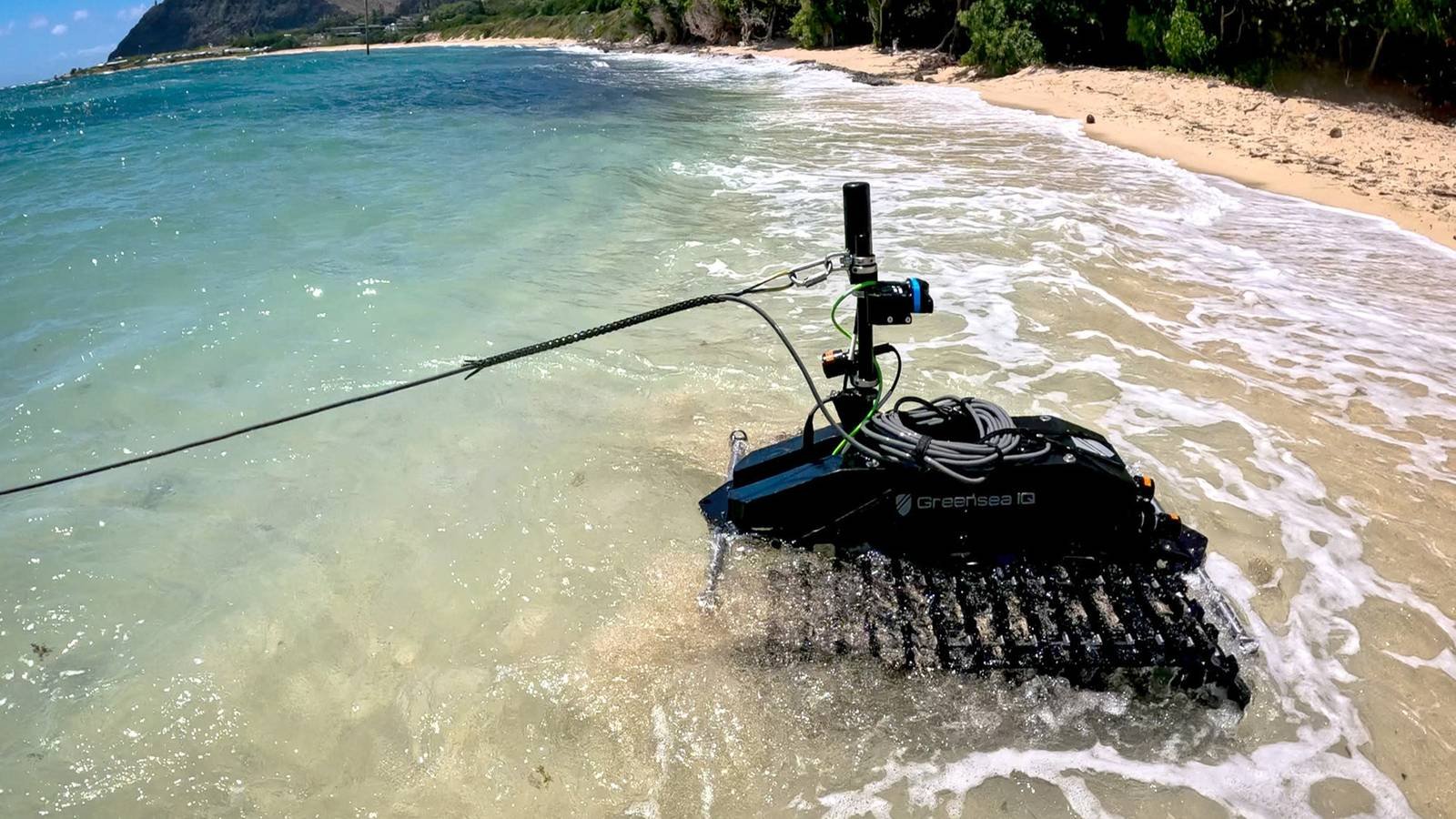
The Marine Corps is fielding tracked robots that crawl the seabed, transit the surf zone, and hunt mines and unexploded ordnance on the beach itself. The Bayonet Autonomous Underwater Ground Vehicles give explosive ordnance disposal teams a way to survey and clear the most dangerous stretch of the approach without first putting Marines in the water.
Recent awards to Greensea IQ cover Bayonet 250 systems under the Littoral Explosive Ordnance Neutralization, or LEON, family of systems. The contract forms part of the service’s effort to place unmanned platforms into high-risk roles that once required divers or dismounted teams.
What the Bayonet Vehicles Do
Bayonet vehicles are tracked crawlers, not free-swimming drones. They operate on the seafloor to 100 meters, move through breaking waves, and climb onto the beach. That continuous bottom-to-shore path is the key difference. Most autonomous underwater vehicles and remotely operated vehicles lose effectiveness or cannot operate at all in the turbulent shallows where waves break.
The Bayonet comes in three sizes that share the same software and control system. The Bayonet 150 is the compact, two-person portable model for lighter weather, smaller payloads, and missions where the vehicle itself may be treated as attritable.
The Bayonet 250 is the workhorse now entering the Marine Corps’ inventory; it handles rougher conditions and larger sensor loads. The Bayonet 350 is the largest for heavier payloads and more stationary survey work.
An open modular deck takes forward-looking sonar, magnetometers, sub-bottom profilers, cameras, and towed sleds. Operators can reconfigure the vehicle for seabed survey, buried unexploded ordnance detection, mine countermeasures, or coastal infrastructure inspection. The vehicles support autonomous, tethered, or radio-linked control and can hold station for extended periods when required.
What the Marine Corps Is Buying
Public award records show the Marine Corps has acquired Bayonet 250 systems through successive task orders on a larger indefinite-delivery/indefinite-quantity contract. One recent firm-fixed-price order of roughly $9 million covered nine new vehicles, refurbishment of six earlier robots, and spares. Deliveries under the latest batch began in late 2025 and continue.
The purchases support the service’s push to expand robotic options for littoral and high-risk missions. Greensea IQ describes the 250 as the scaled-up platform that keeps the same operator interface used on the smaller 150, so units can increase capability without restarting training.

The LEON Program
Littoral Explosive Ordnance Neutralization extends explosive ordnance disposal capability from deeper water through the surf zone and onto the beach exit. It focuses on the shallow-water and beach environments Marines must cross in amphibious operations and complements Navy EOD work farther seaward.
LEON treats the surf zone as its own battlespace. Traditional free-swimming systems lose performance there, and human divers face the highest combination of environmental and explosive risk.
Bayonet vehicles were chosen because they stay on the bottom, remain stable in breaking waves, and deliver sensors or neutralization payloads directly into that zone. The program sits inside the Marine Corps’ effort to integrate unmanned systems into operations in contested littorals.

What This Means for Marines
For EOD technicians and reconnaissance elements, there could be a tangible and practical change. Teams can survey and classify hazards in the surf and on the beach without first committing divers or a small boat into the same water. That cuts exposure time in an environment of strong currents, limited visibility, and explosive threats.
The systems also support wet-gap crossing and lane clearance by providing bathymetric and obstacle data before personnel or vehicles move through. In the same spirit as other Marine robotics efforts that keep Marines out of the most dangerous portions of a fight, Bayonet platforms keep operators at standoff from the highest-risk stretch of the seaward approach.
Because the vehicles are modular and share a common control system, units can begin with the more portable Bayonet 150 for lighter missions and move to the 250 as payloads and conditions require. Training stays consistent across the family. The systems launch from small boats or the shore and do not need a fixed facility.
The first batches will not equip every EOD team at once. They will give selected units a working tool for the exact piece of terrain that has historically forced Marines into the water under the worst conditions. Additional orders remain possible as the LEON family of systems matures.
